
RTX’s Backlog, Program Momentum, and the Strategic Realities of Modern Aerospace & Defense
RTX enters late 2026 with a record backlog, robust defense and commercial positioning, and significant contract wins in missile defense and counter-drone systems.
The central question is whether RTX can sustain execution and margin gains while navigating tight liquidity and the unpredictable pace of global defense spending. [S1] [S2] [N3] [N5] [N6] [N8]
RTX Corporation stands at the intersection of surging geopolitical demand for advanced defense systems and the financial realities of a capital-intensive, government-dependent business. With a record $268 billion backlog and rising quarterly profits, RTX’s near-term revenue visibility and contract momentum are clear. The core strategic question is whether RTX can translate its program wins and technological investments into durable cash flow and margin expansion, or whether budgetary and execution headwinds will limit the upside.
Record Backlog and Defense Contract Wins Reshape Near-Term Outlook
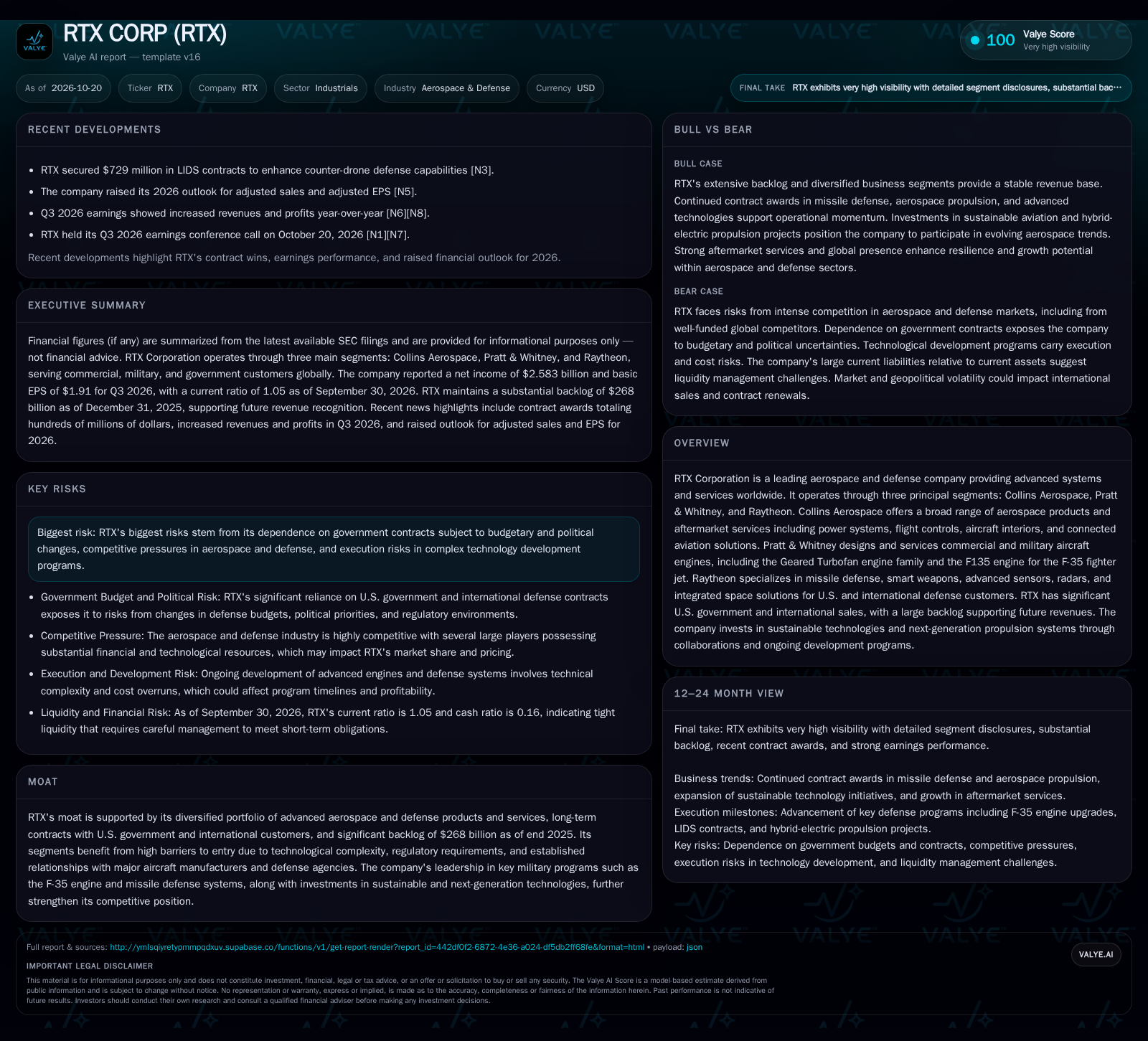
RTX entered Q4 2026 with a $268 billion backlog, of which about 25%, or $67 billion, is expected to be recognized as revenue within the next 12 months. This backlog, spanning major programs in missile defense, propulsion, and aerospace systems, provides unusually high revenue visibility compared to most industrial peers. [S1]
Financial results for Q3 2026 showed net income of $2.583 billion and basic EPS of $1.91, reflecting increased revenues and profitability year-over-year. In response, RTX raised its 2026 outlook for adjusted sales and EPS, signaling management’s confidence in continued operational momentum. [S2] [N5] [N6] [N8]
Recent contract wins include $729 million in LIDS (counter-drone) awards and ongoing advancements in flagship programs such as Patriot, LTAMDS, F135, and Tomahawk, further reinforcing RTX’s position as a critical supplier to U.S. and allied defense establishments. [N3] [S1]
This dynamic puts a premium on execution discipline, especially as the company juggles large program ramps and technology investments. [S2]
How RTX Converts Program Scale Into Profits—And Where Leverage or Strain May Emerge
RTX’s business model is anchored in long-cycle contracts for advanced aerospace and defense systems, often with multi-year or even multi-decade service and upgrade obligations. Revenue recognition is typically milestone- or delivery-based for hardware, with recurring aftermarket and service revenue streams in propulsion and aerospace systems. This structure supports a blend of high fixed costs (R&D, facilities, engineering talent) and operating leverage, especially when production ramps or aftermarket volumes rise.
The company’s economics hinge on a mix of initial system sales (often at lower margins or with upfront investment) and higher-margin aftermarket and sustainment services—particularly in Pratt & Whitney’s engine business and Collins Aerospace’s support contracts. As installed base grows, aftermarket revenue becomes increasingly predictable and lucrative, but is subject to the cyclicality of flight hours and defense operations.
Capital intensity remains high, given the need for continuous investment in new engine architectures, missile systems, and electronics. While large-scale programs provide scale advantages, they also expose RTX to execution risk—cost overruns or delays can quickly erode margins. Cash flows can be lumpy due to contract timing and milestone payments, and working capital requirements swell during production ramps or supply chain disruptions.
Barriers, Substitutes, and the Shifting Battlefield for Aerospace & Defense Suppliers
RTX’s competitive edge is built on a diversified portfolio across commercial and military aviation, missile defense, and advanced electronics, with deep entrenchment in U.S. and allied government procurement. High technical complexity, regulatory barriers, and multi-year qualification processes make market entry difficult for new competitors. Long-standing relationships with aircraft OEMs and defense agencies further insulate its core franchises.
However, RTX faces formidable competition from other global aerospace and defense conglomerates, many of which possess comparable scale, R&D budgets, and government access. In propulsion, engine choices for new aircraft programs are often winner-take-most, while missile defense and sensor markets are shaped by shifting geopolitical threats and procurement priorities.
Substitution risk is generally low in the short run due to platform integration, certification requirements, and the mission-critical nature of RTX’s products. Over the long term, technological advances—such as hypersonics, directed energy, or autonomous defense systems—could shift the competitive landscape. RTX’s ongoing investments in sustainable aviation and hybrid-electric propulsion are intended to anticipate and shape these transitions, but success is not guaranteed.
Sustained Contract Momentum and Aftermarket Expansion Drive Durable Cash Flow Upside
If RTX continues to win major contracts in missile defense, propulsion, and counter-drone systems—and executes cleanly on both development and production—the company could unlock operating leverage and margin expansion. The key drivers would be: (1) accelerated backlog conversion, (2) rapid ramp-up of higher-margin aftermarket services, and (3) successful commercialization of next-generation propulsion and defense technologies.
Confirmation of this scenario would require evidence of rising backlog conversion rates, expanding aftermarket revenue share, and further upward revisions to sales and earnings guidance. Announcements of new wins in hypersonics, hybrid-electric propulsion, or expanded F-35/F135 engine upgrades would further bolster this case.
Falsification would come from contract delays, cost overruns, or evidence that service revenue is not scaling as expected. If aftermarket growth underwhelms or major programs slip, the operating leverage thesis would weaken.
Revenue Visibility Anchors Performance, But Execution and Budget Cycles Set the Pace
The most plausible scenario is that RTX’s large backlog and ongoing contract flow provide a stable baseline for revenue and moderate earnings growth through 2027. Defense program ramps and aftermarket expansion offset commercial aerospace cyclicality, while program execution remains generally on track—though not without periodic schedule or cost pressure.
This outcome assumes that government budget allocations for core U.S. and allied programs remain largely intact, and that RTX manages its working capital and liquidity tightly. The company may see occasional upward or downward guidance revisions tied to macro defense budgets, supply chain events, or regulatory developments.
Evidence supporting this scenario would include steady or slightly rising revenue and margin trends, continued contract awards, and stable cash flow generation. Signs of base scenario breakdown would be significant budget cuts, persistent liquidity stress, or systemic program execution failures.
Budget Cuts, Execution Slips, or Liquidity Strain Derail Backlog Conversion
A more adverse scenario could unfold if U.S. or allied defense budgets contract, major program awards are delayed or canceled, or RTX encounters significant cost overruns or technical setbacks in its largest development programs. In this case, backlog conversion could slow, revenue growth would stall, and margins could compress as fixed costs are spread over a smaller base.
Liquidity could become more pressing if working capital needs spike or milestone payments are delayed, forcing RTX to seek additional external financing or curtail investment. This scenario becomes more likely if geopolitical priorities shift away from RTX’s core franchises or if new entrants disrupt legacy programs with superior technology.
Confirmation of this downside would come from negative budget headlines, missed program milestones, downward guidance revisions, or persistent deterioration in liquidity and cash flow metrics. Falsification would require evidence of stable budgets, on-time program delivery, and successful liquidity management.
What Will Determine If RTX Converts Its Backlog and Program Wins Into Sustainable Value?
Backlog conversion pace and the proportion of total backlog recognized as revenue over the next 12–24 months—a key indicator of execution and demand realization.
Aftermarket revenue growth, especially in Pratt & Whitney and Collins Aerospace, if disclosed, to test the thesis of rising margin contribution from installed base expansion.
Contract award cadence and the size/mix of new wins, particularly in missile defense, propulsion, and next-generation technology programs.
Working capital trends, including receivables, inventory, and payables management, as indicators of liquidity discipline and operational execution.
Government budget allocations and political signals for U.S. and major allied defense programs relevant to RTX’s core franchises.
Execution milestones and cost trends for flagship development programs (e.g., F135 upgrades, hybrid-electric initiatives, LIDS/counter-drone systems).
Liquidity and cash flow generation, especially the ratio of operating cash flow to short-term obligations and any reliance on new external financing.
Any adverse headlines regarding program delays, cost overruns, or regulatory challenges that could affect backlog conversion or profitability.
Disclaimer: This is research-only, informational analysis and not investment advice. It may include AI-generated interpretation and general industry context. Always verify important details using primary sources.

Comments