
GM’s Strategic Recalibration: Navigating EV Uncertainty, Regulatory Demands, and Financial Services Complexity
General Motors’ latest financials and product strategy shift underscore its balancing act between near-term profitability, regulatory headwinds, and the long-term transition to electric vehicles. The interplay between GM’s manufacturing scale, captive finance arm, and evolving technology bets will define its resilience and upside potential.
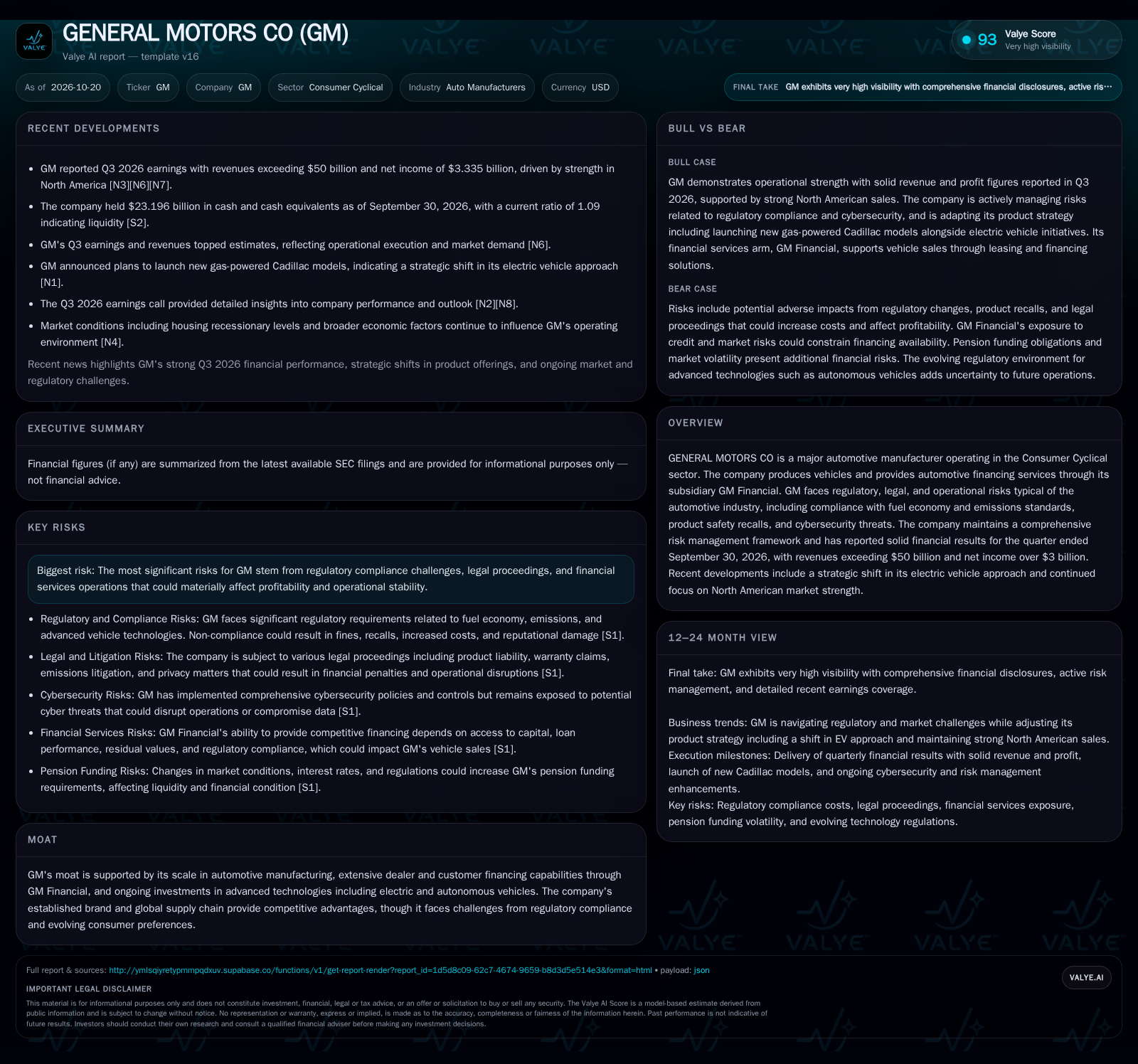
GM reported $23.2B in cash as of September 2026 and beat Q3 earnings estimates amid North American market strength. The company is recalibrating its EV approach, launching new gas-powered Cadillacs, and actively managing regulatory, legal, and cybersecurity risks. Its financial services arm remains a key lever but faces exposure to credit and capital market risks. The path forward hinges on regulatory adaptation, effective risk management, and execution on both legacy and emerging vehicle platforms. [S2] [N6]
General Motors is at a strategic crossroads as it seeks to sustain core profitability while navigating the complexities of the automotive industry’s regulatory, technological, and capital-intensive landscape. The company’s renewed emphasis on gas-powered models, coupled with the pivotal role of GM Financial, highlights a pragmatic, risk-managed approach—but also underscores the uncertainties that will shape its competitive position over the next several years. [S2] [N6]
Recent Financial Strength and Strategic Product Pivot
As of September 30, 2026, General Motors reported $23.196 billion in cash and cash equivalents and reported liquidity-ratio trends of 1.09, reflecting a neutral liquidity position relative to its operational scale. Q3 2026 earnings and revenues exceeded analyst expectations, fueled by robust North American market performance. Notably, GM announced a significant recalibration of its electric vehicle (EV) strategy, introducing new gas-powered Cadillac models while continuing with select EV initiatives. This dual-track approach signals a pragmatic recognition of current market realities and regulatory complexities. [S2] [N6]
How GM Makes Money: Manufacturing Scale, Financing Leverage, and Regulatory Cost Headwinds
GM’s core revenue streams originate from automotive manufacturing—sales of new vehicles, parts, and aftersales services—supplemented by its captive finance arm, GM Financial, which provides leasing, retail, and dealer financing. The company’s scale enables some degree of fixed-cost absorption, but the capital intensity of automotive manufacturing, persistent R&D spend, and supply chain complexity create high operating leverage and substantial ongoing capital needs.
Pricing is shaped by a competitive landscape and regulatory requirements, with profit mix heavily influenced by geographic and segment allocation (e.g., North American trucks/SUVs vs. global small cars). GM Financial augments sales by lowering customer acquisition friction but also exposes GM to credit, residual value, and funding market risks. Regulatory compliance—emissions, safety, and evolving fuel economy standards—imposes material costs and operational constraints, potentially eroding margins if not offset by pricing power or cost control.
The capital intensity inherent in automotive manufacturing necessitates continuous investment in tooling, plant upgrades, and technology integration, which can constrain free cash flow especially during periods of product transition. Moreover, the interplay between fixed and variable costs means that volume fluctuations have amplified effects on profitability. For GM, maintaining high utilization rates across its manufacturing footprint is critical to diluting fixed costs and preserving margins. However, the shift toward electrification introduces new cost structures, including expensive battery components and software development, which may not yet benefit from the same economies of scale as traditional internal combustion engine vehicles. This dynamic complicates short- to medium-term margin management and requires careful balancing of investment priorities.
GM Financial’s role as a captive finance provider extends beyond simple credit facilitation; it also influences vehicle residual values and customer retention through lease structures and buyback guarantees. As residual values are subject to market perceptions of vehicle desirability and technological obsolescence, the transition to EVs introduces uncertainty that could increase credit losses if demand or secondary market values decline unexpectedly. Funding costs for GM Financial are likewise sensitive to capital market conditions, which can tighten during economic stress periods, potentially limiting the availability or increasing the cost of financing. Therefore, GM’s overall profitability is partially contingent on GM Financial’s ability to manage credit risk proactively and maintain access to cost-effective capital.
Competitive Advantages and Structural Challenges in a Shifting Auto Landscape
GM’s competitive edge rests on manufacturing scale, an extensive dealer and service network, brand equity in key markets, and the strategic integration of GM Financial. These elements provide cost advantages, customer stickiness, and sales enablement. However, industry rivalry remains intense, with global peers (legacy automakers and EV specialists alike) investing aggressively in electrification, connected vehicles, and autonomy.
The rapid evolution of consumer preferences, potential technology substitution (especially in propulsion), and regulatory divergence across regions threaten to erode historical advantages. GM’s ability to flex product mix, leverage captive financing, and orchestrate supply chain resilience will determine its ability to defend market share and margins in the face of both traditional and disruptive competitors.
Pathway to Outperformance: Regulatory Adaptation and Profitable Product Diversification
If GM can successfully harmonize its product portfolio with evolving regulatory mandates—delivering compelling gas-powered and electric vehicles that resonate with both consumers and policymakers—it could sustain or even expand market share during the industry transition. Effective risk management, particularly around litigation, cybersecurity, and pension obligations, would limit downside shocks.
Upside would be evidenced by continued earnings outperformance, margin stability despite regulatory cost pressures, and growing penetration of GM Financial without a material increase in credit losses or funding constraints. Confirmation would come from consistent delivery of new product launches on time and on budget, steady or improving North American market share, and regulatory compliance without major fines or recalls.
Realistic Trajectory: Incremental Gains Amid Persistent Headwinds
The most plausible outlook is that GM maintains modest revenue and profit growth, driven by a balanced mix of legacy and electrified vehicles and continued strength in North America. Regulatory and compliance costs are likely to remain a drag on margins, but not catastrophic, provided GM continues to adapt its portfolio and supply chain.
GM Financial will likely remain a key sales enabler but could experience periodic pressure from credit cycles or funding cost volatility. The company’s risk management frameworks may limit the impact of legal, cybersecurity, and pension shocks, but not eliminate them. Evidence supporting this scenario would include stable or slightly improving earnings, manageable litigation and compliance outflows, and the absence of major operational disruptions.
What Could Go Wrong: Regulatory, Legal, or Credit Shocks Derail Momentum
A more adverse chain of events could see GM hit by a confluence of regulatory tightening (e.g., stricter emissions or EV mandates), major product recalls, or unfavorable legal settlements, driving up costs and eroding margins. If GM Financial suffers from rising credit losses, impaired residual values, or restricted access to funding, vehicle sales and cash flows could be sharply impacted.
Such a scenario would be confirmed by negative earnings surprises, significant reserve builds or write-downs at GM Financial, material fines or recall costs, and/or a sharp deterioration in liquidity ratios. Market share losses to more agile competitors—especially in EVs or global growth markets—would further compound the downside.
Milestones and Metrics to Clarify GM’s Strategic Resilience
Progress on new vehicle launches—especially the commercial performance of new gas-powered Cadillac models and the cadence of EV rollouts—will clarify GM’s ability to balance regulatory and market demands.
North American market share trends, if disclosed, would provide a direct signal of competitive positioning and consumer demand resilience.
GM Financial’s credit loss rates, funding costs, and penetration rates are critical for assessing both sales enablement and risk exposure.
Material legal and regulatory outflows—such as product liability settlements, emissions penalties, or large-scale recalls—would test the robustness of GM’s risk management frameworks.
Pension funding status and required contributions, if disclosed, would indicate potential future cash flow constraints.
Cybersecurity incident disclosures, if any, would reveal the adequacy of GM’s cyber risk controls in an increasingly connected vehicle environment.
Segmental profit margins (e.g., by vehicle type and geographic region), if available, would help assess whether product mix shifts are offsetting regulatory and cost headwinds.
Execution against announced cost reduction or efficiency initiatives would help validate management’s ability to sustain or improve margins in a volatile regulatory landscape.
Disclaimer: This is research-only, informational analysis and not investment advice. It may include AI-generated interpretation and general industry context. Always verify important details using primary sources.

Comments