
Pegasystems: Cloud Platform Expansion, Litigation Overhang, and the Economics of Partner-Led Growth
Pegasystems aims to scale its cloud and software services through a hybrid model of internal consulting and partner-led implementations, but faces a complex legal battle and operational risks that shape its near-term financial posture and long-term strategic options.
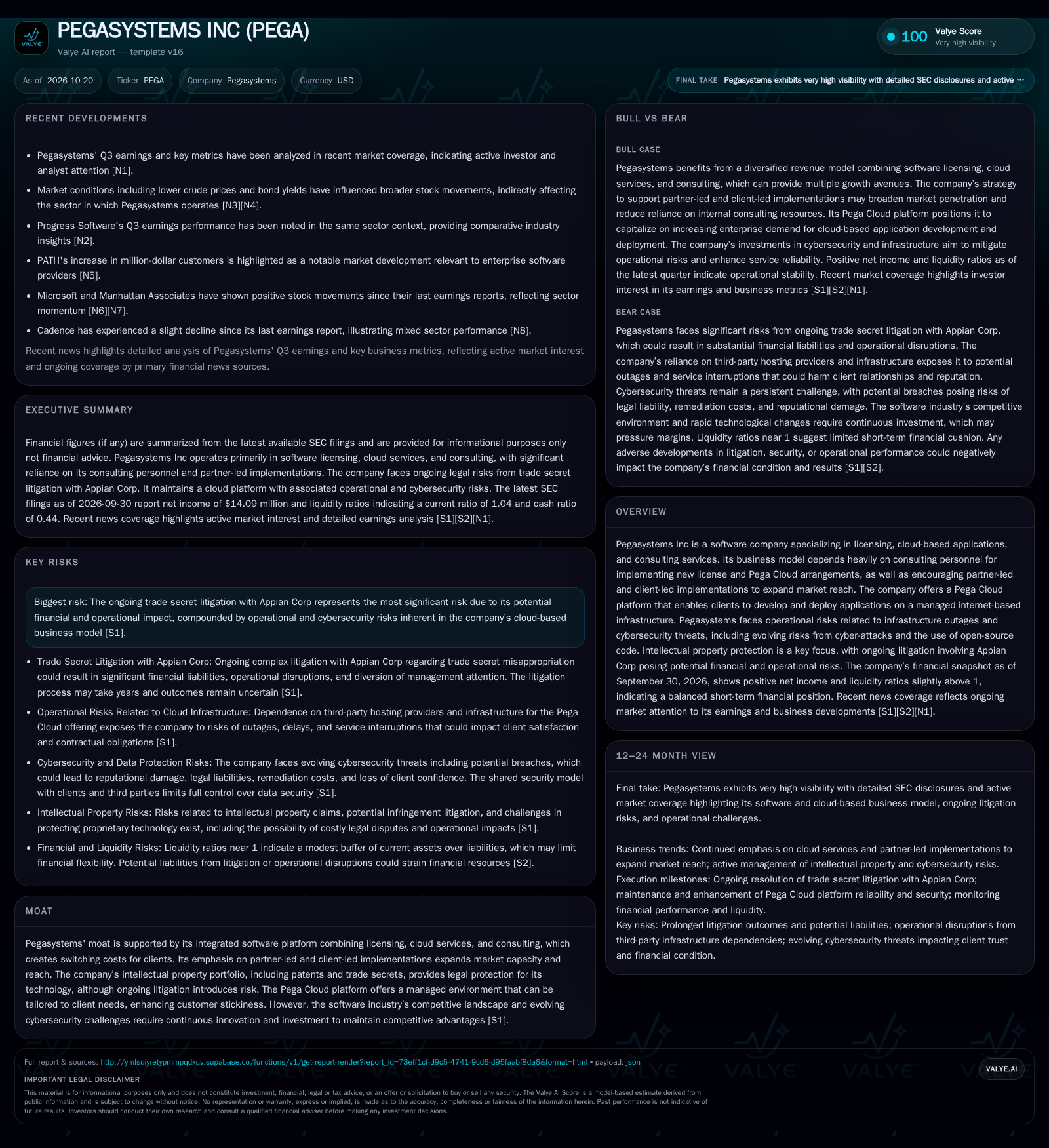
Pegasystems is pursuing growth in cloud and software licensing by supporting both in-house and partner-led implementations, expanding its serviceable market. While its Pega Cloud platform and service diversification offer growth levers, the company’s litigation with Appian Corp presents a material risk to both financial condition and operating flexibility. reported liquidity position and ongoing cybersecurity threats further temper the outlook, requiring close attention to execution, partner ecosystem traction, and legal outcomes [S1] [S2].
Pegasystems stands at a strategic inflection point as it seeks to scale its cloud-based application platform and consulting model beyond the limits of its internal resources. The company’s dual emphasis on partner-led and client-led implementations is designed to accelerate adoption and reduce delivery bottlenecks, but also introduces new dependencies and quality control challenges. Simultaneously, a protracted legal dispute with Appian Corp casts a shadow over its potential financial flexibility and strategic focus, while operational and cybersecurity risks remain ever-present in its cloud-centric business. The next phase for Pegasystems will likely be defined by its ability to balance these growth ambitions against persistent legal and operational headwinds [S1] [S2].
Recent Financials and Legal Challenges Frame the Strategic Landscape
The company reported cash and liquidity metrics for the period; these figures do not by themselves establish operating runway, investment capacity, financial flexibility, or financing capacity. Net income for the period was $14.09 million, signaling operational profitability but not a large financial cushion [S2]. The company remains embroiled in a high-stakes trade secret litigation with Appian Corp, a process that may take years and could materially affect its financial condition and operating results [S1]. Meanwhile, Pegasystems continues to derive a substantial portion of consulting revenue from both internal and partner-led implementations of new licenses and Pega Cloud arrangements [S1]. These facts underpin a business model exposed to both expansion opportunities and significant legal and operational risks.
How the Partner-Led Model Could Reshape Revenue and Margin Dynamics
Pegasystems’ revenue model is built on a mix of software licensing, cloud platform subscriptions, and consulting services. Traditionally, consulting-heavy software businesses face growth bottlenecks as each new customer requires significant internal resources for implementation. By actively supporting and encouraging partner-led and client-led implementations, Pegasystems seeks to decouple revenue growth from direct headcount expansion—a lever that can drive operating leverage if partners can maintain delivery quality [S1].
The economics of this approach depend on the mix of high-margin software and cloud subscription revenues versus the lower-margin, labor-intensive consulting. If partner-led implementations increase as a share of total projects, Pegasystems could see improved gross margins and faster revenue scaling, as partners absorb the costs of delivery. However, this also introduces risks: lower consulting revenues per project, potential variability in customer experience, and the need for robust partner enablement and governance.
Capital needs in this model are moderate: Pegasystems must invest in cloud infrastructure (often via third-party providers), security, and partner ecosystem development. [S2]
Defending Differentiation in a Crowded Cloud and Workflow Automation Market
Pegasystems competes in the enterprise software sector against a wide range of cloud-native workflow automation vendors, traditional business process management (BPM) players, and large-scale enterprise software incumbents. Its platform-centric approach—offering both cloud and on-premise deployment, and extensibility through consulting and partner-led projects—can increase switching costs for customers who invest in bespoke workflows and integrations [S1].
However, the market is highly competitive, with persistent threats from both emerging SaaS workflow platforms and established giants who can bundle similar capabilities into broader enterprise suites. Open-source alternatives and low-code/no-code platforms further compress the differentiation window, requiring Pegasystems to invest continually in product innovation and ecosystem breadth.
The company’s intellectual property portfolio, including patents and trade secrets, provides some legal moat, but ongoing litigation with Appian Corp introduces uncertainty and potential vulnerability [S1]. The success of the partner-led strategy will hinge on Pegasystems’ ability to build a robust, motivated partner ecosystem—without ceding too much control over delivery quality or customer relationships.
If Partner Ecosystem Scaling Drives Subscription Growth and Margin Expansion
The most favorable outcome for Pegasystems would be a scenario where its investment in partner and client-led implementations translates into accelerated adoption of its Pega Cloud platform, higher software and subscription revenue mix, and improved operating leverage. In this case, partners would drive a growing share of new projects, enabling Pegasystems to reach customers more efficiently and with less incremental internal cost.
Evidence that would confirm this scenario includes a rising proportion of revenue from software and cloud subscriptions relative to consulting, improving gross and operating margins, and disclosures of expanded or deepened partner relationships (if provided). Steady or improving customer satisfaction and retention metrics, despite increased partner involvement, would further validate the strategy. A positive resolution or manageable settlement in the Appian litigation would remove a major financial overhang and could unlock additional investment capacity [S1] [S2].
What a Balanced Growth and Risk Management Approach Could Deliver
The most plausible trajectory is one where Pegasystems continues to grow its cloud and software revenue at a moderate pace, with partner-led implementations gradually increasing but not fully replacing internal consulting. Margins could improve incrementally as the revenue mix shifts, but operational risks—such as service outages, cybersecurity incidents, and partner delivery variability—would remain ever-present and require ongoing management [S1].
The litigation with Appian is likely to persist, absorbing management attention and potentially constraining potential financial flexibility, but not resulting in an existential threat in the near term. [S2] Confirmation of this scenario would come from steady financial performance, absence of major litigation shocks, and evidence of measured progress in partner ecosystem development.
Legal Setbacks and Operational Disruptions Could Derail Strategic Momentum
A negative scenario would unfold if Pegasystems suffers an adverse outcome in the Appian litigation, resulting in significant financial liabilities or operational constraints (such as injunctions or forced product modifications).
Simultaneously, a major outage, security breach, or high-profile partner failure could damage client trust and result in lost business or costly remediation. If the company is unable to maintain delivery quality as it scales partner-led implementations, customer churn could rise, further pressuring financials. Evidence of rising legal reserves, insurance payouts, or customer loss would confirm this downside scenario.
Benchmarks That Will Define Pegasystems’ Next Chapter
The proportion of revenue derived from software/cloud subscriptions versus consulting services—if disclosed—will indicate progress toward higher-margin, scalable growth.
Updates or disclosures on the scale and quality of the partner ecosystem (number of certified partners, deal volume through partners, partner-led project success rates) would help test the scalability of the model.
Gross and operating margin trends, especially if partner-led implementations rise as a share of total projects, will be critical for confirming operating leverage.
Developments in the Appian litigation—court rulings, settlements, or changes in disclosed legal contingencies—could materially alter the risk profile.
Incidents of service outages, security breaches, or notable client disruptions will test the resilience of the Pega Cloud platform and operational controls.
Customer retention and satisfaction metrics, particularly as the partner model scales, would provide evidence of delivery quality and customer stickiness.
Disclosure of new or expanded strategic alliances, especially with major system integrators or technology partners, would indicate traction in the partner-led model.
Disclaimer: This is research-only, informational analysis and not investment advice. It may include AI-generated interpretation and general industry context. Always verify important details using primary sources.

Comments