
Equifax: Margin Expansion, Regulatory Exposure, and the Economics of Data-Centric Growth
Equifax’s double-digit revenue and profit growth in 2026 reflect the power of its diversified data platforms and recent international expansion. Yet, as regulatory scrutiny and compliance costs mount, the company’s ability to sustain margin gains and innovate in analytics will shape its next phase of value creation.
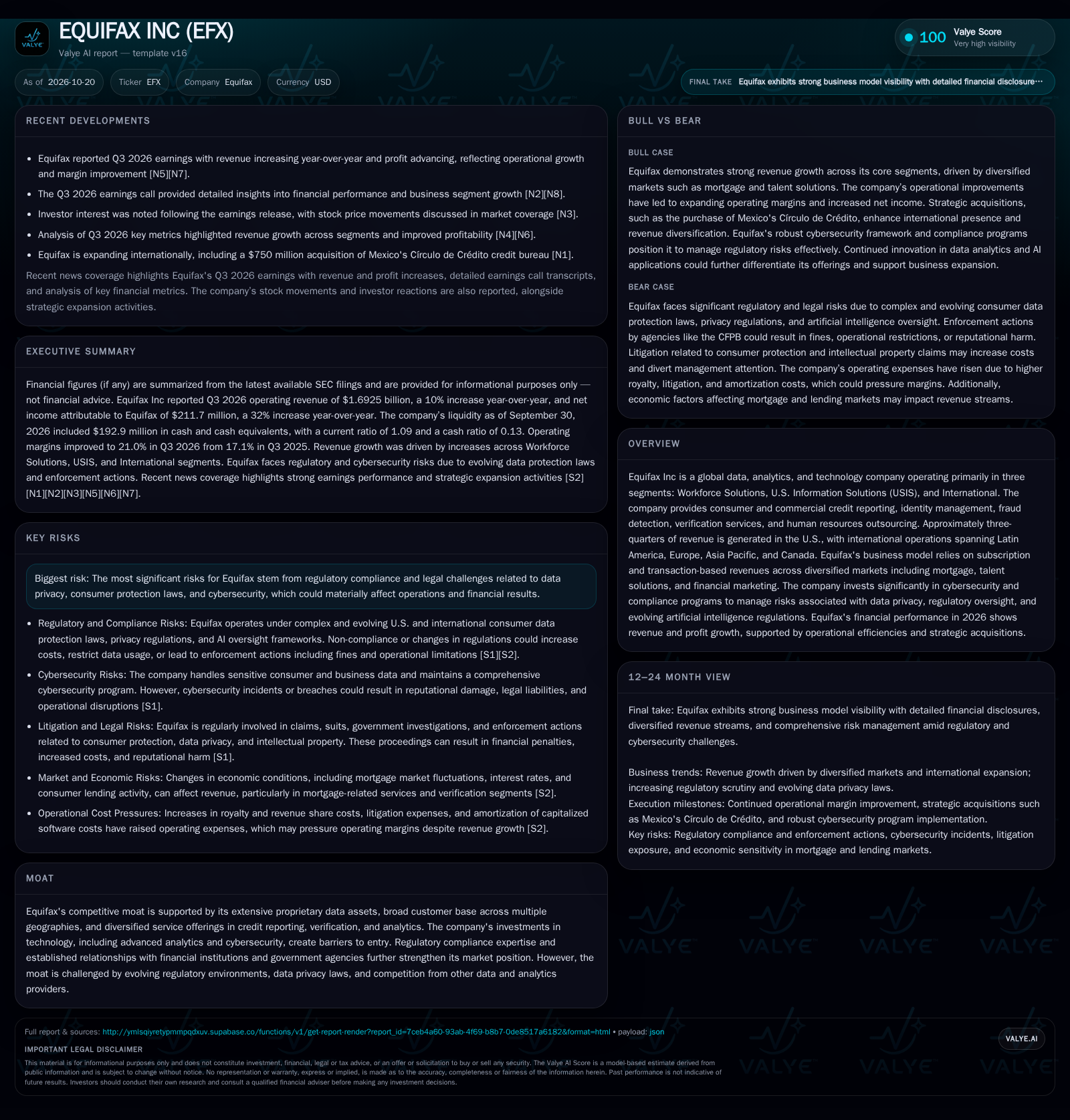
Equifax posted 10% revenue and 32% net income growth in Q3 2026, with operating margins rising to 21% as expansion in U.S. and international segments outpaced growing compliance and technology costs. The $750M acquisition of Mexico’s Círculo de Crédito signals a push for geographic diversification, but regulatory, cybersecurity, and litigation risks remain material. The core question: Can Equifax leverage its data assets and analytics advantage while absorbing rising cost and compliance burdens? [S2] [N5] [N7]
Equifax’s 2026 performance underscores the leverage in its data-driven business model: double-digit revenue and profit growth, expanding margins, and a major move into the Mexican credit market. But the company’s ability to scale these strengths faces mounting headwinds from regulatory complexity, litigation, and technology cost inflation. The durability of Equifax’s moat—rooted in proprietary data, analytics, and compliance infrastructure—will be tested as it seeks to balance aggressive international expansion with rising scrutiny and cost pressures.
Financial Outperformance, Margin Gains, and International Push Define 2026
Equifax reported Q3 2026 revenue of $1.6925 billion, up 10% year-over-year, and net income of $211.7 million, a 32% increase, with operating margins expanding to 21.0% from 17.1% in the prior year period [S2] [N5] [N7]. Growth was broad-based: Workforce Solutions revenue rose 7% (driven by verification services and mortgage), while U.S. Information Solutions surged 13% on mortgage and credit marketing momentum [S2] [N6]. The $750 million acquisition of Mexico’s Círculo de Crédito marked a significant international expansion, signaling an intent to diversify revenue beyond the U.S. [S2]. On the cost side, operating expenses increased due to higher royalty, litigation, and capitalized software amortization, though these were more than offset by revenue gains and some people cost reductions [S2]. Liquidity remained stable, with $192.9 million in cash and a current ratio of 1.09 as of September 30, 2026 [S2].
How Equifax Monetizes Data: Scale, Recurring Revenue, and Cost Structure
Equifax’s economics revolve around monetizing proprietary data and analytics for financial institutions, employers, marketers, and governments. Revenue is generated through both subscription and transaction-based models, with recurring revenue underpinned by long-standing relationships and regulatory mandates in credit reporting, verification, and compliance use cases. The Workforce Solutions segment, in particular, benefits from high transaction volumes in verification services, which are critical for mortgage origination, employment screening, and government programs. USIS and International offer similar services, with cross-sell opportunities as regulatory adoption and digital lending expand globally.
Operating leverage is a key feature: incremental revenue from new data products or higher transaction volumes can drop through at attractive margins, provided fixed costs (data acquisition, platform maintenance, compliance, and cybersecurity) are well managed. However, the cost base is increasingly burdened by royalty payments (for third-party data), litigation, and amortization of capitalized software—suggesting that margin expansion relies as much on mix and automation as on pure volume growth. Capital needs are moderate for a data-centric business, but significant investment is required in cybersecurity, compliance, and international integration, especially following major acquisitions.
Data Assets, Compliance Infrastructure, and Industry Entrenchment: Durable, but Challenged
Equifax’s moat is built on three pillars: exclusive or hard-to-replicate data sets, sophisticated analytics and technology infrastructure, and deep regulatory/compliance expertise. These create switching frictions for large financial and employer customers, who depend on integration, data reliability, and compliance validation. However, the competitive landscape includes other major credit bureaus and specialized data/analytics providers, many of whom are investing in AI, alternative data, and digital onboarding.
The regulatory environment acts as both a moat and a vulnerability: while compliance expertise is a barrier to entry, any misstep can expose Equifax to severe penalties, customer churn, or reputational damage. The rise of privacy-centric regulation, consumer data portability, and competition law creates the possibility of new entrants or substitutes—such as fintechs leveraging open banking or public data sources. To maintain its edge, Equifax must continually invest in cybersecurity, AI-driven analytics, and global compliance operations.
If Data Analytics Innovation and International Expansion Outrun Compliance Drag
The bull case is that Equifax leverages its data and analytics platforms to drive sustained double-digit growth, both in core U.S. markets and in newly acquired international geographies. If the integration of Círculo de Crédito is smooth and cross-selling accelerates in Latin America, Equifax could meaningfully diversify its revenue base and reduce reliance on U.S. mortgage cycles. Continued innovation in AI-powered analytics and fraud prevention could open new verticals—such as small business lending, alternative credit scoring, or government verification—enabling higher pricing and improved customer retention.
Evidence that would support this scenario includes: ongoing margin expansion despite rising compliance costs, rapid revenue growth in international segments, successful launches of new analytics products, and limited regulatory or litigation setbacks. If Equifax can demonstrate that its investments in cybersecurity and compliance are translating into customer trust and regulatory goodwill, the company could solidify its premium pricing and long-term contracts.
Sustaining Growth Amid Cost Inflation and Regulatory Tightening
The most plausible case is that Equifax delivers mid- to high-single-digit revenue growth, with operating margins stabilizing around current levels as cost inflation (royalties, compliance, litigation) partly offsets scale benefits. U.S. mortgage and employment markets remain cyclical, but diversified product lines and international expansion provide some buffer. Regulatory and legal exposures are managed, but not eliminated, with periodic settlements or compliance investments required as the price of doing business.
Confirmation would come from steady, if unspectacular, growth in both core and international segments; modest margin improvement or maintenance; and no major regulatory or cybersecurity incidents. Falsification would look like persistent cost overruns, repeated regulatory fines, or evidence of customer attrition due to compliance or technology failures.
What Happens If Regulatory and Litigation Pressures Overwhelm Scale Advantages?
The bear case centers on regulatory, legal, or cybersecurity shocks eroding Equifax’s economics. A major enforcement action, data breach, or change in data privacy laws could result in substantial fines, remediation costs, and reputational harm—potentially triggering customer churn and compressing margins. If royalty and technology costs continue to escalate, margin gains from scale could be wiped out, especially if revenue growth slows in mature markets or integration of acquisitions proves more costly than anticipated.
Downside confirmation would include a marked increase in compliance or litigation expenses as a percentage of revenue, adverse regulatory headlines, meaningful loss of large customers, or operational disruptions from cybersecurity incidents. Watch for signs of regulatory tightening in key markets, especially the U.S. and Latin America, and for early warning signals in quarterly expense line items.
Milestones That Will Define Equifax’s Margin Durability and Regulatory Resilience
Sustained operating margin trends: Quarterly margin progression, especially relative to incremental revenue and expense growth, will clarify whether scale can outpace cost inflation.
International revenue mix and growth: If disclosed, the pace at which non-U.S. revenues (especially from Mexico post-acquisition) expand as a share of total sales will indicate diversification success.
Compliance and litigation expense ratios: Monitoring these as a percentage of revenue will show whether regulatory and legal risks are being managed or are escalating.
New product launches and adoption rates: Announcements or disclosures (if provided) on uptake of new analytics, AI, or verification offerings would help test innovation and pricing power.
Customer retention and contract renewal rates: If disclosed, these metrics would signal the strength of Equifax’s switching frictions and value proposition in the face of regulatory change.
Cybersecurity incident disclosures: Any material breach or system compromise would be a key test of risk management and could affect customer trust and regulatory standing.
Integration milestones for Círculo de Crédito: Updates on operational synergies, cross-sell wins, or cost savings from the Mexico acquisition would clarify the value creation thesis.
Changes in regulatory environment: Track major U.S. or international legislative developments on data privacy, AI, or consumer rights that could affect Equifax’s business model or cost structure.
Disclaimer: This is research-only, informational analysis and not investment advice. It may include AI-generated interpretation and general industry context. Always verify important details using primary sources.

Comments