
Karbon-X: Climate Tech Ambitions Meet Financial Strain and Commercial Execution Risk
Karbon-X’s international push into carbon credits, emissions tracking, and restoration projects highlights a differentiated product vision, but persistent operating losses, high customer concentration, and negative working capital create a precarious foundation. The company’s ability to diversify revenue, remediate operational weaknesses, and secure new capital will determine its viability in a competitive, rapidly evolving climate solutions market.
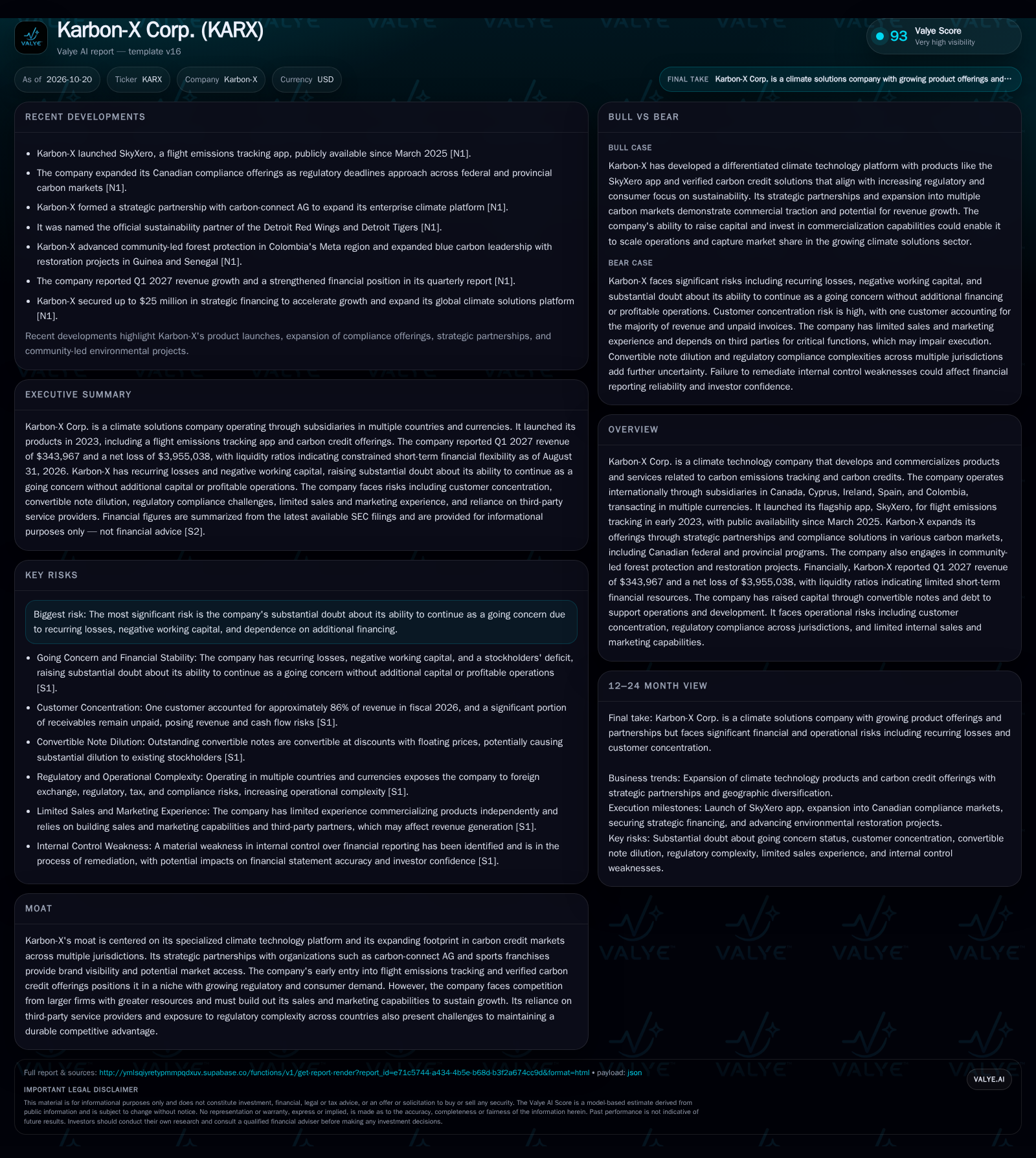
Karbon-X is expanding its climate technology platform across multiple jurisdictions, with products like SkyXero and carbon credits aimed at regulatory and consumer demand. Success will hinge on reducing customer concentration, scaling sales, and accessing further capital before dilution or insolvency risks materialize. [S1] [S2]
Karbon-X Corp. is pursuing a global vision for climate technology, combining digital emissions tracking, carbon credits, and restoration projects to address both compliance and voluntary carbon markets. Its international expansion and partnerships with recognized brands demonstrate strategic ambition, but the business faces a critical juncture. With recurring losses, negative working capital, and heavy reliance on a single customer, Karbon-X’s financial footing is fragile. The company’s future depends on its ability to diversify its revenue base, scale its commercialization efforts, and secure new capital before dilution or insolvency risks intensify.
Recent Financial and Strategic Milestones Define the Stakes
Karbon-X’s Q1 2027 financials show revenue of $343,967 and a net loss of $3,955,038, with cash and equivalents of $1.46 million and a current ratio of just 0.36 as of August 31, 2026. These figures spotlight serious liquidity stress and ongoing operational deficits. The launch of its SkyXero flight emissions tracking app to the public in March 2025, plus new compliance carbon credit offerings and partnerships with organizations like carbon-connect AG and major sports franchises, represent key commercial milestones. However, customer concentration remains acute—one customer represented 86% of revenue in fiscal 2026. The company is also contending with a material weakness in internal controls and negative working capital, raising substantial doubt about its ability to continue as a going concern without additional funding or a step-change in profitability. [S1] [S2]
Underlying Economics: Carbon Credits, Recurring Revenue, and Capital Demands
Karbon-X’s business model spans compliance and voluntary carbon credit sales, digital emissions tracking software, and environmental project development. The economics of carbon credits are sensitive to regulatory pricing, project verification costs, and buyer mix. While digital apps like SkyXero may offer software-like gross margins if scaled, the current limited user base and lack of disclosed recurring contract structure leave the revenue model unproven. Carbon credit sales can be volatile, dependent on spot market demand, regulatory cycles, and corporate ESG budgets, with margins pressured by verification, brokerage, and project origination costs.
Fixed costs are likely high at this stage, given international operations and platform development, while variable costs include carbon credit procurement and third-party service fees. The company’s reliance on convertible notes and debt—raising roughly $10 million over the past year—underscores the capital intensity and limited self-funding capacity. Operating leverage could theoretically emerge if Karbon-X scales its digital and credit offerings, but current losses and negative working capital suggest that fixed costs are outpacing revenue growth. If the sales mix shifts toward recurring app subscriptions or multi-year credit contracts, margin and cash flow visibility could improve; absent that, cash burn and dilution risks remain acute. [S1] [S2]
Competitive Pressures and the Challenge of Building Differentiation
Karbon-X operates in a crowded and rapidly evolving sector, with competitors ranging from specialist carbon credit brokers and emissions tracking startups to established environmental consultancies and global carbon registries. Its early entry into flight emissions tracking and partnerships with sports organizations may offer brand visibility, but larger players have deeper resources, existing client relationships, and more mature compliance offerings.
Barriers to entry in carbon markets are moderate—project origination and verification require expertise, but digital platforms are relatively easy to replicate without proprietary data or regulatory integration. Karbon-X’s ability to secure exclusive partnerships, embed in compliance regimes, or develop unique data assets could confer an edge, but these advantages are not yet proven. Reliance on third-party service providers for distribution and invoicing further weakens the company’s control over customer experience and operational resilience. The path to a durable moat likely depends on building network effects in its software, securing direct customer relationships, and demonstrating regulatory credibility across jurisdictions. [S1]
If Karbon-X Diversifies Revenue and Scales Digital Solutions
A favorable outcome would see Karbon-X leveraging its SkyXero app and compliance credit offerings to attract a broader customer base, reducing dependence on any single client and creating a more predictable, recurring revenue stream. Strategic partnerships—especially with high-profile brands or compliance market gatekeepers—could accelerate adoption and lend credibility. Successful remediation of internal controls would help restore investor confidence and support new capital raising on less punitive terms.
Upside evidence would include: a rising number of unique paying customers across multiple sectors; new, multi-year contracts or subscription arrangements; a declining share of revenue from the top customer; and gross margin expansion as digital solutions scale. Announcements of new compliance market integrations, major corporate client wins, or successful capital raises without excessive dilution would also confirm positive momentum.
Gradual Expansion Amid Persistent Funding and Execution Challenges
The most plausible trajectory is one where Karbon-X achieves incremental growth—expanding its product suite and customer list, but at a pace insufficient to rapidly mitigate current financial pressures. Revenue may diversify modestly, but continued reliance on a few large contracts and project-based carbon credit sales could keep cash flow volatile. The company will likely need to raise additional capital, potentially through further convertible debt or discounted equity, with ongoing dilution risk.
Confirmation would come from small but steady increases in customer count and geographic reach, modest improvement in gross margins, and evidence of cost control. However, persistent working capital deficits, slow progress on internal control remediation, or further customer concentration would suggest that the company remains vulnerable to external shocks or execution missteps.
Liquidity Crunch and Customer Loss Could Trigger a Crisis
A negative scenario would unfold if Karbon-X is unable to secure new financing before its reported liquidity position is exhausted, or if its primary customer significantly reduces or delays orders. Such a scenario could force the company into distressed financing, asset sales, or even insolvency proceedings. Regulatory setbacks, compliance failures, or operational disruptions by third-party providers could further erode trust with customers and partners.
Evidence of downside risk would include: further deterioration in liquidity ratios; a spike in unpaid receivables or customer defaults; inability to close new contracts; or resignations of key management. Regulatory penalties, adverse audit findings, or publicized failures of internal controls would also reinforce the downside thesis.
Factors That Will Determine Karbon-X’s Viability and Growth Trajectory
Revenue concentration: The proportion of revenue from the top customer, and whether this dependency declines over time, will be a critical signal.
Cash burn and runway: The pace of quarterly operating losses and remaining liquidity as disclosed in future filings will clarify the urgency of new financing needs.
Customer acquisition: The number of unique paying customers, especially in new sectors or geographies, would help test the thesis around scalable demand.
Gross margin trends: Improvements in gross margin, particularly from software and recurring digital services, would indicate operating leverage potential.
Success of SkyXero and new apps: User growth and engagement metrics for the SkyXero app (if disclosed) will show whether digital products are gaining traction.
Capital raising terms: The pricing, structure, and dilution associated with any new debt or equity financings will reveal investor confidence and balance-sheet risk.
Progress on internal control remediation: Updates on the status and resolution of the material weakness in financial controls will affect credibility and access to capital.
Customer payment and receivables: The aging and collection of accounts receivable, especially from the largest customer, will signal near-term cash flow risk.
Disclaimer: This is research-only, informational analysis and not investment advice. It may include AI-generated interpretation and general industry context. Always verify important details using primary sources.

Comments