
XTI Aerospace: Drone Distribution Scale, Defense Ambitions, and the Realities of Early-Stage Manufacturing
XTI Aerospace’s commercial drone business delivers nearly all current revenue, while advanced defense and manufacturing initiatives remain pre-revenue but carry outsized future potential.
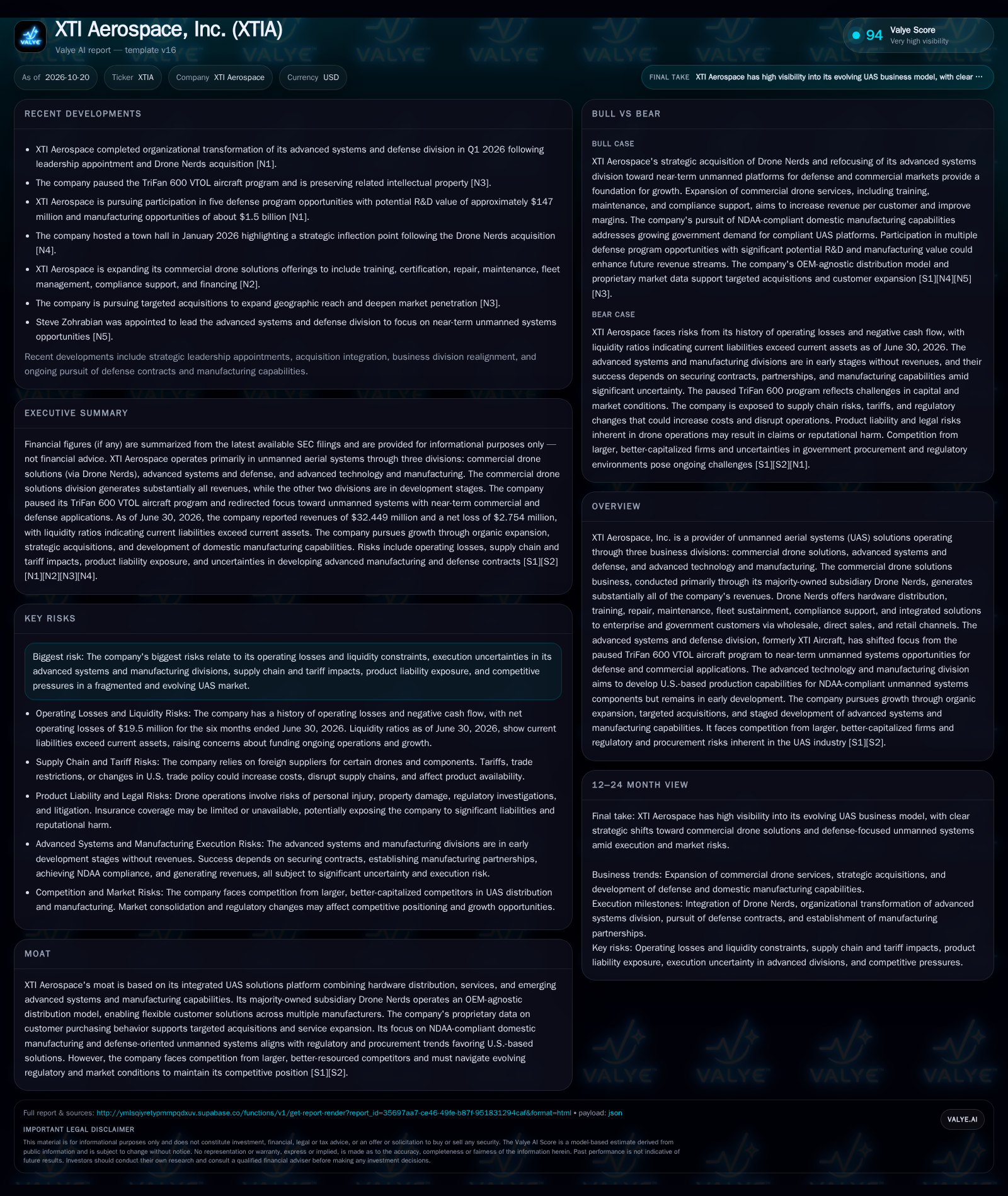
XTI Aerospace generates nearly all revenue from its subsidiary Drone Nerds’ commercial drone solutions, with advanced defense and manufacturing divisions still pre-revenue. The company is targeting growth through acquisitions, participation in high-value defense program opportunities, and development of domestic NDAA-compliant manufacturing. [S1] [S2]
XTI Aerospace stands at a crossroads where tangible commercial drone revenues contrast sharply with the high-stakes ambitions of its defense and manufacturing initiatives. With virtually all sales flowing from its Drone Nerds subsidiary, XTI is betting on scaling through targeted acquisitions, winning defense contracts, and developing domestic NDAA-compliant manufacturing. The company’s future will depend not only on market demand for unmanned aerial systems but also on its ability to integrate acquisitions, secure large government contracts, and build a resilient supply chain amid regulatory and competitive headwinds.
Where the Business Stands: Commercial Revenue and Defense Pipeline
As of June 30, 2026, XTI Aerospace reported $32.449 million in revenue for the first half of the year, almost entirely from its majority-owned Drone Nerds subsidiary, which provides commercial drone hardware, services, and support to enterprise and government customers. In contrast, the advanced systems and defense and advanced technology and manufacturing (ATM) divisions have not yet generated revenue, remaining in development or pre-contract phases. The company is pursuing five defense-related program opportunities with a combined potential R&D value of $147 million and a possible $1.5 billion in manufacturing opportunities if production phases are reached, but these remain prospective and uncontracted. Liquidity is tight: as of June 30, 2026, XTI held $7.214 million in cash and equivalents against $84.238 million in current liabilities, for a current ratio of 0.54. The TriFan 600 VTOL program is paused, with focus redirected to near-term unmanned defense opportunities. [S2] [N1] [N3] [N5]
How XTI Turns (or Hopes to Turn) Revenue into Profits
XTI Aerospace’s current economics are anchored in Drone Nerds’ distribution and service model. Revenue is driven by hardware sales, training, maintenance, compliance support, and potentially higher-margin integrated solutions. The OEM-agnostic approach may enable flexibility in matching customer needs, but also exposes XTI to OEM pricing, dealer terms, and potential supply chain volatility. Margins in drone hardware distribution are typically thin, but can be improved through value-added services and recurring support contracts if customer retention is strong.
The advanced systems and defense division, while pre-revenue, is targeting large, multi-phase government contracts. If XTI can convert its identified defense pipeline into awarded R&D and production contracts, the economics could shift dramatically toward higher-margin, longer-term program revenues. However, defense procurement cycles are lengthy, highly competitive, and subject to budget and regulatory risk.
The ATM division aspires to develop U.S.-based, NDAA-compliant manufacturing. If successful, this could eventually improve gross margins and supply chain control, but would require high upfront capital investment, partnerships, and regulatory navigation. Until scale is reached, fixed costs could outpace any initial revenue, and capital needs may intensify. Across all divisions, ongoing operating losses and negative cash flow highlight the need for either accelerated growth or meaningful cost discipline to reach sustainable profitability.
Competitive Pressures and Potential Advantages in a Fragmented Market
XTI operates in a rapidly evolving, highly fragmented unmanned aerial systems market, facing competition from larger, better-capitalized hardware distributors, integrated service providers, and OEMs pursuing direct sales. In defense and manufacturing, barriers to entry include regulatory compliance, customer trust, and the ability to scale production to government standards—domains where incumbents have entrenched relationships and resources.
XTI’s OEM-agnostic distribution model and proprietary customer data may provide some differentiation, allowing more tailored solutions and the potential to identify and acquire complementary businesses. The company’s focus on NDAA-compliant manufacturing and U.S. supply chain localization aligns with current regulatory and procurement trends, which may favor domestic players if executed well.
However, larger competitors can absorb supply chain shocks, undercut on pricing, and offer broader product portfolios. XTI’s relative lack of scale, thin balance sheet, and dependence on third-party suppliers could limit its ability to defend share if incumbent OEMs or distributors intensify direct competition or if government contracts favor established primes.
Unlocking Value: What Could Drive a Step-Change in Growth and Margins
The clearest upside scenario for XTI Aerospace is the successful conversion of one or more of its five targeted defense program opportunities into awarded R&D and production contracts. This could deliver multi-year, high-margin revenue streams, de-risk the advanced systems division, and provide the scale necessary to support ATM manufacturing investment. Parallel success in integrating acquisitions could expand distribution reach, increase operating leverage, and create cross-selling opportunities for services and support.
Expansion of NDAA-compliant domestic manufacturing would position XTI to capitalize on government and enterprise demand for secure, U.S.-made drone systems, potentially commanding premium pricing and margin uplift. Evidence supporting this scenario would include announced contract wins with government agencies, meaningful revenue contributions from advanced divisions, successful acquisition integration, and improved cash flow or profitability metrics. Confirmation would also come from visible progress in establishing domestic manufacturing partnerships and a shift in revenue mix toward recurring or program-based income.
Commercial Core Sustains, Defense Remains Unproven
The most plausible near-term outcome is that XTI continues to generate the bulk of its revenue from Drone Nerds’ commercial drone solutions, with gradual growth from expanded services and incremental acquisitions. Defense and manufacturing divisions may see slow progress—advancing through contract pursuit and partnership development, but not yet reaching revenue-generating stages at scale.
Operating losses and negative cash flow likely persist in the short term, given ongoing investment requirements and thin hardware distribution margins. Liquidity constraints may force disciplined capital allocation, delaying or resizing advanced initiatives if external financing is not secured on favorable terms. Evidence supporting this scenario would be stable or modestly growing commercial revenues, continued pre-revenue status for advanced divisions, and either flat or deteriorating liquidity ratios. Milestones such as small contract wins or pilot projects in defense/manufacturing, without full-scale program conversion, would further confirm the base case.
Liquidity Squeeze and Execution Risk Derail Expansion Plans
A negative scenario involves XTI’s liquidity constraints worsening, forcing the company to scale back or discontinue investment in advanced systems and manufacturing before they contribute material revenue. Failure to secure defense contracts or manufacturing partnerships could leave the company overextended, while larger competitors take share in both commercial and defense segments.
Supply chain disruptions, tariffs, or regulatory changes could erode margins or limit product availability, impacting Drone Nerds’ core business. Product liability incidents or adverse legal/regulatory outcomes could trigger unexpected costs or reputational harm. Confirmation of this downside would come from further deterioration in liquidity ratios, asset sales, layoffs, discontinued divisions, or a sharp decline in commercial revenue due to competitive or operational setbacks.
Milestones That Will Define XTI Aerospace’s Next Chapter
Progress on converting any of the five targeted defense program opportunities into signed, revenue-generating contracts with government agencies.
Disclosure of meaningful revenue or backlog from the advanced systems and defense or advanced technology and manufacturing divisions, if achieved.
Integration outcomes and revenue uplift from recent or future acquisitions, as measured by segment performance and margin trends.
Updates on the establishment of NDAA-compliant domestic manufacturing partnerships, including facility buildout or supply agreements.
Changes in the company’s liquidity position—particularly cash, working capital, and any new financing, as disclosed in future filings.
Evidence of recurring revenue or long-term service contracts within the Drone Nerds business, if disclosed, supporting margin stability.
Material supply chain disruptions, tariff impacts, or OEM relationship changes affecting product availability or pricing.
Any product liability or regulatory incidents and their impact on insurance, reputation, or ongoing operations.
Disclaimer: This is research-only, informational analysis and not investment advice. It may include AI-generated interpretation and general industry context. Always verify important details using primary sources.

Comments