
Cleveland-Cliffs: Operational Scale, Cyclical Exposure, and the Realities of Steel Sector Leverage
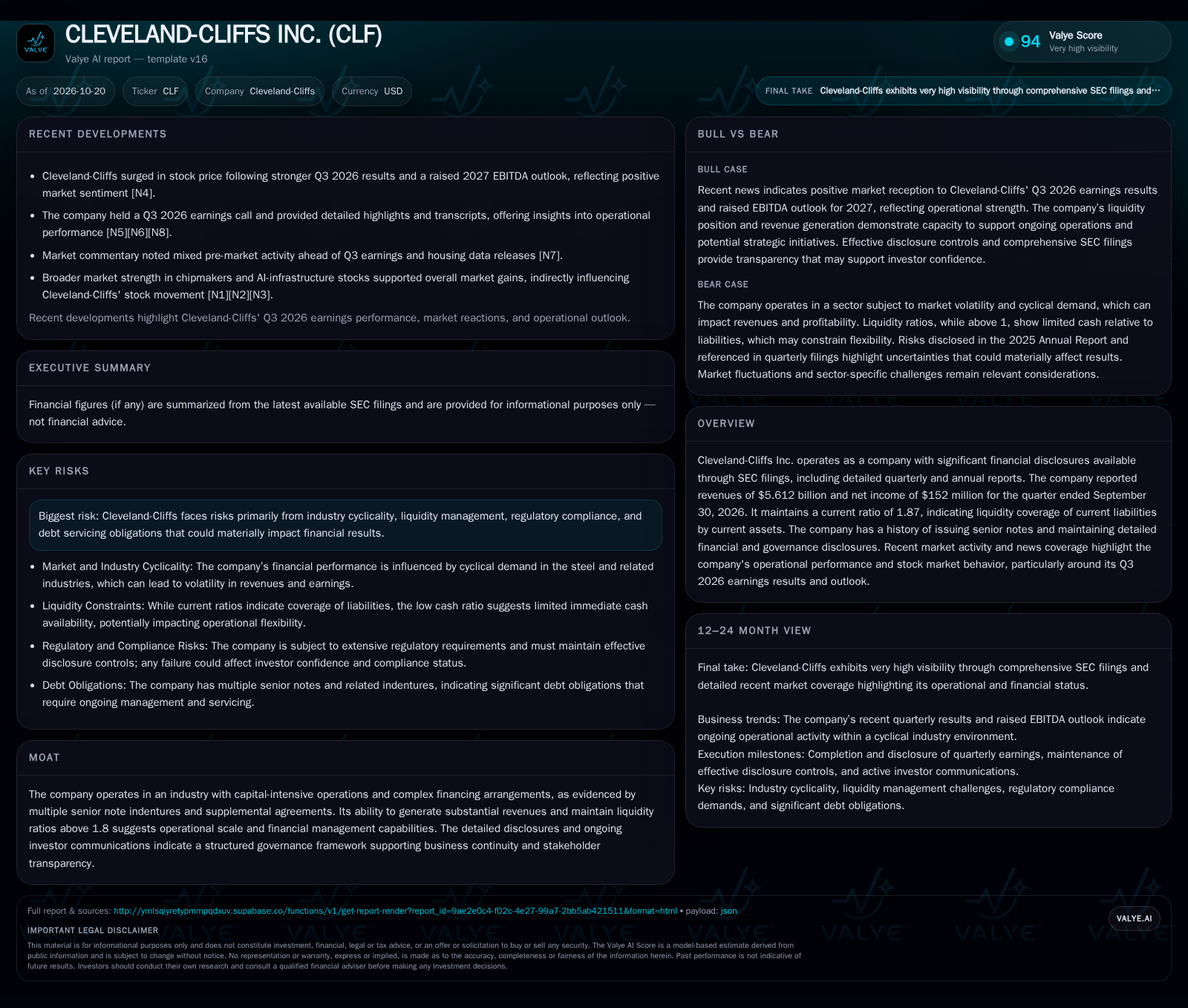
Cleveland-Cliffs reported $5.6 billion in Q3 2026 revenues and net income of $152 million, with a current ratio of 1.87 but a cash ratio of just 0.02.
Cleveland-Cliffs reported $5.6 billion in Q3 2026 revenues and net income of $152 million, with a current ratio of 1.87 but a cash ratio of just 0.02. The company’s stock surged on improved results and a raised 2027 EBITDA outlook, yet its liquidity profile and sector cyclicality remain critical watchpoints [S2] [N4].
Cleveland-Cliffs Inc. delivered a robust Q3 2026 performance, reporting $5.612 billion in revenue and net income of $152 million, which led to a notable surge in its stock price and a raised EBITDA outlook for 2027. With comprehensive SEC disclosures supporting transparency, the company’s trajectory will be shaped by its ability to navigate sector volatility, manage working capital, and address its debt load.
Q3 2026: Strong Operating Results, Tight Cash Position, and Market Reaction
Cleveland-Cliffs reported Q3 2026 revenues of $5.612 billion and net income of $152 million, resulting in basic and diluted EPS of $0.27 and $0.26, respectively [S2]. These results surpassed market expectations and prompted a surge in the company’s stock price following the earnings release and a raised EBITDA outlook for 2027 [N4]. The company reported cash and liquidity metrics for the period; these figures do not by themselves establish operating runway, investment capacity, financial flexibility, or financing capacity. The company reported a cash ratio of 0.02 for the period. [S2] This dynamic frames the company’s operational scale against a backdrop of persistent liquidity management challenges.
The juxtaposition of a reported current ratio against a notably reported cash ratio suggests that Cleveland-Cliffs holds a significant portion of its current assets in forms other than cash, such as inventory or receivables. This composition can introduce liquidity risk, especially if market conditions deteriorate and converting these assets to cash becomes challenging. In cyclical industries like steel, where demand and pricing can fluctuate rapidly, the timing of cash inflows and outflows becomes critical. Therefore, the company’s ability to efficiently manage working capital components—such as accelerating receivables collection or optimizing inventory levels—will be essential to maintaining operational flexibility without resorting to costly external financing.
How Cleveland-Cliffs Makes Money: Volume, Margins, and Working Capital Intensity
Cleveland-Cliffs operates primarily as an integrated steel and iron ore producer, generating revenue through the sale of steel products to automotive, construction, and manufacturing customers. In this business, revenue is driven by shipment volumes, realized prices per ton, and product mix—with higher-margin specialty steel products and value-added processing generally delivering better profitability than commodity steel. The sector is capital-intensive, requiring ongoing investment in plant, equipment, and maintenance, while also demanding significant working capital to finance raw materials, work-in-progress, and receivables.
Fixed costs are substantial, so operating leverage can swing both ways: strong demand and higher utilization rates can rapidly improve margins and cash generation, but downturns expose the company to margin compression and liquidity strain. The company’s multiple senior note indentures also indicate a material interest and principal servicing burden, making efficient capital allocation and working-capital discipline critical to sustaining profitability and strategic flexibility.
Capital intensity in integrated steel manufacturing not only drives fixed cost commitments but also imposes a continuous need for reinvestment to maintain operational efficiency and comply with evolving environmental regulations. This dynamic means that Cleveland-Cliffs must balance short-term liquidity pressures with longer-term capital expenditure requirements. Furthermore, working capital intensity can vary significantly with production cycles and customer payment terms, potentially exacerbating cash flow volatility. In periods of rising raw material costs or supply chain disruptions, the company may face compressed margins unless it can pass costs through to customers promptly, underscoring the importance of pricing power and contract structures in sustaining profitability.
Industry Structure and Competitive Pressures: Scale, Substitution, and Cyclical Forces
Cleveland-Cliffs competes in a global steel industry characterized by large, capital-intensive players, significant price competition, and exposure to raw material cost swings. Its scale and vertical integration—encompassing iron ore mining, steelmaking, and value-added processing—can provide cost advantages and supply security relative to smaller or less integrated competitors. However, the company faces ongoing threats from international steel producers, especially those in regions with lower labor or energy costs, as well as from substitute materials (e.g., aluminum, composites) in automotive and construction applications.
Customer relationships in steel are often long-standing but price-sensitive, with contracts and spot sales subject to renegotiation as market conditions shift. Barriers to switching suppliers can be moderate for commoditized products but higher for specialty grades requiring technical certification or just-in-time logistics. Cyclical demand, particularly from automotive and infrastructure end-markets, amplifies profit volatility and heightens the importance of balance-sheet resilience during downturns.
The competitive landscape in steel is further complicated by geopolitical factors and trade policies, which can alter import-export dynamics and influence domestic pricing. Cleveland-Cliffs’ vertical integration offers a buffer against raw material price swings but also exposes it to operational risks across multiple stages of the value chain. Additionally, the threat from substitute materials is conditional on technological advancements and shifts in end-market preferences, which could gradually erode demand for certain steel grades. Maintaining technical expertise and investing in product innovation may thus be critical to preserving market share, especially in specialty steel segments where customer switching costs and certification requirements are higher.
A Tight Steel Market, Operational Discipline, and Debt Reduction Drive Value Creation
If steel market fundamentals strengthen—driven by infrastructure stimulus, automotive production rebounds, or supply constraints—Cleveland-Cliffs could benefit from higher volumes, improved pricing, and greater utilization of fixed assets.
Evidence supporting this scenario would include continued upward revisions to forward EBITDA guidance, declining net debt balances, increased capital expenditures on high-return projects, and sustained pricing power relative to peers. Confirmation would also come from management commentary highlighting multi-quarter customer contract wins, higher capacity utilization, and a shift in product mix toward higher-margin steel grades.
Navigating Cyclical Fluctuations with Stable Operations and Working Capital Management
The most plausible near-term course is that Cleveland-Cliffs continues to operate profitably but with ongoing sensitivity to steel demand cycles and commodity input costs. Revenue and earnings may fluctuate quarter to quarter, reflecting shifts in automotive production, construction activity, and broader economic trends.
In this scenario, management maintains a focus on cost control, inventory optimization, and disciplined capital spending. Debt servicing remains manageable but constrains the ability to pursue aggressive growth or shareholder returns. Confirmation would come from steady, if unspectacular, quarterly results, modest net debt reduction, and limited movement in either direction on forward guidance. Negative confirmation would include a spike in short-term borrowings or a deterioration in working capital metrics.
A Demand Shock or Steel Price Drop Exposes Balance Sheet Vulnerabilities
Should there be a sharp decline in steel demand—driven by a recession, automotive slowdown, or a surge in low-priced imports—Cleveland-Cliffs could face margin compression, reduced cash flow, and potential strain in meeting debt obligations.
Indicators of this scenario would include negative operating cash flow, rising short-term debt, missed or revised-down guidance, and management commentary on cost-cutting or asset sales. Additional confirmation could come from covenant breaches, debt rating downgrades, or distressed refinancing activity.
Operational Indicators and External Triggers That Will Shape Cleveland-Cliffs’ Trajectory
Quarterly free cash flow generation and its relationship to reported net income—sustained positive free cash flow would support debt reduction and investment capacity.
Net debt and leverage ratio trends, especially in the context of EBITDA and forward guidance revisions.
The evolution of working capital metrics, including inventory days and receivables turnover; a useful metric would be cash conversion cycle if disclosed.
Changes in customer concentration or contract structure, particularly with major automotive and industrial clients—a shift toward more stable, multi-year contracts would increase revenue visibility if disclosed.
Updates on capital expenditure plans and the balance between maintenance versus growth investments.
Any new regulatory or trade actions impacting steel imports/exports, which could affect pricing power and capacity utilization.
Management’s commentary on liquidity management, credit facility usage, and potential refinancing or asset sales.
Market signals around steel price benchmarks and end-market demand, especially in automotive and infrastructure sectors.
Disclaimer: This is research-only, informational analysis and not investment advice. It may include AI-generated interpretation and general industry context. Always verify important details using primary sources.

Comments