
UPAY: Integrated Lending and Compliance Platforms Seek Growth Amid Persistent Liquidity Strains
UPAY’s multi-pronged fintech strategy—spanning South African credit management software, compliance automation, and a U.S.-focused hunting marketplace—has delivered notable revenue expansion. Yet, severe working capital shortfalls, net losses, and customer concentration highlight the company’s acute dependence on new financing and successful integration of acquired platforms.
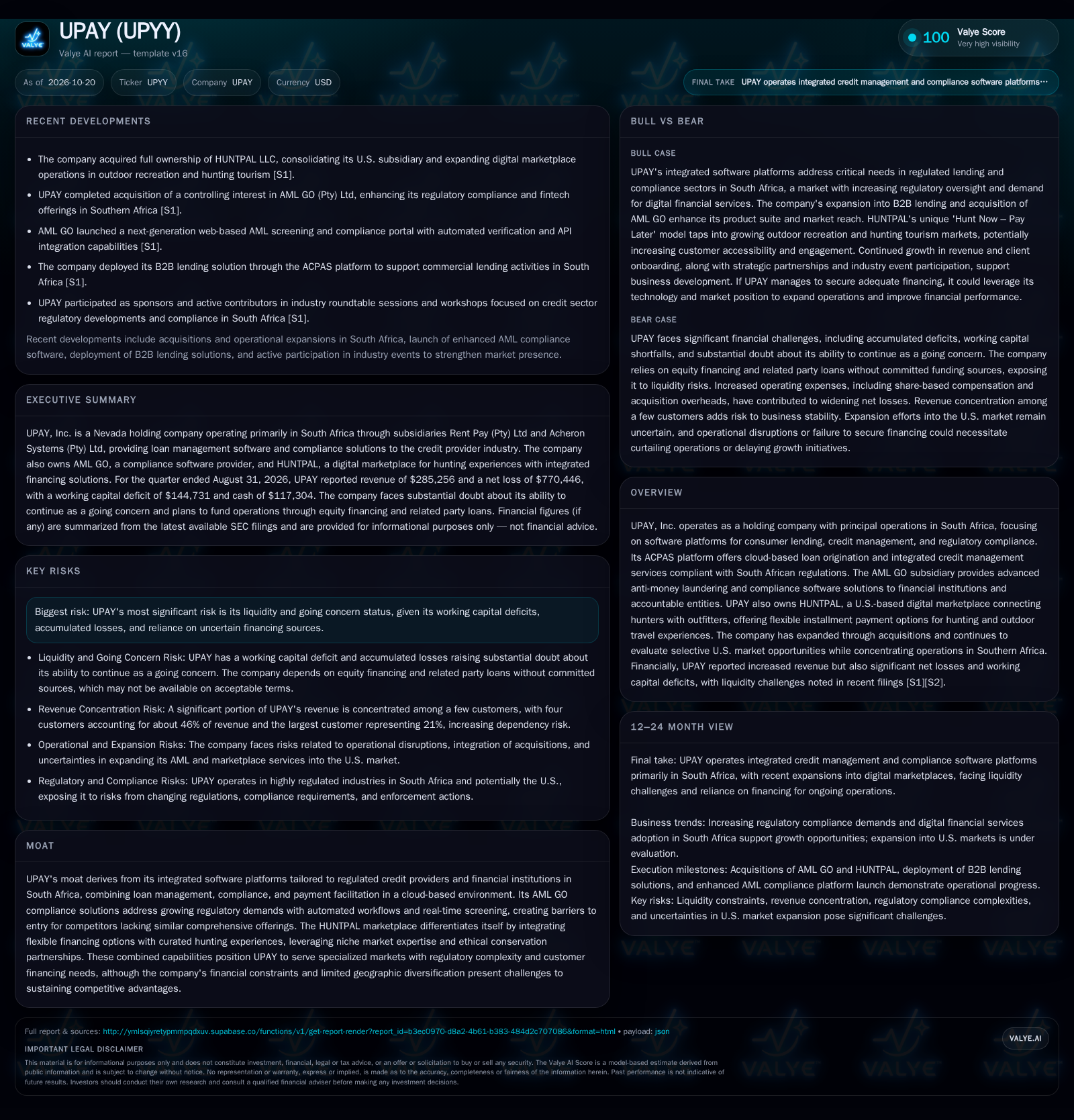
UPAY reported a 51% year-over-year revenue increase to $285,256 for the quarter ended August 31, 2026, driven by growth in development fees and recent acquisitions. Expansion into compliance automation and a U.S. hunting marketplace diversify the model but heighten execution risk. The business remains highly reliant on external financing to sustain operations and growth initiatives. [S2]
UPAY, Inc. has delivered robust top-line growth through its core South African credit management platform, new compliance software, and a novel U.S. hunting marketplace.
Recent Revenue Gains Offset by Mounting Losses and Liquidity Deficit
In the quarter ending August 31, 2026, UPAY reported revenue of $285,256—a 51% increase from the prior year period. This growth was primarily attributed to higher development fees and the impact of recent acquisitions, namely AML GO (compliance software) and HUNTPAL (U.S. hunting marketplace) [S2]. However, the company recorded a net loss of $770,446, driven in large part by a $515,595 non-cash loss on settlement of notes payable and a sharp rise in general and administrative expenses following its acquisition of Acheron Systems [S2].
Liquidity remains a critical concern: as of August 31, 2026, UPAY held only $117,304 in cash, with a current ratio of 0.57 and a working capital deficit of $144,731. The company’s filings explicitly raise substantial doubt about its ability to continue as a going concern, given the absence of committed financing sources [S2]. Revenue concentration is another immediate risk, with four customers accounting for nearly half of all revenue [S2].
UPAY continues to pursue selective U.S. market opportunities, particularly for its compliance and marketplace platforms, even as its operational and financial base remains centered in South Africa [S1].
Unit Economics and the Funding Equation: Software, Compliance, and Marketplace Dynamics
UPAY’s business model is predicated on developing and licensing cloud-based loan management software (ACPAS), compliance automation solutions (AML GO), and transaction facilitation through its HUNTPAL marketplace. The core economics of software and compliance platforms typically feature high gross margins after initial development and integration costs, as incremental users can be added with relatively low variable expenses. This can create operating leverage if customer acquisition scales efficiently and churn remains low.
However, the company’s current stage is characterized by rising operating costs, especially from share-based compensation and acquisition overheads. The integration of acquired platforms (Acheron, AML GO, HUNTPAL) has increased fixed expenses before revenue synergies are fully realized. UPAY’s working capital deficit and negative cash flow mean it is highly sensitive to the timing and scale of new customer wins and collections.
The HUNTPAL marketplace introduces a different revenue logic, potentially generating transaction fees, installment financing margins, and service charges for trip logistics. However, two-sided marketplaces often require sustained investment in both supply (outfitters) and demand (hunters), and margins may be thin until scale is achieved. Without explicit disclosure of contract structures, it is not clear whether revenues are recurring, usage-based, or transactional—each with different implications for predictability and cash conversion.
UPAY’s capital needs are acute: with no committed sources of external financing, the company has signaled it will rely on equity issuance or related party loans to fund continued operations and any growth initiatives [S2].
Where UPAY May Stand Out—and Where Rivals and Substitutes Apply Pressure
UPAY’s potential competitive edge in South Africa lies in its integrated, cloud-based approach to credit management and compliance, addressing increasingly complex regulatory requirements. Its ACPAS platform covers loan origination, collections, payment facilitation, and compliance in one ecosystem, which could appeal to regulated lenders seeking turnkey solutions. AML GO’s automation of due diligence and integration with watchlists and credit bureaus may provide further differentiation in an environment where regulatory scrutiny is rising.
However, the South African fintech and regtech landscape is competitive, with established local and international vendors offering credit management, payments, and compliance solutions. Larger competitors may offer greater scale, broader integrations, or stronger brand recognition. In compliance, global players with mature platforms and deeper R&D budgets could outpace UPAY’s innovation.
The HUNTPAL marketplace faces an entirely different set of competitors, including established online booking platforms, niche hunting travel agents, and other vertical marketplaces. The novelty of ‘Hunt Now – Pay Later’ financing could attract customers, but also exposes the business to credit risk and the challenges of scaling both supply and demand in a fragmented, relationship-driven sector.
UPAY’s high customer concentration, limited geographic diversification, and financial constraints reduce its ability to absorb competitive shocks or invest aggressively in market share gains.
Unlocking Platform Synergies: What Would Signal a Turnaround
The most favorable outcome for UPAY is predicated on successfully scaling its integrated platforms while alleviating liquidity strain through new funding. If the company can secure sufficient equity financing or related party loans, it could continue investing in product development, customer acquisition, and U.S. market entry.
Revenue growth would need to accelerate, ideally with a more diversified client base and less concentration risk. Meaningful adoption of the AML GO platform by South African financial institutions—or early traction in U.S. compliance markets—would support the case for product-market fit. For HUNTPAL, expanding both the number of outfitters and booked trips, and demonstrating low default rates on installment plans, would indicate the marketplace model is gaining traction.
Confirmation of this scenario would come from several quarters of sequential revenue growth, improved gross margins, reduced customer concentration, and evidence of recurring or contracted revenue streams. Announcements of new strategic partnerships, customer wins, or non-dilutive funding would further support the bull case.
A scenario in which operating leverage begins to manifest—i.e., expenses grow slower than revenue—would suggest that the fixed cost of acquisitions is being absorbed and that the model is becoming more sustainable.
Treading Water: Incremental Progress Amid Funding Dependence
The most plausible near-term outcome is that UPAY continues to grow revenue at a moderate pace through incremental client wins and ongoing contributions from its acquired platforms, but remains hamstrung by liquidity constraints and customer concentration. The company may be able to secure enough short-term funding—through small equity raises or related party loans—to maintain operations without meaningfully accelerating growth.
Operating expenses are likely to remain elevated as the company integrates its acquisitions and invests in platform enhancements. Margin expansion will be limited until revenue growth materially outpaces fixed costs. Geographic and product diversification could reduce risk over time, but the benefits may be offset by execution complexity and increased cash burn.
Evidence supporting this scenario would include continued but uneven revenue growth, persistent net losses, and recurring disclosures of going concern risk. Customer concentration may persist, and any new market entry (such as U.S. compliance) would likely proceed cautiously and without immediate scale.
Falsifying the base case would require either a clear pivot to profitability and funding stability (moving toward the upside scenario), or a severe liquidity event forcing operational retrenchment (downside).
Liquidity Crunch and Customer Flight: What Could Force a Retrenchment
The most adverse scenario for UPAY involves its inability to secure additional financing, leading to a cash crunch that forces curtailment of operations or asset sales. In this environment, the company’s working capital deficit would worsen, and it could be unable to meet payroll, vendor obligations, or regulatory requirements.
Revenue risks are amplified by customer concentration: the loss of one or more of the top four clients—who account for nearly half of revenue—would significantly impact cash flow. Integration challenges or underperformance in the AML GO or HUNTPAL businesses could exacerbate losses and erode confidence among customers and partners.
Operational disruptions, regulatory setbacks, or adverse market conditions in South Africa or the U.S. could further stress the business. In this scenario, UPAY may be forced to pursue distressed asset sales, seek protection from creditors, or wind down portions of its business.
Confirmation would come from missed payroll, vendor disputes, default notices, or fire-sale financings. Persistent negative operating cash flow, failed equity raises, or rapid customer attrition would further validate the downside.
Milestones That Will Define UPAY’s Survival and Strategic Progress
Quarterly revenue growth rate, especially sequential improvements and contributions from AML GO and HUNTPAL, will clarify whether the business is gaining real traction.
Gross margin trends and the mix between recurring, transactional, and project-based revenue would help test the scalability and predictability of the model.
Customer concentration metrics—specifically, whether the top four customers’ share of revenue declines—will signal diversification and risk reduction [S2].
Cash burn and operating cash flow, relative to available liquidity and announced financing events, are critical to assessing near-term solvency [S2].
Updates on successful equity raises, debt financings, or non-dilutive funding will determine UPAY’s ability to continue as a going concern [S2].
Evidence of customer wins or partnerships in the U.S. for AML GO or HUNTPAL would indicate progress in market expansion.
Disclosure of customer retention rates, renewal rates, or churn would help assess the stickiness and durability of UPAY’s platform revenues.
Disclaimer: This is research-only, informational analysis and not investment advice. It may include AI-generated interpretation and general industry context. Always verify important details using primary sources.

Comments