
Zeta Network Group: Crypto Mining Expansion, Capital Structure Shifts, and the Challenge of Profitability
Amid aggressive restructuring and a pivot to Kazakhstan-based crypto mining, Zeta Network Group faces the test of turning strategic partnerships and specialized equipment investments into sustainable returns—while navigating persistent net losses and liquidity complexities.
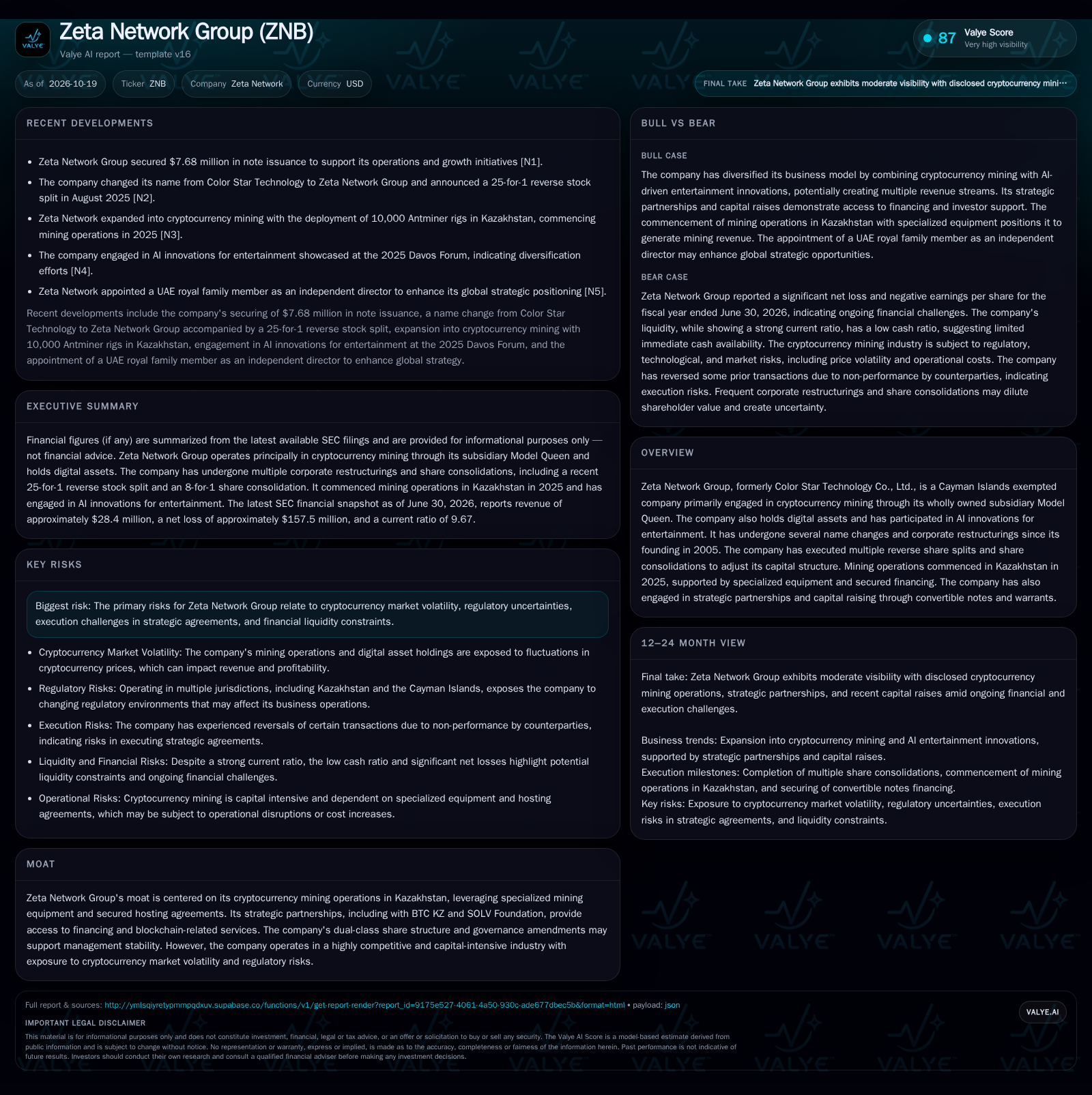
Zeta Network Group has shifted its core operations to cryptocurrency mining in Kazakhstan, supported by recent equipment purchases and a secured term loan.Despite reporting $28.4 million in revenue for the year ended June 30, 2026, the company incurred a net loss of $157.5 million and maintains a reported cash ratio despite a reported current ratio. The group’s capital structure is in flux, with multiple share consolidations, convertible note offerings, and a dual-class share setup. The thesis now hinges on the scalability and profitability of its mining operations, the effectiveness of its strategic partnerships, and its ability to manage financial and operational risks in a volatile industry environment. [S1] [S2] [N2]
Zeta Network Group’s transformation from a diversified entertainment and digital assets company into a focused cryptocurrency miner marks a high-stakes bet on the scalability and profitability of industrial-scale mining in Kazakhstan. While recent capital raises, strategic partnerships, and equipment acquisitions have enabled a jump in reported revenue, the company’s persistent net losses and intricate capital structure signal that sustainable value creation remains an open question. The next phase will test whether Zeta can convert its operational investments and blockchain partnerships into resilient, cash-generating performance—or whether financial and execution risks will continue to dominate the narrative.
Pivot to Kazakhstan Mining and Capital Structure Overhaul Define the Present
The company’s operational pivot is now centered on cryptocurrency mining in Kazakhstan, where its subsidiary Model Queen began operations in April 2025 using newly acquired specialized equipment. This shift is financially underpinned by a $31.6 million secured term loan with BTC KZ, which is collateralized by the mining hardware and requires quarterly repayments starting September 2025. For the fiscal year ended June 30, 2026, Zeta Network Group reported $28.4 million in revenue but a substantial net loss of $157.5 million, with basic and diluted EPS at -$927.59 per share. The capital structure has been actively managed: the company executed a 25-for-1 reverse stock split in August 2025 and an 8-for-1 share consolidation in July 2026, alongside convertible note and warrant issuances. As of June 30, 2026, the current ratio stood at 9.67, but the cash ratio was just 0.01, indicating that most current assets are not immediately liquid. [S1] [S2] [N2]
Mining Revenue, Cost Structure, and the Economics of Scale
Zeta’s revenue model now primarily relies on the production and sale of mined cryptocurrencies, with Bitcoin likely as the core output given industry norms. Revenue is a function of mined coin volume, prevailing crypto prices, and the efficiency of mining operations. The economics are capital-intensive: large upfront investments in ASIC mining rigs, ongoing costs for power and hosting (especially in Kazakhstan), and periodic hardware replacement as mining difficulty and technological obsolescence increase. The company’s secured term loan and strategic partnerships may provide leverage and access to infrastructure, but introduce fixed repayment obligations that must be covered by operating cash flows.
Operating leverage is high—scaling up mining output can drive revenue growth if fixed costs are spread over more hash power, but this also amplifies downside risk if crypto prices fall or if mining difficulty outpaces hardware efficiency gains. The reported cash ratio suggests much of the current asset base is tied up in non-cash holdings (potentially mined coins, receivables, or inventory), limiting immediate liquidity. The reported net loss, despite $28.4 million in revenue, signals that either direct costs (electricity, hosting, depreciation) or overhead remain high relative to realized mining yields. Strategic partnerships in liquid staking and structured finance could, if operationalized, diversify revenue or improve asset utilization, but commercial mechanics are not fully disclosed.
Industry Dynamics: Scale, Cost Pressures, and the Race for Hashrate
Zeta Network Group operates in a brutally competitive mining ecosystem where scale, electricity costs, and hardware efficiency are the primary drivers of profitability. Entrenched incumbents, including large U.S., Chinese, and Central Asian mining pools, benefit from economies of scale and preferential access to low-cost energy. Kazakhstan’s appeal as a mining hub lies in its relative energy affordability and regulatory openness—though both can be subject to abrupt change. Zeta’s partnership with BTC KZ may offer local operational advantages, but the company lacks the global scale of the largest players.
The company’s prior forays into AI entertainment and digital assets suggest a willingness to diversify, but these activities have been deemphasized; dissolved subsidiaries and reversed transactions indicate limited current contribution. The dual-class share structure may shield management from hostile actions, but could also deter some institutional investors wary of governance risk. Strategic partnerships (e.g., with SOLV Foundation) may provide access to emerging DeFi or staking markets, but the competitive moat remains narrow unless Zeta can drive down mining costs or secure a sustainable edge in hardware or energy procurement.
Leveraging Partnerships and Mining Scale for Sustainable Profitability
The upside scenario hinges on several reinforcing mechanisms: Zeta successfully ramps its Kazakhstan mining operations, achieving industry-competitive efficiency and uptime; crypto prices remain robust or increase, raising the value of mined coins; and the company leverages its partnerships (BTC KZ for operations, SOLV Foundation for staking/finance) to enhance returns or unlock new revenue streams (e.g., liquid staking or structured crypto lending).
Confirmation would come from sequential revenue growth, narrowing net losses or a pivot to operating profit, and disclosures of meaningful cash flow from mining rather than just asset revaluation. Additional evidence would include announcements of expanded mining capacity, reductions in per-coin mining costs, or the successful launch of staking/DeFi products that generate incremental yield on mined assets. If Zeta can demonstrate consistent repayment of its term loan from operating cash, this would further validate operational resilience.
Mining Output Grows, But Margin Pressure and Volatility Persist
The most plausible scenario is that Zeta Network Group grows its mining output in Kazakhstan, benefiting from initial equipment investments and strategic partnerships, but continues to face significant margin pressure. Crypto price volatility and periodic increases in mining difficulty limit the company’s ability to consistently convert revenue into profit. Overhead costs, debt service from the BTC KZ loan, and the capital intensity of replacing or upgrading mining hardware constrain free cash flow.
Evidence confirming this scenario would be continued revenue growth without a corresponding improvement in net income or cash flow, periodic equity or convertible note offerings to shore up liquidity, and limited disclosures on positive cash generation. Falsification would require clear and sustained progress toward operating profitability and evidence that cost per mined coin is declining faster than industry averages.
Cost Overruns, Crypto Downturn, and Liquidity Squeeze Amplify Losses
In a negative scenario, Zeta’s mining operations encounter cost overruns—perhaps from rising electricity prices in Kazakhstan, hardware failures, or adverse regulatory changes. Crypto prices could fall, shrinking mining margins and forcing the company to sell assets at unfavorable prices to meet loan repayments.
Confirmation would come from widening net losses, missed or renegotiated loan payments, fire-sale liquidation of digital assets, or emergency capital raises via dilutive equity or high-cost debt. Additional signs would include disclosures of operational disruptions, loss of key hosting agreements, or further reversals of strategic transactions.
Milestones That Could Shift the Zeta Network Group Thesis
Quarterly updates on mining output (hashrate, coin production volume, and realized pricing) would help gauge operational scalability and efficiency—if disclosed.
Per-coin mining cost (including power, hosting, and depreciation) versus industry benchmarks would clarify whether Zeta is gaining or losing cost competitiveness.
Cash flow from operations, especially after debt service, would indicate whether the business is approaching or achieving self-sufficiency.
Updates on the status and terms of the BTC KZ loan—repayment progress, potential renegotiations, or covenant breaches—would signal financial stress or stability.
Disclosures on the commercial progress of partnerships with the SOLV Foundation or similar entities: Are these generating incremental revenue, yield, or cost savings?
Announcements relating to expansion—such as additional mining equipment orders, new hosting deals, or entry into supplemental blockchain services—would test the company’s growth strategy.
Any regulatory developments in Kazakhstan or the Cayman Islands that directly impact mining operations or asset holdings would be critical external conditions to monitor.
Shareholder dilution from further reverse splits, note conversions, or warrant exercises would affect long-term equity value and should be closely tracked.
Disclaimer: This is research-only, informational analysis and not investment advice. It may include AI-generated interpretation and general industry context. Always verify important details using primary sources.

Comments