
Atlantic American: Niche Insurance Strategy and Agent Model Underpin Earnings Potential
Recent financial recovery highlights Atlantic American’s resilience in specialized insurance markets, but its agent-driven distribution and reserving uncertainties leave open questions about the durability of profitability and competitive edge.
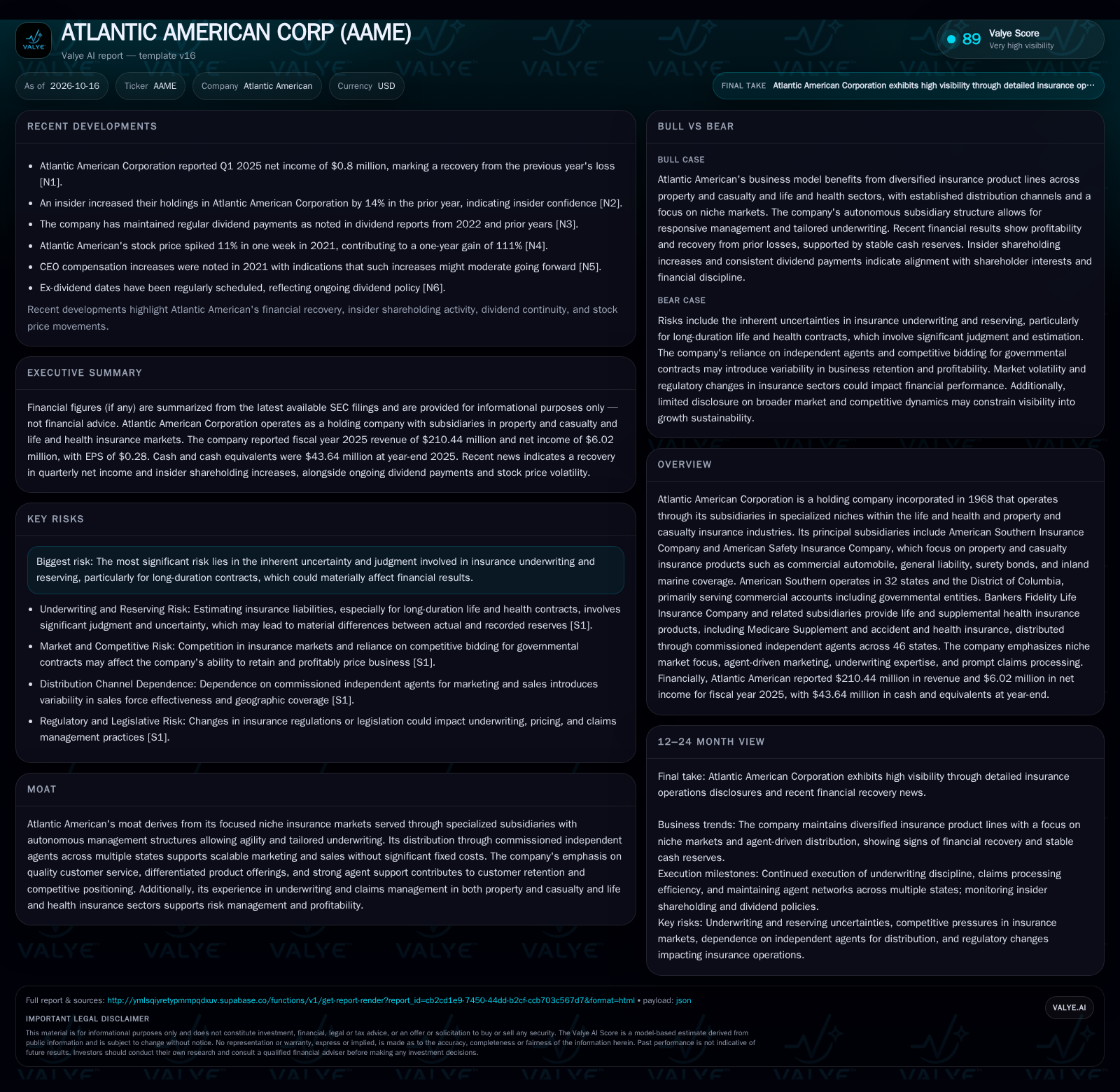
Atlantic American operates through subsidiaries in property/casualty and life/health insurance, focusing on niche markets and distributing via commissioned independent agents. Recent results show a return to profitability, with $210.44M in 2025 revenue and $6.02M net income. However, the company’s business remains exposed to risks in underwriting, reserving, and agent/channel variability, making sustained outperformance dependent on execution and market conditions. [S1] [N1]
Atlantic American Corporation’s return to profitability in 2025 underscores its adaptability within specialized insurance markets, operating through subsidiaries focused on property/casualty and life/health segments. With agent-driven distribution and a niche-market approach, the company has historically balanced risk management with tailored underwriting. Yet, as insurance sector dynamics evolve, the interplay between reserving accuracy, agent channel variability, and regulatory changes will dictate whether recent gains can be sustained—or if the business remains structurally vulnerable to adverse cycles. [S1] [N1]
Profitability Returns Despite Ongoing Structural Vulnerabilities
Atlantic American reported $210.44 million in revenue and $6.02 million in net income for fiscal year 2025, with basic and diluted EPS of $0.28. This marks a recovery from prior losses, as confirmed by a Q1 2025 net income of $0.8 million after a loss in the previous year. [S1] [N1]
The life and health segment, led by Bankers Fidelity, accounted for 84% of net earned premiums in 2025, highlighting a portfolio skew toward health-related products. Distribution remains agent-centric, with approximately 6,565 licensed agents in the life/health division and a focus on independent agents and governmental accounts for property/casualty. [S1]
Recent insider share accumulation and a regular dividend cadence suggest some degree of insider alignment and capital return, though these signals do not directly address the sustainability of core earnings. [N2] [N3]
Agent-Driven Model Influences Revenue, Cost Structure, and Profit Dynamics
Atlantic American’s economics hinge on underwriting margin, claims experience, and the productivity of its independent agent network. The company’s two main engines—property/casualty (American Southern) and life/health (Bankers Fidelity and affiliates)—have contrasting economic profiles. Property/casualty business, especially commercial auto and surety, tends to be short-duration, allowing for relatively rapid premium recognition and reserve release, but is exposed to claims volatility. Life and health products, particularly those with long durations (like Medicare Supplement), generate persistent premium streams but require careful actuarial reserving and risk pricing.
The agent-driven distribution model reduces fixed salesforce costs but introduces variable commission expenses and potential volatility tied to agent productivity, recruitment, and retention. Agent commissions in property/casualty are explicitly linked to profitability, aligning incentives but also exposing the company to swings in underwriting results. In life/health, commissions are a major upfront cost, with profitability dependent on policy persistency and claims experience. Simplified issue underwriting in life/health may expand reach but could introduce selection risk if not properly managed.
Operating leverage is inherently limited by the need for risk-based capital and regulatory constraints on reserve adequacy. While scale can help absorb fixed overhead (IT, claims infrastructure, regulatory compliance), the company’s niche focus and multi-state footprint mean that margin expansion is often constrained by competitive pricing and the cost of agent-based distribution.
Capital needs are dominated by statutory reserve requirements and the need to support premium growth without overleveraging, especially in volatile or catastrophic claims environments. [S1]
Niche Positioning Offers Strengths and Reveals Limitations
Atlantic American’s competitive edge lies in its focus on specialized insurance products and markets where large national carriers may have less appetite or scale advantages are muted. The company’s subsidiaries target commercial and governmental accounts in property/casualty, and senior/Medicare-related products in life/health. This positioning can insulate it from pure price competition and allow for tailored underwriting and service.
However, reliance on independent agents means the company must continuously compete for agent mindshare and business flow—not just against other regionals, but also against national carriers and insurtechs offering digital platforms, more attractive commissions, or broader product suites. In life/health, the simplified issue approach may appeal to certain demographics but could be replicated by larger players or digital-first entrants.
Substitution risk is rising as digital distribution models, direct-to-consumer platforms, and embedded insurance partnerships gain traction. While Atlantic American’s claims service model (prompt processing, 24/7 reporting) supports retention, it does not in itself create strong switching costs. The moat is thus primarily in niche underwriting expertise, agent relationships, and speed of service—not in proprietary data, technology, or capital cost advantages.
Competitive pressure is most acute in governmental contracts (property/casualty), where business can shift based on bid cycles, and in Medicare/health, where regulatory changes or new entrants can quickly alter the market landscape. [S1]
A Virtuous Cycle Emerges Through Agent Productivity, Claims Management, and Targeted Growth
The most favorable scenario for Atlantic American involves sustained growth in premiums and earnings driven by agent productivity gains, successful targeting of underserved insurance niches, and disciplined underwriting that keeps loss ratios and reserve development favorable. If the company leverages its agent network to expand in profitable micro-markets—such as specialty commercial auto or Medicare Supplement—with superior claims service and risk selection, it could achieve above-peer growth and margin stability.
Confirmation would come through consecutive years of positive net income, growing premium volumes in both segments, stable or improving combined ratios (property/casualty) and loss ratios (life/health), and persistently high agent retention and productivity (if disclosed). Evidence of winning new governmental contracts or expanding into adjacent niche products—without adverse reserve development—would further support the case.
A falsification would be a reversion to underwriting losses, agent attrition, or evidence that premium growth is coming at the expense of margin (e.g., rising loss ratios or negative reserve development).
Execution Remains Crucial for Maintaining Profitability Amid Volatility
The most plausible path is continued moderate profitability, with periodic swings tied to claims experience, agent network variability, and regulatory or competitive changes. Atlantic American is likely to maintain its niche focus and agent-driven model, benefiting from expertise in targeted markets but facing the ongoing risk of adverse selection, competitive encroachment, and reserving uncertainty.
Base case confirmation would involve stable annual net income, steady premium growth in both segments, and no material negative reserve developments.
The scenario would be challenged by evidence of increasing claims volatility, declining agent productivity, or regulatory changes that significantly affect pricing or capital requirements.
Risks in Underwriting and Distribution Could Reverse Progress
A negative outcome could arise if adverse claims experience, especially in long-duration life/health or commercial auto, leads to reserve strengthening and earnings pressure. Reliance on independent agents could exacerbate volatility if key agents leave, if business is lost to digital or national competitors, or if commission costs rise faster than premium growth.
Regulatory changes—such as shifts in Medicare reimbursement, state-level insurance mandates, or capital requirements—could squeeze margins or require new investments in compliance and IT. If premium growth stalls or reverses and loss ratios deteriorate, the company’s reported cash balance could erode, potentially forcing a reduction in dividends, a capital raise, or retrenchment from certain markets.
Downside confirmation would include a return to net losses, negative reserve development, shrinking premium base, or a spike in agent attrition (if disclosed).
Factors Influencing the Longevity of Atlantic American’s Niche Earnings
Trends in net earned premiums by segment (property/casualty vs. life/health), indicating growth or contraction in core markets. [S1]
Annual and quarterly net income trajectory, particularly after reserve adjustments, to test the durability of recent profitability. [S1] [N1]
Combined ratio (property/casualty) and loss ratio (life/health)—if disclosed—to gauge underwriting discipline and claims experience.
Agent count, retention, and productivity metrics—if disclosed—since the model’s scalability and stability depend on agent network health.
Evidence of reserve strengthening or adverse development in actuarial estimates, especially for long-duration life/health contracts. [S1]
New business wins or contract renewals, particularly in governmental property/casualty or Medicare Supplement markets.
Regulatory changes in key states or at the federal level that could impact pricing, capital requirements, or product offerings.
Disclaimer: This is research-only, informational analysis and not investment advice. It may include AI-generated interpretation and general industry context. Always verify important details using primary sources.

Comments