
Loop Industries: Chemical Recycling Potential Meets Execution and Funding Headwinds
Loop Industries’ Infinite Loop™ technology promises a breakthrough in PET plastic recycling, but persistent revenue declines, liquidity shortfalls, and commercialization hurdles threaten both its Nasdaq listing and long-term viability.
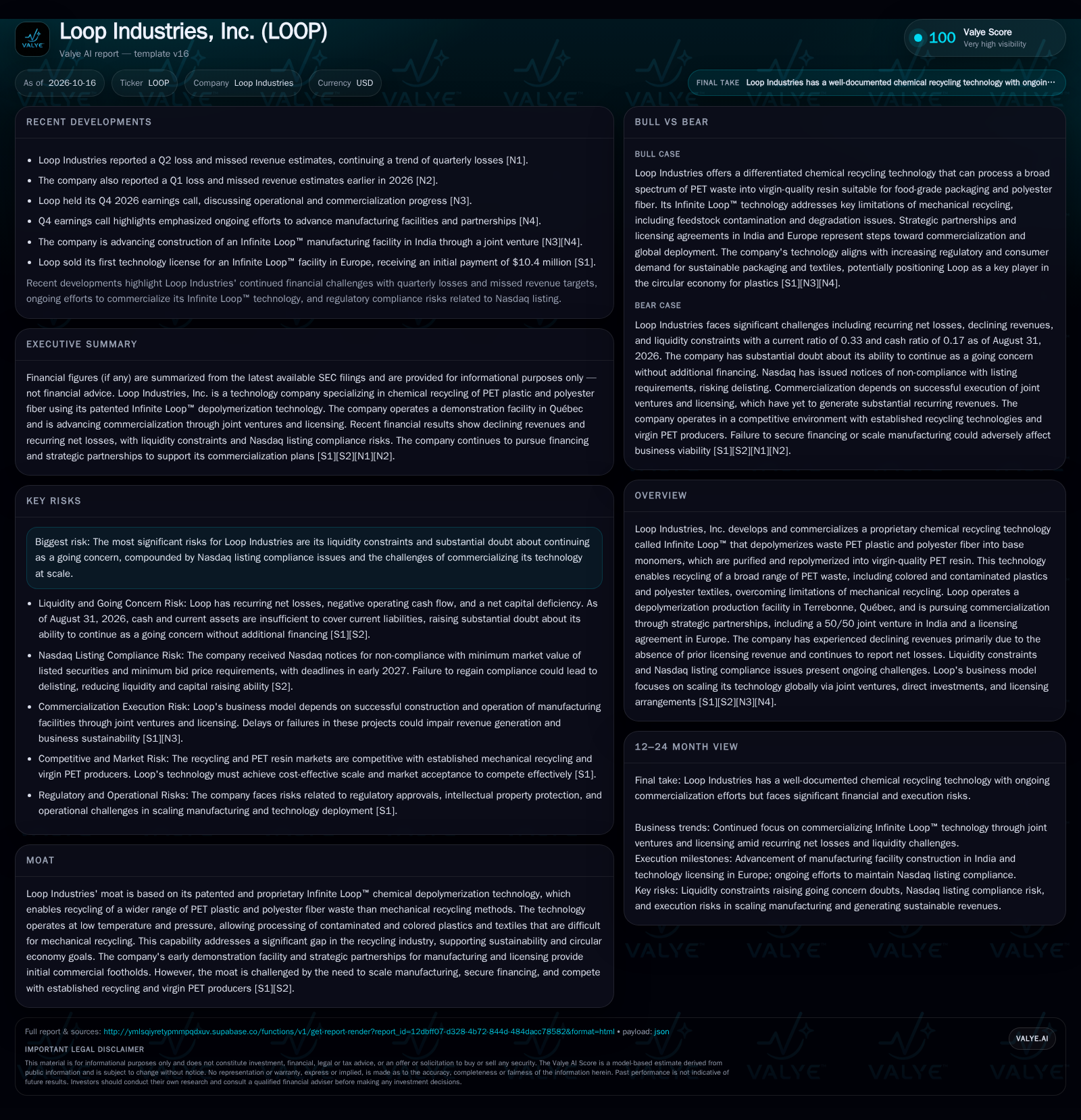
Loop Industries is attempting to commercialize a proprietary chemical recycling technology that can process hard-to-recycle PET waste into food-grade resin. Commercialization efforts via joint ventures and licensing have yet to yield recurring revenues, and imminent Nasdaq listing compliance deadlines add urgency to the company’s strategic execution. [S1] [S2] [N1] [N2]
Loop Industries is positioning its Infinite Loop™ chemical recycling technology as a solution to the persistent limitations of traditional PET recycling, aiming to transform contaminated and colored plastics into high-quality, food-grade resin. The company’s roadmap hinges on scaling through joint ventures and technology licensing, but the reality of declining revenues, deepening losses, and a precarious liquidity position casts doubt on its ability to deliver. With critical Nasdaq compliance deadlines looming and commercialization milestones still to be proven, Loop stands at a crossroads—balancing breakthrough potential with existential financial and execution risks. [S1] [S2] [N1] [N2]
Falling Revenues and Looming Compliance Deadlines Define the Present
Loop Industries reported revenues of $514 thousand for the fiscal year ended February 28, 2026—a sharp decline from $10.9 million the prior year, primarily due to the absence of new technology licensing revenue. Net losses remain substantial at $12.3 million, though slightly improved from the previous year’s $15.1 million. The company reported cash and liquidity metrics for the period; these figures do not by themselves establish operating runway, investment capacity, financial flexibility, or financing capacity. Nasdaq has formally notified Loop of non-compliance with minimum market value and bid price requirements, with compliance deadlines set for early 2027. These facts frame a company under acute financial pressure, with both execution and funding risks now existential. [S1] [S2] [N1] [N2]
How the Infinite Loop™ Model Could Generate Profits—If Scalable
Loop’s core business proposition is to monetize its Infinite Loop™ chemical depolymerization technology through a mix of direct resin sales, joint-venture manufacturing, and technology licensing. The licensing model has the potential to generate high-margin, upfront payments and recurring royalties if adopted by major packaging and fiber producers. Joint ventures, such as the 50/50 partnership with Ester Industries in India, could drive recurring revenue through equity participation in plant operations.
However, fixed costs are high due to R&D, facility development, and regulatory compliance, while variable costs depend on feedstock sourcing, energy, and purification. The technology’s ability to process contaminated and colored PET could, in theory, allow access to cheaper, more abundant feedstock than traditional recyclers, possibly improving gross margins over time. But realizing these economics requires successful commercialization at scale, with sufficient plant throughput and customer adoption. The capital intensity of building and operating recycling plants, combined with the need for ongoing technology support, means Loop is likely to require continued external funding and/or strong licensing uptake to reach breakeven.
Differentiation Versus Incumbents: Can Technology Alone Build a Moat?
Loop’s technology promises to address fundamental limitations of mechanical PET recycling—namely, the inability to process colored, contaminated, or textile-derived waste into food-grade resin. This technical differentiation, if robust and scalable, could allow Loop to tap into feedstock streams that are uneconomical for traditional recyclers, positioning it as a solution provider for the circular plastics economy.
However, established mechanical recyclers, major virgin PET producers, and other chemical recycling startups all compete for market share. Incumbents benefit from scale, integration, and established customer relationships. Technology alone does not guarantee a defensible moat without cost-competitive operations, reliable product quality, and proven commercial execution. Furthermore, the capital requirements and complexity of building new chemical recycling plants create high barriers to widespread adoption, and regulatory acceptance and customer trust in chemically recycled PET remain evolving factors.
Breakthrough Adoption: What Would a Commercial Inflection Look Like?
A favorable scenario for Loop would see its Indian joint venture complete construction and ramp to commercial-scale production, demonstrating operational reliability and product quality that meets regulatory and customer standards. If the European licensee successfully brings its Infinite Loop™ facility online and Loop captures recurring royalty streams, this would validate the licensing model and establish a multi-region commercial footprint.
Confirmation would come from sequential increases in licensing revenue, recurring resin sales, and publicized offtake agreements with major packaging or textile brands. Additional license sales or joint ventures, especially with blue-chip partners, would further de-risk the model. A successful equity raise or non-dilutive funding that extends runway beyond 2027 would also signal increasing market confidence.
Stalled Commercialization and Ongoing Funding Scramble Remain Most Likely
The most plausible near-term scenario is one of continued financial strain and slow commercialization. Loop may secure incremental financing via its At-The-Market equity facility or debt funding, temporarily extending its runway but at the cost of dilution or higher leverage. Joint venture and licensing projects could progress, but may encounter delays, capacity bottlenecks, or customer hesitancy—limiting recurring revenue growth.
Revenue is likely to remain lumpy, dependent on milestone payments rather than steady product or royalty streams. Nasdaq listing compliance could remain at risk absent a sustained improvement in share price or market cap, potentially constraining future capital raising. Confirmation of this scenario would include further missed revenue targets, continued net losses, and limited progress in scaling commercial operations.
Liquidity Crisis or Delisting Could Force Structural Change
In a negative outcome, Loop’s liquidity could deteriorate further, resulting in missed payroll, vendor defaults, or halted project development. Failure to regain Nasdaq compliance by early 2027 could lead to delisting, reducing access to equity capital and eroding investor and partner confidence. Inability to secure bridge financing or equity infusions would force Loop to curtail operations, defer R&D, or attempt asset sales under distress.
Further, if joint venture partners or licensees delay or abandon projects due to market, regulatory, or technical setbacks, Loop’s pathway to recurring revenues would be blocked. This scenario would be confirmed by additional going concern warnings, workforce reductions, halted facility construction, or public disclosures of default or delisting proceedings.
Milestones That Will Determine If Loop’s Model Can Survive and Scale
Progress on the construction, commissioning, and commercial operation of the Infinite Loop™ joint venture facility in India, including any disclosed production milestones or customer contracts.
Timing, terms, and magnitude of new technology license agreements, particularly evidence of recurring royalty streams or upfront payments beyond the initial European license.
Quarterly revenue trends, with attention to the mix of product sales, licensing income, and milestone payments—if disclosed, recurring revenue breakdown would clarify business momentum.
Status updates on Nasdaq listing compliance, including share price recovery or market value improvements, as well as any extensions or appeals granted.
Disclosure of additional financing events—drawdowns on the ATM equity facility, new debt, or strategic investments—that materially change the company’s liquidity outlook.
Public announcements of binding offtake agreements or partnerships with major packaging or textile brands, which would signal commercial validation.
Operational cost trends, including updates on R&D, G&A, and impairment expenses, to assess the company’s ability to manage cash burn while scaling.
Regulatory approvals or certifications for Infinite Loop™ resin in key markets, which would impact addressable market size and customer adoption curves.
Disclaimer: This is research-only, informational analysis and not investment advice. It may include AI-generated interpretation and general industry context. Always verify important details using primary sources.

Comments