
East West Ave Acquisition Corp.: Early-Stage SPAC Structure, Trust Capital, and the Search for a Business Combination
East West Ave Acquisition Corp. (EWAV) is a recently listed SPAC with $100 million in trust and no operating business, now seeking an acquisition target. Its capital structure and sponsor incentives shape its opportunity set, but the lack of a defined sector focus and typical SPAC time constraints introduce execution and deal-quality risk.
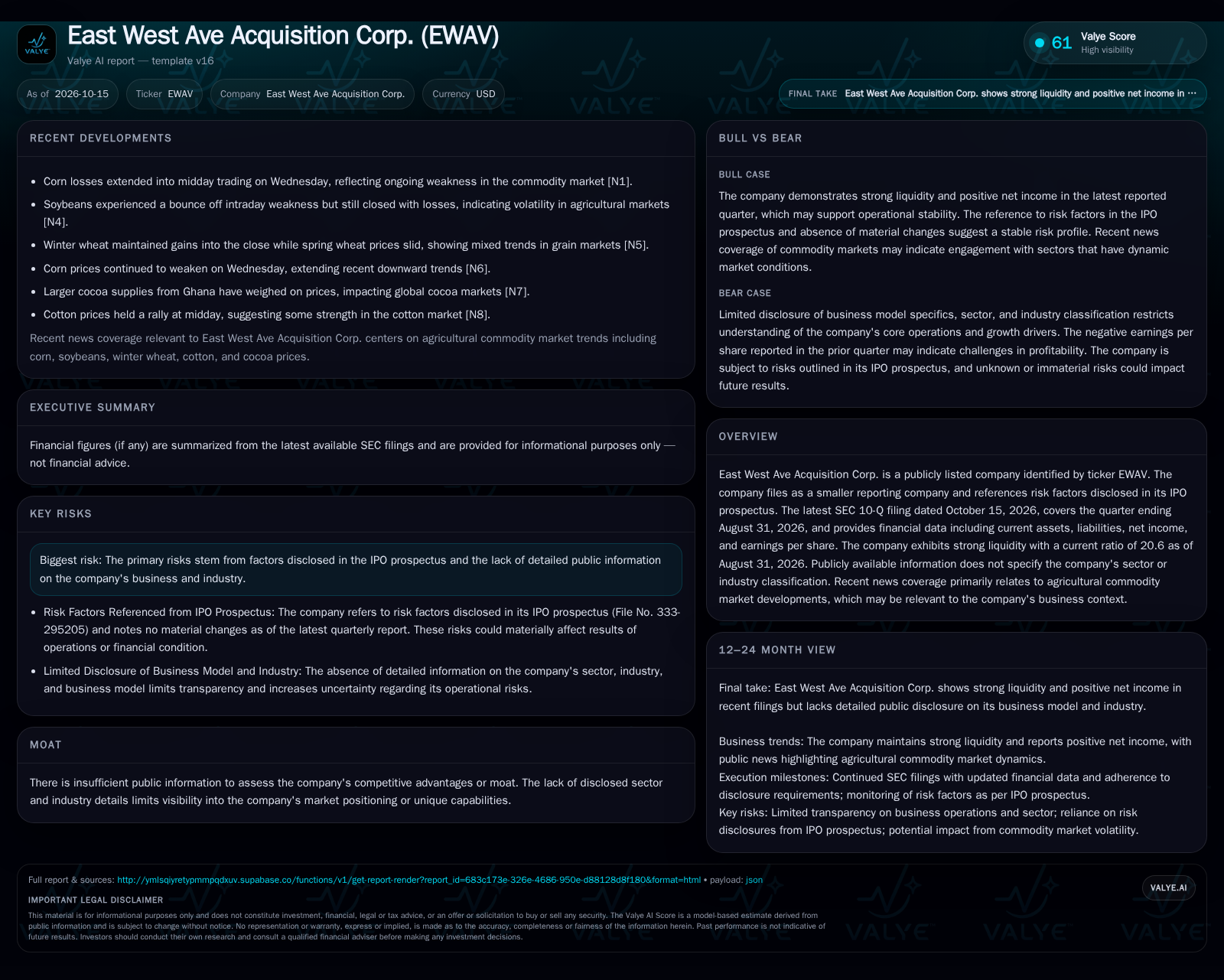
EWAV is a blank check company with $100 million in trust, formed to acquire or merge with an operating business. It has not commenced operations and currently generates interest income from its trust account. Short-term reported liquidity position, but the core value proposition will hinge on the quality and terms of a future business combination, with significant uncertainty until a target is identified and a deal is executed. [S1]
East West Ave Acquisition Corp. (EWAV) is a newly public special purpose acquisition company (SPAC), formed in late 2025 and completing its IPO in August 2026. With $100 million held in trust and no operating business to date, EWAV exists to identify and acquire an as-yet-unknown target. Its current financial profile is defined by interest income on trust assets and minimal operating expenses. The company's future will hinge on its ability to source and execute a compelling business combination—an outcome that depends on sponsor incentives, market dynamics, and the competitive landscape for SPAC deals. Until a target is announced, the company's risks and upside remain largely theoretical. [S1]
SPAC Launch, Trust Structure, and Financial Snapshot
East West Ave Acquisition Corp. (EWAV) is a blank check company incorporated in Nevada in October 2025. As of August 31, 2026, it had not commenced any operations and had generated no operating revenue. The company completed its $100 million IPO in August 2026, with proceeds placed in a trust account. EWAV’s net income for the recent quarter was $136,744, derived entirely from interest income on trust assets, offset by organizational and compliance expenses. The company reported cash and liquidity metrics for the period; these figures do not by themselves establish operating runway, investment capacity, financial flexibility, or financing capacity. [S1]
The sponsor structure includes both East West Avenue LLC (Delaware) and NFR Capital Limited (Hong Kong), a detail that could influence the breadth of the target search. There is no sector or industry focus disclosed, and recent news coverage relating to agricultural commodities suggests only a possible thematic interest rather than a confirmed strategy. [S1]
How the SPAC Model Shapes Economics and Incentives
EWAV’s economics are defined by the SPAC model, which differs fundamentally from an operating company. The IPO capital is held in trust and cannot be used for operations (other than interest income) until a business combination is completed. Expenses are limited to compliance, due diligence, and formation costs, typically funded by sponsors or reported cash balance outside the trust. The company’s current net income is not the result of business activity, but rather the yield on trust account investments—typically low-risk, short-term securities.
Upon successful acquisition, the trust capital will be used to fund the transaction and provide working capital to the acquired business. Sponsors often receive a substantial equity stake for nominal investment (the 'promote'), creating strong incentives to close a deal within the allowed timeframe. However, if no deal is consummated within a set period (often 18-24 months), the trust is returned to public shareholders (less expenses), and the sponsors lose their promote. This structure creates a tension between deal quality and the pressure to complete any transaction before the deadline.
The capital needs for ongoing operations are minimal until a deal is announced, but future capital requirements will depend entirely on the characteristics of the acquired business—its sector, capital intensity, and growth profile.
SPACs in a Crowded Market: Deal Competition and Sponsor Differentiation
EWAV faces competition from a large universe of active SPACs, private equity funds, and strategic acquirers, all seeking attractive acquisition targets. In recent years, the SPAC market has seen increased scrutiny and a surplus of capital chasing a limited pool of quality targets, driving up valuations and making it harder for SPACs to source compelling deals.
The dual-sponsor structure—one US-based, one Hong Kong-based—could theoretically broaden EWAV’s opportunity set to include both North American and Asia-Pacific targets. However, absent a sector focus or disclosed sourcing pipeline, there is no evidence of a competitive advantage or pre-identified deal flow. The lack of a defined industry thesis can be a double-edged sword: it provides flexibility but may reduce the ability to attract, diligence, and win high-quality targets.
Ultimately, EWAV’s competitive position will be revealed only once a target is announced and the terms of the proposed transaction are disclosed. Until then, the company is undifferentiated relative to other early-stage SPACs.
High-Quality Acquisition and Favorable Deal Terms Unlock Value
The most favorable outcome for EWAV shareholders would come from the identification and execution of a business combination with a high-growth, scalable target at a reasonable valuation. If the sponsors leverage their cross-border networks to source a differentiated asset—such as a technology, consumer, or industrial company with strong margins and growth prospects—the combined entity could generate material value for shareholders.
Confirmation of this upside would require: (1) the announcement of a definitive business combination agreement with a credible, growing operating company; (2) investor enthusiasm reflected in low redemption rates and positive market reaction; (3) clear disclosure of the acquired company’s financials, growth trajectory, and management depth; and (4) alignment of sponsor incentives with long-term shareholder value (e.g., sponsor lockups or earnouts).
Falsification would occur if the announced target is undifferentiated, overvalued, or faces significant structural headwinds, or if the market reacts with high redemption rates and negative sentiment.
The Default Path: Sourcing, Negotiation, and Shareholder Vote
The most plausible scenario is that EWAV spends the next 12-18 months evaluating potential targets across various sectors and geographies, as allowed by its broad mandate. The process typically involves initial sourcing, diligence, negotiation, and ultimately the announcement of a proposed business combination subject to a shareholder vote.
Confirmation of this scenario would include regular SEC filings indicating ongoing search activity, public communications about progress or target screening, and eventually the filing of a merger proxy with target company details. Falsification would come from a prolonged absence of deal announcements or an extension vote, signaling difficulty in finding a suitable target.
Shareholder approval is not guaranteed; if the proposed deal is not compelling, a high redemption rate could undermine the transaction, returning capital to public investors and potentially resulting in SPAC liquidation.
Deal Failure, Liquidation, or Value-Destructive Combination
A negative outcome could result from several mechanisms: EWAV may fail to identify a suitable target within the mandated timeframe, leading to liquidation and return of trust capital to public shareholders (less transaction expenses). In this scenario, public investors may recover most of their investment, but sponsors and early backers would lose their promote and sunk costs.
Alternatively, EWAV could announce a business combination with an unattractive or overvalued target—one with poor financials, limited growth, or sector headwinds. If public shareholders redeem their shares in large numbers, the deal could collapse, or the post-merger entity could trade poorly, destroying value for those who remain invested.
Confirmation of downside would include: (1) repeated deadline extensions; (2) lack of credible deal announcements; (3) high redemption rates upon deal announcement; or (4) post-merger stock underperformance and weak operating results from the acquired company.
Milestones That Will Define EWAV’s Prospects and Shareholder Outcomes
Announcement of a definitive business combination agreement, including sector, geography, and target financials.
Shareholder redemption rates at the time of deal vote—a high rate could signal lack of confidence in the transaction.
Level of sponsor skin-in-the-game post-combination (e.g., lockups, earnouts, additional capital commitments), if disclosed.
Nature and depth of the acquired company’s management team and board composition, once a target is announced.
Any extension votes required to prolong EWAV’s deal-making window beyond the standard SPAC period.
Changes in trust account balance or non-operating income, which could reflect redemptions, deal expenses, or trust withdrawals.
Disclosure of sector or geographic focus, or evidence of proprietary sourcing relationships, if provided.
Disclaimer: This is research-only, informational analysis and not investment advice. It may include AI-generated interpretation and general industry context. Always verify important details using primary sources.

Comments