
WEWARDS, INC.: Public Listing Without Operations—Parsing the Realities of a Zero-Revenue Microcap
Despite over 107 million shares outstanding and regular SEC compliance, WEWARDS, INC. faces existential questions: with no revenue, no cash, and no disclosed business activity, what defines the company's value or future? This analysis unpacks the implications, economic mechanics, and potential scenarios for a microcap entity with little operational substance.
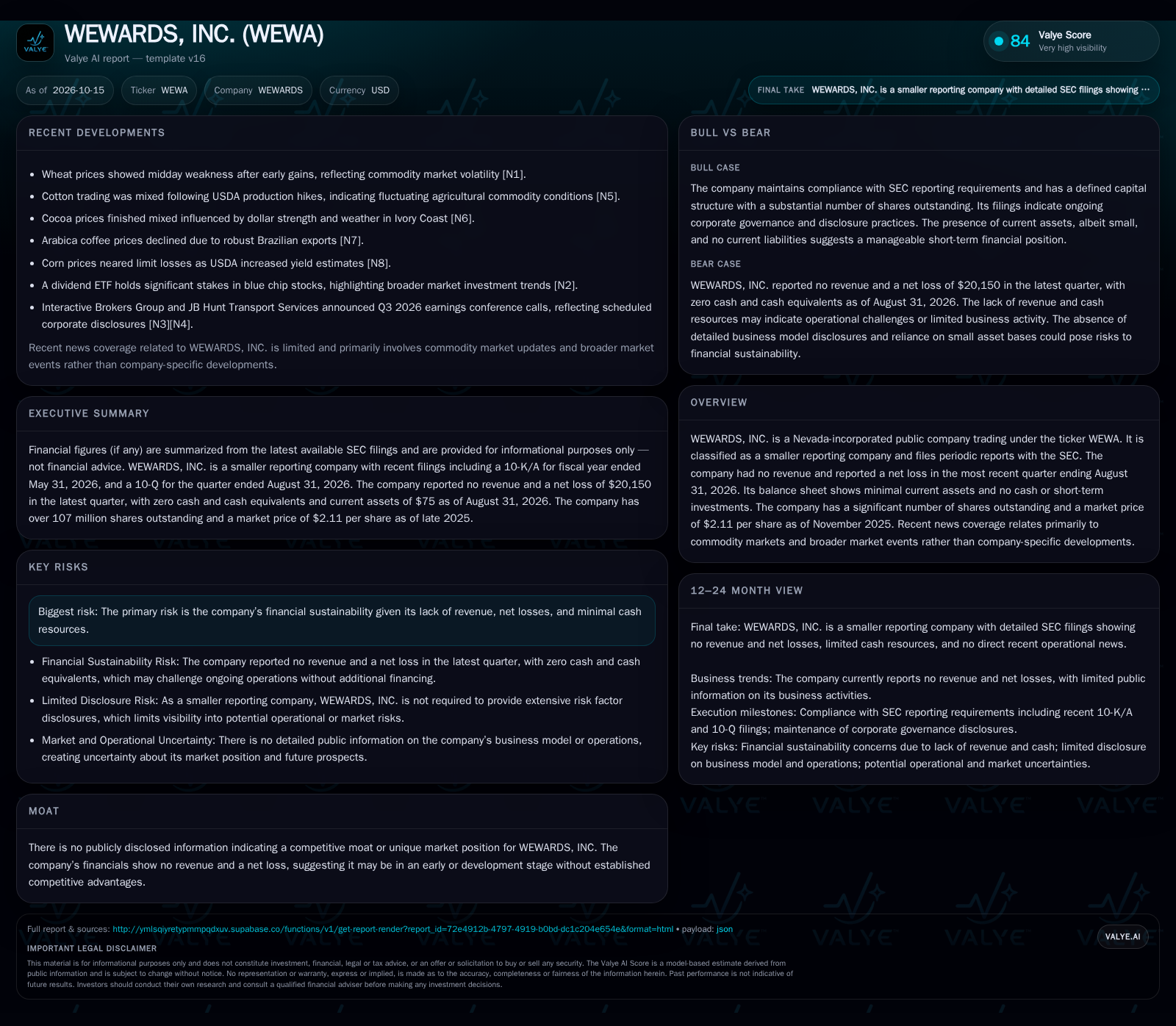
WEWARDS, INC. is a Nevada-incorporated microcap with zero revenue, zero cash, and minimal current assets as of August 31, 2026. The company remains compliant with SEC filings but discloses no business operations or model. With a $12.9 million market cap based on late 2025 prices, its valuation is disconnected from any evident underlying business. The key question: Can WEWARDS transition from a shell to an operating business, or does it exist primarily as a public vehicle?
WEWARDS, INC. exemplifies the opaque end of the microcap public company spectrum: a Nevada-registered entity with over 107 million shares outstanding, zero revenue, zero cash, and no disclosed business activity as of August 2026. While it remains compliant with SEC reporting requirements, its filings reveal no operational substance or commercial direction. The company’s $12.9 million market valuation stands in stark contrast to its lack of assets or business model, raising critical questions about the basis for its public listing and the potential pathways forward—whether as a shell, a platform for future acquisitions, or a candidate for dissolution.
A Public Company in Name Only: What the Latest Filings Reveal
WEWARDS, INC. reported zero revenue and a net loss of $20,150 for the quarter ended August 31, 2026. Its balance sheet lists zero cash and cash equivalents, $75 in current assets, and zero current liabilities [S2]. The company maintains over 107 million shares outstanding, with a public float valued at $12.9 million as of late 2025 [S1]. No business operations or commercial activities are disclosed in recent filings. These facts suggest WEWARDS functions as a public shell—a listed entity without active operations or a defined business model. The absence of cash, income, or liabilities indicates neither ongoing business activity nor immediate financial distress, but rather a state of dormancy or strategic liminality.
How Does a Zero-Revenue Shell Persist? Microcap Economics and Incentives
With no revenue, no cash, and minimal assets, WEWARDS currently generates no operating income and bears only nominal costs—likely limited to compliance and administrative expenses. Such entities often persist as public shells, maintained for their listing status rather than for active business operations. The economics of a shell company revolve around the value of its public vehicle: the ability to facilitate a reverse merger, attract a business seeking a public listing, or serve as a speculative trading instrument. The cost structure is almost entirely fixed, comprising SEC reporting and minimal overhead. Without an operating business, there is no gross margin, no operating leverage, and no organic path to value creation except through capital structure maneuvers or business combination events. If the company were to launch operations or acquire assets, it would require significant external funding—either through equity issuance, private placements, or merger consideration.
The persistence of a zero-revenue shell like WEWARDS also hinges on the broader microcap market dynamics and regulatory environment. Public shells derive value primarily from their potential as acquisition vehicles, but this potential is sensitive to shifts in investor sentiment, regulatory scrutiny, and capital market liquidity. For instance, heightened regulatory enforcement or increased reporting requirements can raise the cost of maintaining a shell, reducing its attractiveness. Conversely, periods of robust capital market activity and demand for public listings can enhance shell valuations. Additionally, the opportunity cost for shareholders and management to maintain a dormant public entity without operational progress can influence decisions to seek business combinations or wind down the company. Thus, the shell’s survival is not purely a function of internal economics but also external market and regulatory conditions.
Shell Status and the Absence of Moat: Where WEWARDS Sits in the Microcap Landscape
WEWARDS currently lacks any disclosed competitive advantages, business model, or market presence. As a shell, its only point of differentiation is its listing status and public float. In the ecosystem of microcap shells, value is often determined by the cleanliness of the corporate structure (no debts, no litigation, current SEC filings), the size of the public float, and the ease with which a merger or business combination can be executed. There are no product, service, or customer switching costs—nor any intellectual property, operational assets, or brand equity. The competitive set includes other clean shells, distressed microcaps, and special purpose acquisition companies (SPACs), all of which compete for the attention of private businesses seeking a public listing. The lack of liabilities could make WEWARDS attractive as a merger target for certain acquirers, but without further disclosures, there is no evidence of a competitive moat.
In the competitive microcap shell ecosystem, differentiation may emerge not from traditional moats but from structural and transactional cleanliness. For example, shells with straightforward capital structures, absence of outstanding warrants or complex convertible instruments, and no pending litigation tend to be more attractive to potential acquirers. Moreover, the timing and transparency of SEC filings can influence perceived reliability and reduce due diligence friction. The size of the public float is a double-edged sword: a larger float can facilitate liquidity but may also complicate control dynamics post-merger. In this context, WEWARDS’ lack of liabilities and clean financial disclosures could position it favorably relative to more encumbered shells, provided it maintains compliance and transparency. However, without proactive engagement or strategic positioning, it risks being outcompeted by shells with more compelling transactional attributes.
If a Business Combination Materializes: The Reverse Merger Pathway
The primary upside scenario for WEWARDS is the successful consummation of a reverse merger or acquisition, whereby an operating business seeks public listing by merging into the shell. This could inject assets, management, and cash into the entity, transforming it into an active company. The value of the public float would then be tied to the prospects of the acquired business. Evidence confirming this scenario would include SEC filings announcing a definitive merger agreement, proxy materials for a business combination, or the emergence of new management and a disclosed business plan. Falsification would be the absence of such filings or the continued reporting of zero revenue and zero assets. Upside is contingent on the shell’s attractiveness to acquirers, regulatory compliance, and the ability to close a transaction before administrative costs deplete residual value.
Dormancy and Administrative Survival: The Most Likely Near-Term Trajectory
Absent evidence of an imminent business combination or capital infusion, the most plausible near-term scenario is continued dormancy. WEWARDS may persist as a shell, incurring minimal costs to maintain SEC compliance and its listing. The company would likely file periodic reports reflecting zero or nominal financial activity, with no material change in operations. This state could persist until a private business seeks to utilize the shell for a public market entry or until administrative costs exhaust all remaining resources. Confirmation would be continued zero-revenue filings and lack of business development news; falsification would be the announcement of a new business plan, asset acquisition, or financing event.
Value Erosion and Delisting: How Dormant Shells Can Unwind
The core risk is that administrative and compliance costs gradually erode the nominal asset base, leaving WEWARDS unable to meet regulatory obligations. This could trigger SEC delisting, dissolution, or involuntary liquidation. In the absence of a business combination or external funding, the value of the public float would likely collapse, and shareholders could be left with illiquid or worthless securities. Evidence supporting this scenario would include late or missing filings, auditor resignations, notice of delisting proceedings, or formal dissolution actions. Falsification would be any sign of new funding, asset injection, or business activity.
Milestones That Would Transform WEWARDS’ Status or Validate Its Potential
SEC filings disclosing a merger agreement, asset purchase, or new operating subsidiary would directly test whether WEWARDS is transitioning from a shell.
The filing of a comprehensive business plan, new management bios, or a shift in board composition would signal a strategic repositioning.
Any announcement of capital raises, private placements, or debt financing would indicate an intent to fund business activity and break dormancy.
Material changes in share structure—such as reverse splits, new classes of stock, or large insider transactions—would merit scrutiny for potential control shifts.
A useful metric would be the company’s ongoing administrative and compliance costs, if disclosed, to assess how long it can maintain its public status.
Evidence of regulatory action, delisting warnings, or auditor concerns would signal rising risk of value erosion.
If disclosed, any signed customer contracts, partnership agreements, or licensing deals would be early proof points for commercial traction.
Unusual trading volume or price spikes absent operational news may indicate speculative activity rather than business fundamentals.
Disclaimer: This is research-only, informational analysis and not investment advice. It may include AI-generated interpretation and general industry context. Always verify important details using primary sources.

Comments