
Laredo Oil’s Proprietary Recovery Bet: Technology Leverage Confronts Liquidity and Execution Hurdles
Laredo Oil, Inc. aims to commercialize its underground gravity drainage technology to unlock stranded oil in mature fields. The company’s technical proposition stands in stark contrast to its acute financial constraints, limited operational scale, and the formidable competitive and regulatory landscape of upstream oil and gas.
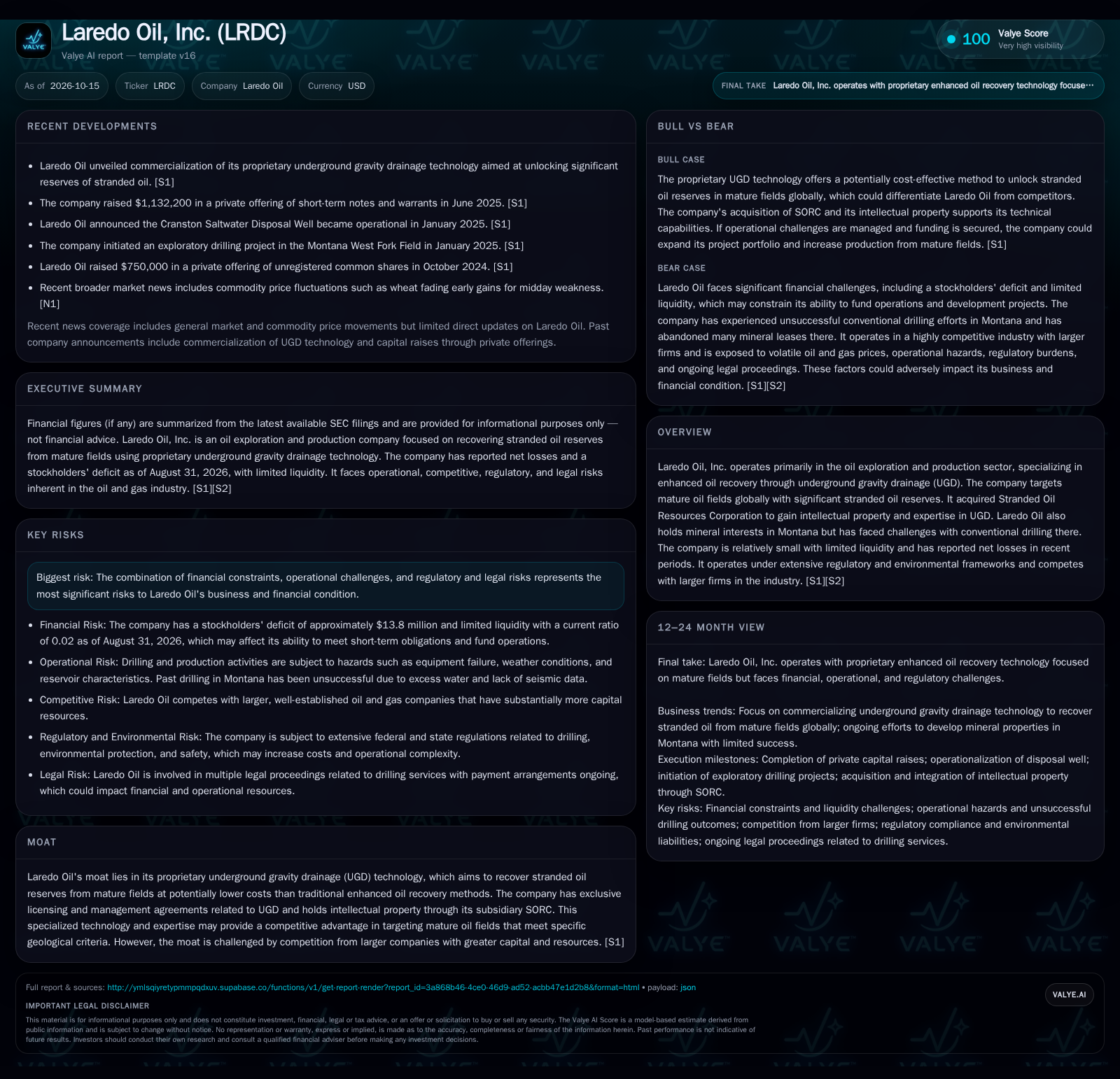
Laredo Oil is betting on proprietary underground gravity drainage (UGD) technology to recover oil from mature fields, but faces a severe stockholders’ deficit, reported liquidity position, and ongoing net losses. While the technical approach could offer a differentiated solution to stranded reserves, persistent financial strain, unsuccessful past drilling, and competition from much larger industry players create a precarious balance between potential breakthrough and existential risk. [S1] [S2]
Laredo Oil, Inc. stands at a crossroads defined by technological promise and acute financial vulnerability. The company’s proprietary underground gravity drainage (UGD) technology targets a global niche: extracting stranded oil from mature fields that traditional methods leave behind. However, with a mounting stockholders’ deficit, chronically low liquidity, and recent operational disappointments, Laredo faces a critical test. Its future now depends on bridging the gap between technical differentiation and the realities of capital, scale, and industry competition. [S1] [S2]
Financial Strain and Technology Focus Define Today’s Laredo Oil
Laredo Oil’s current operating reality is dominated by two facts: a proprietary enhanced oil recovery approach and a severe financial deficit. The company reported total assets of approximately $939,375 against total liabilities of $14.7 million as of August 31, 2026, resulting in a stockholders’ deficit of $13.8 million. [S2] Meanwhile, Laredo continues to pursue commercial opportunities for its underground gravity drainage (UGD) technology, which aims to recover stranded oil from mature fields globally. Despite this technical focus, unsuccessful conventional drilling in Montana and the abandonment of most mineral leases there highlight execution barriers. [S1]
The company operates with only seven full-time employees and faces ongoing legal proceedings related to drilling services. Its recent capital raises—$1.1 million in short-term notes and warrants in June 2025, and $750,000 in unregistered common shares in October 2024—underscore a reliance on external funding to sustain even minimal operations. [S1] [S2]
How Laredo’s Business Model Could Work—If the Pieces Align
Laredo Oil’s business model is predicated on unlocking value from mature oil fields that still contain substantial, but technically stranded, reserves. The company’s proprietary UGD technology is designed to reduce the cost and complexity of enhanced oil recovery (EOR) by using underground chambers and gravity-driven drainage, theoretically minimizing need for costly injection fluids or energy-intensive lift methods. If this approach can be proven at scale, it could enable Laredo to acquire underappreciated fields at low cost and extract incremental barrels with superior margins relative to traditional EOR.
However, the economics depend on several uncertain variables: the upfront capital required for UGD infrastructure, the recovery factor achieved versus expectation, ongoing operating costs, and the ability to secure field access and regulatory approval. The proprietary nature of UGD could, in principle, allow for licensing or joint venture models, but the company’s current focus appears to be on direct project development. Laredo’s small size and reported liquidity position mean it is highly sensitive to capital requirements and project delays; fixed costs may quickly outstrip available resources if projects stall or underperform. The company’s recurring net losses and need for repeated capital infusions suggest that positive free cash flow is not yet achievable under its current operating structure. [S2]
UGD’s Edge: Proprietary Technology Faces Industry Giants and Substitution Risks
Laredo Oil’s competitive proposition is its exclusive access to UGD intellectual property, acquired through Stranded Oil Resources Corporation (SORC). This could, in theory, allow it to target mature fields overlooked by larger players due to perceived technical or economic barriers. However, the moat provided by UGD is narrow and unproven at commercial scale. The oil and gas industry is crowded with established E&P firms—many with superior financial resources, access to advanced EOR techniques, and integrated operations capable of absorbing project risk that would overwhelm a small player like Laredo.
Technology substitution is a persistent risk. Advances in alternative EOR technologies, digital reservoir modeling, or even declining future demand for oil (due to energy transition dynamics) could erode the long-term relevance of UGD. At the same time, larger competitors may seek to license or replicate any demonstrated UGD success, reducing Laredo’s first-mover advantage. The company’s limited operational track record, especially after the setbacks in Montana, further weakens its competitive position relative to better-capitalized peers. [S1]
Breakthrough in UGD Deployment Could Unlock Transformative Value
The most favorable scenario for Laredo Oil is one in which it successfully demonstrates the commercial viability of UGD in a mature field, achieving recovery rates and cost efficiencies that attract industry attention and validate the technology. Such a breakthrough could open the door to larger project partnerships, licensing revenue, or even acquisition interest from major E&P players seeking to revitalize their own mature assets. This scenario would likely require a combination of successful well performance data, regulatory approval, and positive third-party technical validation.
Evidence that would confirm this scenario includes: public disclosure of a field-scale UGD deployment achieving targeted recovery rates and operating margins, announcement of a major partnership or licensing deal, or a significant reduction in the company’s reliance on dilutive financing as operations turn cash flow positive. Conversely, continued inability to move beyond pilot stages or lack of external validation would challenge the plausibility of this upside. [S1] [S2]
Stalled Progress: Capital Constraints and Operational Hurdles Persist
The most likely trajectory for Laredo Oil, given current facts, is a continuation of its struggle to fund and execute commercial UGD projects. Progress on new field projects is likely to be slow, with risk of further property abandonment if technical or regulatory hurdles persist.
Confirmation of this scenario would be ongoing net losses, additional dilutive capital raises, and limited disclosure of meaningful production or revenue growth. Any incremental operational milestones—such as a new pilot project or disposal well coming online—would be steps forward, but not sufficient to shift the fundamental capital and execution equation. A sudden improvement in oil prices could offer temporary relief, but would not resolve the structural funding gap unless paired with a proven project breakthrough. [S2]
Liquidity Exhaustion and Project Failures Threaten Corporate Survival
In the adverse scenario, Laredo Oil is unable to secure sufficient new capital to continue operations, leading to default on obligations, further property abandonment, and possible insolvency. This could be triggered by a failed attempt to commercialize UGD, continued legal or regulatory setbacks, or a sharp downturn in oil prices that reduces investor appetite for high-risk E&P ventures. Under this scenario, the company’s intellectual property may be sold at a distressed valuation, or operations could be wound down entirely.
Evidence for this scenario includes: missed debt payments, further reduction in field activity, absence of new capital raises, or legal actions escalating to asset seizures or bankruptcy filings. A declining share count due to delisting or restructuring would also signal severe distress. [S2]
Milestones That Will Determine If Laredo Oil’s Technology Can Become a Business
Field-level data on UGD project performance, including recovery rates, operating costs, and production volumes, if disclosed, would directly test the technology’s commercial viability.
Announcement of a significant partnership, licensing agreement, or third-party investment in UGD projects would demonstrate external validation and potential for scaling.
Trends in net operating cash flow and disclosure of positive free cash flow would indicate improving business sustainability beyond reliance on external financing.
Updates on the resolution of ongoing legal proceedings related to drilling services would clarify the company’s operational and financial risk profile.
Disclosure of new mineral lease acquisitions or successful regulatory approvals for UGD deployment would signal continued project pipeline development.
Changes in share count and terms of any new capital raises would reveal the company’s ability to attract funding and the associated dilution risk.
Evidence of cost reductions in UGD deployment or successful transition from pilot to commercial-scale projects would support the case for operational leverage.
Disclaimer: This is research-only, informational analysis and not investment advice. It may include AI-generated interpretation and general industry context. Always verify important details using primary sources.

Comments