
Cannabis Suisse Corp.: Extreme Operating Minimalism, Concentrated Control, and the Roadblocks to Commercial Viability
The company’s plans for IT and CBD product lines remain speculative amid a going concern opinion and operational dependence on its CEO.
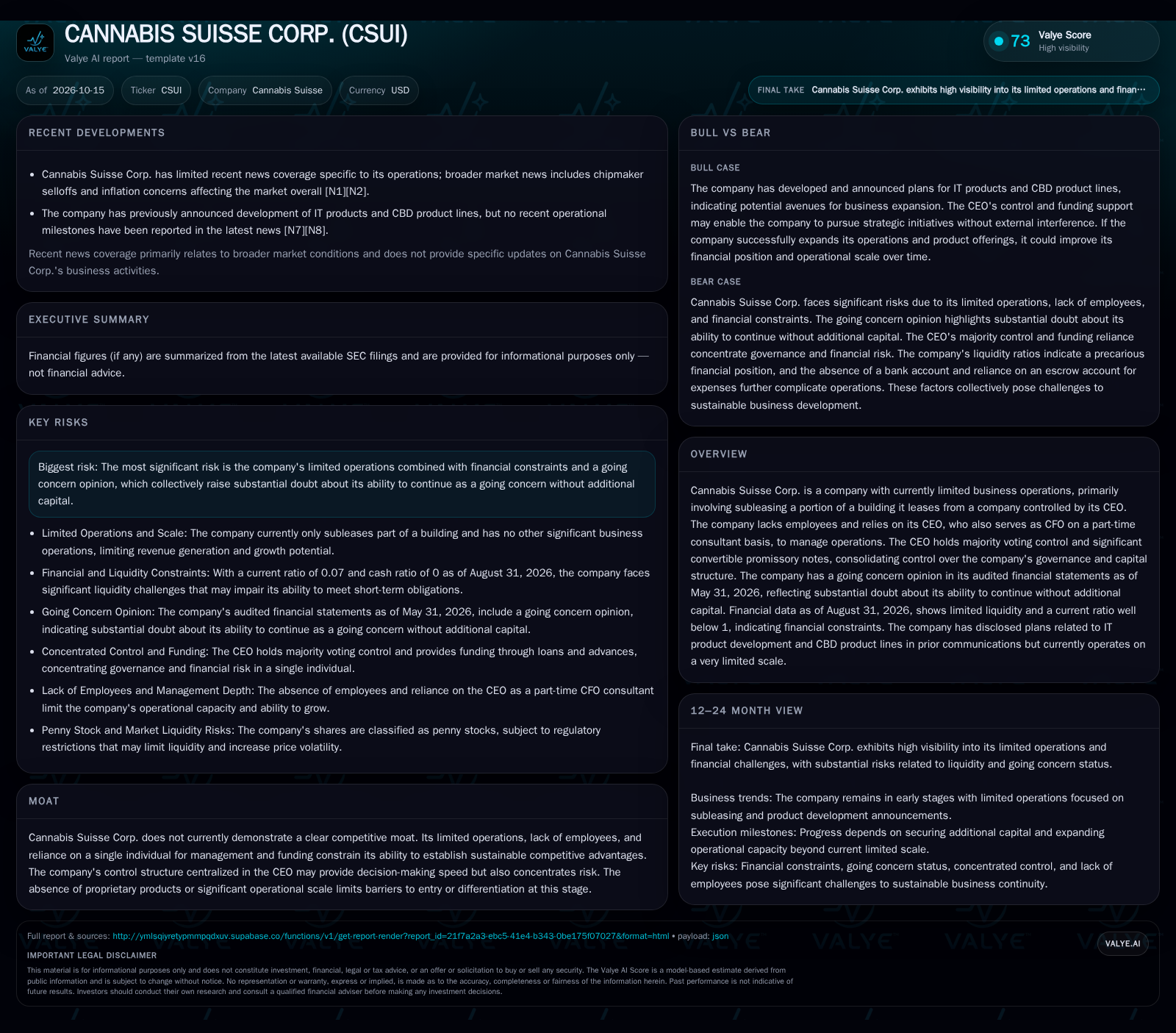
The CEO holds concentrated control and funds operations, but the company faces a going concern opinion and must secure capital to pursue its stated ambitions in IT and CBD products. The current structure and financial state suggest formidable hurdles to achieving sustainable business expansion or even continuity. [S2]
Cannabis Suisse Corp. exemplifies the existential challenges facing ultra-microcap public entities with little to no operational activity. Despite public announcements of ambitions in IT and CBD products, the company’s current reality is defined by minimal revenue, no employees, and a complete reliance on its CEO for funding, management, and governance. A going concern opinion underscores the urgency of securing capital, while the absence of a bank account and the use of an escrow for expenses highlight both operational fragility and the practical limitations of conducting business in this state. The company’s future hinges on its ability to raise funds, recruit operational capacity, and translate stated aspirations into actual market activity. [S2]
Present Realities: Subleasing, Severe Liquidity, and Singular Leadership
As of August 31, 2026, Cannabis Suisse Corp. reported $256 in cash, current assets of $41,301, and current liabilities of $576,438—resulting in a current ratio of 0.07 and a cash ratio of 0. The company’s only disclosed revenue was $21,000, with net income of $55,127, but the core business activity is limited to subleasing a portion of a building originally leased from a company controlled by its CEO. There are no employees; all operational, financial, and strategic tasks are managed by the CEO, who also holds the CFO title and is the company’s sole director. The CEO’s majority voting control is further consolidated by convertible promissory notes representing over 135 million potential shares. Recent audited financials carry a going concern opinion, highlighting substantial doubt about the company’s ability to continue as an ongoing business absent new capital. The company does not maintain a bank account, instead using an escrow account set up by the CEO to process expenses. [S2]
How (and If) Money Could Be Made: Structural Constraints and Theoretical Avenues
Cannabis Suisse Corp. currently lacks a functioning economic engine. Its main reported activity—subleasing space—suggests modest, potentially one-off or low-frequency revenue, with little margin or repeatability. Fixed costs are likely minimal, given there are no employees and the only direct outlay appears to be for the lease and basic corporate compliance. However, even these costs outstrip the company’s available cash and liquidity, as reflected in negative working capital and the lack of a bank account.
The company has announced plans for IT and CBD product lines, which—if realized—could introduce higher-margin products or recurring revenue streams. In practice, launching either would require upfront investment: product development, regulatory compliance, marketing, and working capital for inventory or IT infrastructure. With no internal staff or operational infrastructure, any expansion would likely require external funding and/or the use of third-party contractors, further eroding margins and increasing risk. Operating leverage in such a scenario could be high if fixed costs rise with scale, but given the current operational vacuum, the more urgent economic question is simply survival and the ability to fund even minimal expansion.
Potential Market Positioning: Barriers, Substitution, and the Challenge of Differentiation
At present, Cannabis Suisse lacks any concrete competitive positioning. In both the IT and CBD sectors, barriers to entry are low at the product-launch level but high at the scale, compliance, and brand-recognition levels. Both markets are characterized by intense competition from better-capitalized, established players, and in the case of CBD, additional layers of regulatory complexity and evolving consumer trust. Without proprietary intellectual property, unique distribution channels, or demonstrated execution in product development, the company would enter as an undifferentiated new entrant.
Relying on a single executive for all decisions and funding further undermines resilience and scalability. The CEO’s control may allow for fast pivots, but it also concentrates risk and limits access to broader networks and capital pools. In the absence of clear product launches, customer contracts, or channel partnerships, Cannabis Suisse’s competitive threats are not from direct rivals, but from the structural inability to compete at all.
What Successful Capital Raising and Execution Would Look Like
A favorable scenario for Cannabis Suisse would require the company to secure substantial new funding—potentially through equity, convertible debt, or strategic partnerships. With new capital, the company could hire operational staff, establish a banking relationship, and move from subleasing to actual product development and market entry in either IT or CBD lines. Early wins might include a minimum viable product launch, a pilot customer contract, or regulatory clearance for a CBD offering.
Confirmation of this scenario would come from public disclosures of capital raises, new hires, bank account establishment, formal product or service launches, and the signing of commercial contracts or pre-orders. Evidence of revenue growth tied to new business lines, rather than subleasing, would further validate the transition from a shell to an operating entity. The scenario would be falsified by continued absence of capital inflow, lack of operational hires, and ongoing dependence on the CEO’s personal resources.
Most Likely Trajectory: Prolonged Dormancy and Episodic Activity
Given the acute liquidity stress, lack of employees, and the CEO’s personal funding as the only operational lifeline, the most plausible scenario is that Cannabis Suisse remains in a state of commercial dormancy. The company may continue to generate nominal revenue from subleasing, occasionally announce product development intentions, but will likely struggle to convert these into operational milestones without a clear capital infusion.
This status quo could persist until either the CEO secures outside investment or decides to wind down operations. Evidence supporting this scenario would include ongoing minimal revenues, a lack of new hires or bank account establishment, continued going concern qualifications in filings, and further reliance on the CEO’s advances or convertible notes. A shift away from this pattern would require clear external funding and operational expansion.
If Liquidity Runs Out: Dissolution, Delisting, or Involuntary Restructuring
The adverse scenario is that Cannabis Suisse exhausts its remaining resources, with the CEO unable or unwilling to continue funding. In such a case, the company could face involuntary dissolution, regulatory penalties for failing to meet basic public-company compliance, or delisting for failure to maintain operations. With no employees and no bank account, even basic functions such as paying auditors, filing reports, or maintaining legal status could become untenable.
Confirmation of this scenario would include public filings indicating intent to liquidate, missed SEC filing deadlines, auditor resignations, or explicit notices of delisting or dissolution. The scenario would be less likely if the CEO continues to fund minimal operations or if a last-minute capital injection materializes, but the risk of operational collapse is elevated given the current facts.
Milestones That Would Signal a Shift in Cannabis Suisse’s Trajectory
Any public disclosure of a completed capital raise, whether through equity, debt, or partnership, would fundamentally alter the company’s near-term viability.
Announcement of hiring employees beyond the CEO, especially in operational or product development roles, would indicate an intention to build actual business capacity.
Establishment of a corporate bank account and transition away from reliance on escrow arrangements would reflect improved operational infrastructure.
Launch of a concrete IT or CBD product, along with details on commercial terms, distribution channels, or customer contracts, would serve as a proof point for business expansion.
Material increase in revenue not attributable to subleasing would suggest progress toward a functioning operating business.
Changes to the CEO’s control—such as the addition of independent directors or dilution of convertible notes—would affect governance risk and strategic flexibility.
Removal of the going concern qualification from audited financials would indicate improved financial health and a sustainable capital position.
Any SEC filings or public notices regarding delisting, involuntary dissolution, or auditor resignation would signal acute distress or terminal decline.
Disclaimer: This is research-only, informational analysis and not investment advice. It may include AI-generated interpretation and general industry context. Always verify important details using primary sources.

Comments