
Londax Corp.: Strategic Reinvention Collides with Severe Liquidity and Execution Hurdles
Londax Corp.’s pivot from niche software development to AI-driven digital infrastructure signals ambition but is constrained by acute financial distress, a lack of operating scale, and formidable industry competition. The company’s future hinges on its ability to secure capital and execute a credible transformation in a capital-intensive, winner-take-most sector.
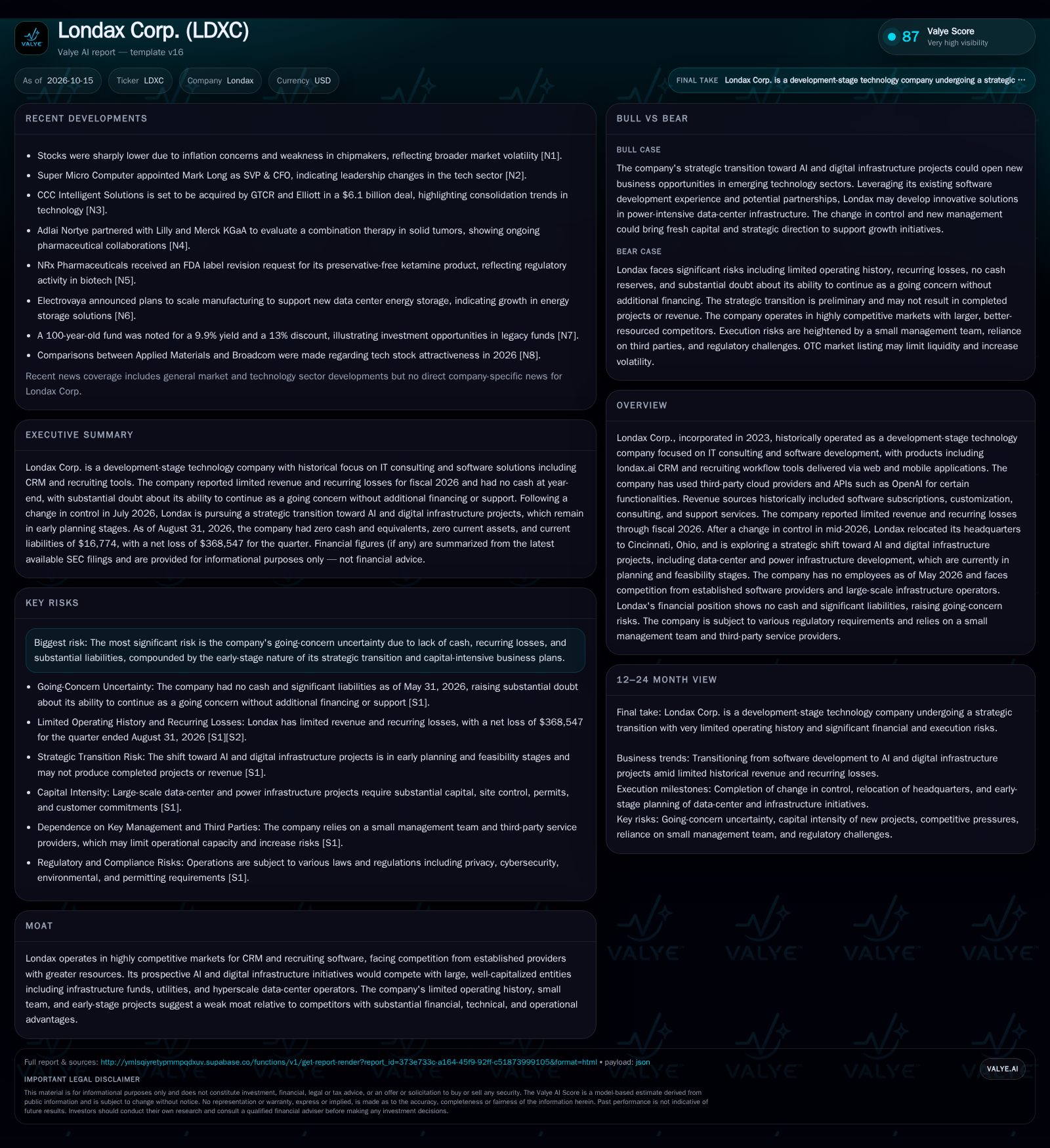
Londax Corp. is attempting a high-stakes transition from small-scale software tools and IT consulting to the power- and capital-intensive world of AI and data-center infrastructure. This shift follows a change in control but comes amid zero cash, recurring losses, and no operating employees. With no visible revenue base and an unproven ability to deliver large infrastructure projects, Londax’s survival depends on raising capital and demonstrating real execution capability in one of the most competitive technology markets. [S1] [S2]
Londax Corp. stands at a precarious inflection point: after years of modest software development and consulting activity, the company is attempting to reinvent itself as a player in the AI and digital infrastructure arena. Yet this strategic leap is unfolding against a backdrop of zero cash, significant liabilities, and no current revenue base. With its only recent activity being a change in control and a sweeping strategic reset, Londax faces a steep climb to establish credibility, secure funding, and break into a fiercely competitive, capital-intensive market. The company’s future will be determined less by its legacy software assets and more by its ability to marshal resources and execute on ambitious infrastructure plans.
Acute Liquidity Strain and Strategic Overhaul Define Londax’s Status Quo
The company reported cash and liquidity metrics for the period; these figures do not by themselves establish operating runway, investment capacity, financial flexibility, or financing capacity. The company generated no revenue for the quarter and posted a net loss of $368,547, deepening an accumulated deficit of $40,622. These conditions triggered a formal going-concern qualification from auditors, highlighting the risk of insolvency absent immediate financing or related-party support. [S2]
Following a July 2026 change in control, new management has initiated a strategic pivot away from its legacy CRM and recruiting software tools toward prospective AI and digital infrastructure projects. However, these initiatives remain in early-stage planning and have yet to yield any revenue or demonstrable operational progress. [S1]
Operational capacity is limited: as of the last fiscal year-end, Londax had no employees, relying instead on a small management team and third-party service providers. The corporate headquarters was relocated to Cincinnati, Ohio, as part of the strategic transition. [S1]
From Low-Scale SaaS to Capital-Intensive Infrastructure: Economic Model Tensions
Historically, Londax’s business economics reflected those of a micro-scale SaaS provider: modest, lumpy revenues from software subscriptions, customization, consulting, and support, with a reliance on third-party APIs and cloud infrastructure. Such models typically feature low marginal costs but require scale to cover fixed development and support expenses. Londax’s inability to reach meaningful revenue or customer traction resulted in recurring losses, even before its pivot. [S1]
The planned move into AI and digital infrastructure—encompassing data centers and power-intensive assets—would radically alter the company’s economic profile. This sector is defined by high upfront capital expenditures, long permitting and construction cycles, and the need for anchor customer contracts to underwrite financing. Ongoing operating costs are dominated by power, cooling, and maintenance, but fixed costs (real estate, hardware, development) are substantial. Achieving positive returns typically requires high utilization rates and economies of scale.
Londax’s absence of cash, working capital, and operating personnel raises the question of how it will bridge the gap from feasibility studies to shovel-ready projects. Without anchor customers or access to meaningful financing, the company could struggle to even initiate development, let alone realize operating leverage or asset returns.
Facing Entrenched Giants: Competitive Landscape and Barriers to Entry
Londax’s legacy software offerings competed in a crowded field of CRM and workforce management solutions, dominated by large, established vendors as well as agile, well-funded startups. The company’s limited product differentiation and lack of scale offered little insulation from intense price and feature competition. [S1]
The contemplated move into AI and digital infrastructure pits Londax against a different—arguably more formidable—set of competitors: hyperscale cloud providers, infrastructure funds, utilities, and technology conglomerates. These incumbents benefit from vast balance sheets, established customer relationships, global procurement power, and expertise in navigating complex regulatory and permitting processes.
Switching costs for customers in both the SaaS and infrastructure domains tend to favor larger, integrated providers who can guarantee uptime, security, and capacity. Unless Londax can articulate a distinctive value proposition—such as highly specialized colocation, unique regulatory positioning, or differentiated power sourcing—it is likely to face a steep uphill battle in winning contracts or site control.
How a Turnaround Could Take Shape: Securing Capital and Carving a Niche
The most favorable scenario for Londax involves successfully raising fresh capital—likely through private placements, strategic partnerships, or related-party infusions—enabling the company to staff up, secure project sites, and begin development on a pilot data-center or AI-infrastructure initiative. Leveraging its software background, Londax could focus on niche, underserved segments (such as regional AI compute for regulated industries) or pursue joint ventures with local utilities or technology partners.
Early customer commitments or letters of intent from anchor tenants would be essential, as would demonstrable progress on permitting and site control. If Londax can establish even a modest operational proof point and demonstrate credible project management, it could attract further financing and begin to scale. Confirmation of this scenario would include announcements of financing, project site acquisitions, or signed customer contracts.
Probable Outcome: Extended Feasibility Phase and Ongoing Financial Stress
Absent an immediate capital infusion or breakthrough partnership, Londax is likely to remain in the planning and feasibility stage for its proposed infrastructure projects. The company may continue to incur operating losses as it explores options, but with no cash and no revenue, its ability to pay creditors and cover basic expenses will depend on ongoing related-party loans or management support. [S1] [S2]
The most plausible scenario is a protracted search for funding, punctuated by incremental, low-cost steps toward project development but with no near-term revenue or operational scale. Additional SEC filings may disclose restructuring, dilutive financings, or asset sales as the company seeks to avoid insolvency. Evidence confirming this scenario would include further going-concern warnings, limited or no new project milestones, and continued reliance on related-party or short-term financing.
Failure to Secure Funding: Insolvency and Potential Delisting Risks
If Londax cannot obtain new financing or related-party support, it faces the acute risk of running out of options to pay creditors, cover regulatory filings, or support even minimal operations. This could trigger creditor actions, forced asset sales, or a bankruptcy filing. Given its OTC market status, prolonged non-compliance or lack of activity could also result in delisting or a regulatory trading halt.
The downside is further exacerbated by the company’s lack of employees, reliance on outside service providers, and absence of any recurring revenue base. Confirmation of this scenario would include bankruptcy filings, announcements of asset liquidation, or notifications of OTC delisting.
Milestones That Could Validate or Refute Londax’s Reinvention Thesis
Any disclosed capital raise or financing facility—private placement, strategic investment, or related-party loan—that materially extends the company’s operational runway.
Announcements of project site acquisitions, land options, or binding agreements with utilities or local governments for digital infrastructure development.
Disclosed anchor customer contracts, letters of intent, or memoranda of understanding that provide future revenue visibility, if disclosed.
Addition of experienced infrastructure or data-center executives to the management team or board, signaling increased execution capacity.
Regulatory or permitting progress on proposed infrastructure projects, such as zoning approvals, environmental assessments, or utility interconnection agreements.
Any evidence of a shift in recurring revenue (e.g., SaaS, maintenance, or infrastructure services), which would indicate traction beyond feasibility.
SEC filings disclosing restructuring, asset sales, or changes in control that alter the company’s strategic direction or capital structure.
A useful metric would be disclosure of project pipeline size, estimated capex, or targeted customer segments for the planned infrastructure business.
Disclaimer: This is research-only, informational analysis and not investment advice. It may include AI-generated interpretation and general industry context. Always verify important details using primary sources.

Comments