
Cosan S.A.: Diversification, Liquidity, and the Challenge of Converting Scale into Profitable Growth
Cosan’s vast portfolio across Brazilian energy, agriculture, and logistics delivers scale and optionality, but persistent net losses and the voluntary NYSE delisting underscore the company’s struggle to transform revenue into durable profits while maintaining global investor appeal.
Future upside depends on operational efficiency, margin stabilization, and strategic capital deployment that translates scale into earnings resilience.[S1] [S2]
Cosan S.A. stands as one of Brazil’s most diversified conglomerates, spanning sugar, ethanol, fuel distribution, logistics, and agricultural inputs. Yet, despite generating nearly BRL 44 billion in annual revenue and maintaining a reported cash position, Cosan closed 2024 with a substantial net loss and has since withdrawn its American Depositary Shares from the NYSE. This combination of operational breadth, high disclosure standards, and recent market retrenchment spotlights a central tension: can Cosan turn scale and balance-sheet strength into durable, profitable growth, or will structural sector risks and complexity continue to erode returns and investor confidence?
Recent Losses and NYSE Exit Reshape Cosan’s Investment Narrative
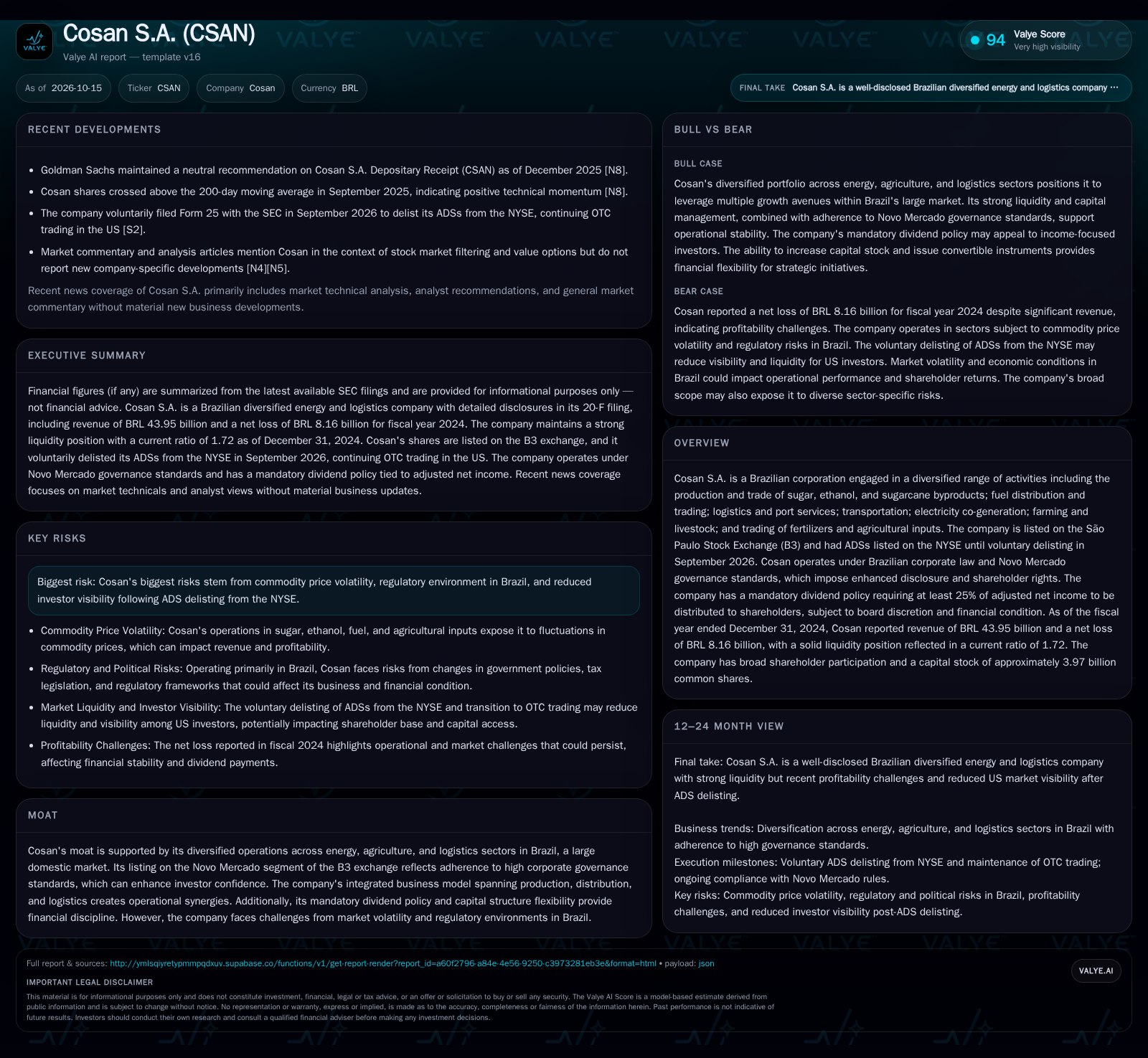
Cosan reported BRL 43.95 billion in revenue for 2024 but posted a significant net loss of BRL 8.16 billion, highlighting ongoing profitability challenges despite its multi-segment scale. The company reported cash and liquidity metrics for the period; these figures do not by themselves establish operating runway, investment capacity, financial flexibility, or financing capacity. [S1] [S1] In September 2026, Cosan voluntarily delisted its ADSs from the NYSE, shifting US trading to the OTC market—an action that reduces visibility and may limit access to global capital pools and institutional investors.[S2] These developments collectively mark a pivotal period, forcing a reassessment of Cosan’s ability to sustain growth, margins, and international investor relations.
How Cosan’s Diversified Model Drives Both Scale and Complexity
Cosan’s business model spans upstream (sugarcane production, farming, ethanol manufacturing) and downstream (fuel distribution, logistics, port services, electricity co-generation, fertilizer trading) activities. This breadth theoretically allows the company to capture value at multiple points along Brazil’s vast agribusiness and energy value chains, offering some natural hedges: for example, sugar price declines may be offset by ethanol demand or logistics revenue. However, each segment is highly exposed to commodity cycles, regulatory shifts, and operational volatility, which can dilute overall margin resilience.
Fixed costs are substantial, particularly in logistics infrastructure, port operations, and energy assets, creating the potential for operating leverage if volumes rise or if Cosan can improve utilization rates. However, variable costs—especially feedstock and fuel inputs—are subject to local and global price swings, making consistent margin expansion difficult without tight cost controls and disciplined capital allocation.
The cited source reports dividend-related activity; that disclosure alone does not establish dividend-policy continuity, management confidence, or a material constraint on capital flexibility. Cosan’s capital structure, with board authority to issue up to 8 billion new shares and convertible instruments, provides theoretical funding flexibility for acquisitions or deleveraging—yet also raises dilution risk if profitability cannot be restored.
The interplay between Cosan’s upstream and downstream operations introduces both strategic flexibility and operational challenges. For instance, upstream production variability—due to weather or agronomic factors—can disrupt downstream supply chains, requiring sophisticated inventory and risk management systems to maintain service levels and cost efficiency. Moreover, the capital intensity of infrastructure assets, such as port terminals and fuel distribution networks, demands a long-term investment horizon and exposes the company to cyclical demand fluctuations. Additionally, regulatory uncertainty in environmental and energy policies can impose compliance costs or constrain operational flexibility, further complicating margin management in a multi-segment portfolio.
Integrated Operations Provide Synergies, but Sector Volatility and Regulatory Risks Remain
Cosan’s integrated footprint across energy, logistics, and agriculture creates synergy opportunities—such as captive logistics for sugar and ethanol, or cross-selling between fuel distribution and agricultural input trading. This integration can offer cost advantages relative to more narrowly focused local competitors and may improve supply chain reliability in Brazil’s often fragmented infrastructure environment.
That said, Cosan’s markets are intensely competitive and highly regulated. In fuel distribution, large multinationals and local players compete aggressively, often leading to thin margins and frequent price wars. Agricultural trading is exposed to global competition, weather extremes, and shifting regulatory regimes, while logistics and port services face both domestic rivals and state-owned entities.
A key differentiator is Cosan’s adherence to Novo Mercado governance standards, which can enhance investor confidence and potentially lower cost of capital compared to less transparent local peers. However, the voluntary NYSE delisting could erode this advantage by reducing international visibility and analyst coverage, especially as global investors seek liquid, transparent Brazilian vehicles.
Cosan’s integrated model offers potential for cross-segment cost synergies and revenue optimization, but realizing these benefits depends on effective coordination and technology adoption across divisions. For example, leveraging data analytics to optimize logistics routes or fuel distribution schedules can reduce operating expenses and improve asset utilization. However, integration also raises complexity in performance measurement and accountability, as underperformance in one segment may obscure overall profitability trends. Furthermore, regulatory frameworks across sectors differ significantly, requiring adaptive compliance capabilities and stakeholder engagement strategies. The company’s governance standards may mitigate some investor concerns, but the loss of NYSE listing could reduce analyst coverage and transparency benchmarks, potentially increasing the cost of capital and limiting access to sophisticated institutional investors who prioritize governance and disclosure quality.
Margin Recovery and Capital Deployment Could Unlock Hidden Earnings Power
If Cosan can leverage its scale to drive margin improvement—through operational efficiencies, better cost discipline, or strategic divestitures of underperforming segments—the company could turn revenue scale into earnings resilience. A sustained period of favorable commodity prices, coupled with improved logistics throughput, would allow fixed costs to be absorbed over higher volumes, boosting operating leverage. Reinvestment of surplus cash into high-return projects (such as logistics upgrades or value-added agricultural processing) could further enhance returns.
Evidence confirming this scenario would include a return to sustained net profitability, sequential margin improvement, and clear disclosures of cost savings or asset optimization. Additional confirmation would come from increased dividend payments (above the minimum), share repurchases, or selective strategic acquisitions that are demonstrably accretive. A reversal of the NYSE delisting or renewed international capital markets engagement would further signal restored confidence.
Sector Headwinds and Complexity Keep Returns Volatile Despite Scale
The most plausible trajectory is that Cosan continues to generate large revenues but struggles to deliver consistent net profits, given exposure to commodity cycles, regulatory interventions, and the operational complexity of managing diverse segments.
The business would remain resilient but not transformative, with value tied to cyclical swings rather than structural improvements.
Persistent Losses and Reduced Market Access Undermine Long-Term Value
The bear case is that Cosan’s operational complexity and sector volatility continue to overwhelm its ability to generate profits, with recurring losses eroding equity value and limiting reinvestment in core assets. Commodity downturns, unfavorable regulatory changes, or execution missteps could lead to further write-downs, asset sales at unattractive prices, or even covenant breaches if debt rises. Reduced US market presence following the NYSE delisting could constrain access to low-cost funding and limit the shareholder base to more domestic or less liquid pools.
This scenario would be confirmed by repeated net losses, declining cash balances, rising leverage, and forced asset sales or equity issuances at depressed valuations. A shrinking or less engaged shareholder base, combined with a persistent discount to book value and negative analyst sentiment, would further support the downside thesis.
Milestones That Will Shape Cosan’s Ability to Convert Scale into Durable Value
Sustained net profitability and margin expansion across core segments—particularly in energy and logistics—would help validate a thesis of operational turnaround.
Segment-level disclosures on asset utilization, cost per ton/kilometer, or return on invested capital (if disclosed) would clarify whether scale advantages are translating into better economics.
Changes in capital structure—such as significant share issuances, convertible debt offerings, or asset sales—would reveal management’s approach to funding and risk.
Evidence of renewed international investor engagement, such as increased OTC trading volume, new ADR initiatives, or re-listing efforts, would test Cosan’s global capital market relevance.
Commodity price sensitivity analysis and hedging disclosures (if provided) would show how effectively Cosan is managing core input risk.
Any major regulatory or policy changes in Brazil impacting fuel, agriculture, or logistics sectors must be tracked for their direct earnings impact.
Disclaimer: This is research-only, informational analysis and not investment advice. It may include AI-generated interpretation and general industry context. Always verify important details using primary sources.

Comments