
Winmark Corp: Franchise Fee Initiatives, System Economics, and the Franchisee Tension Line
The company’s future hinges on its ability to convert these initiatives into higher network value without eroding franchisee economics or system growth.
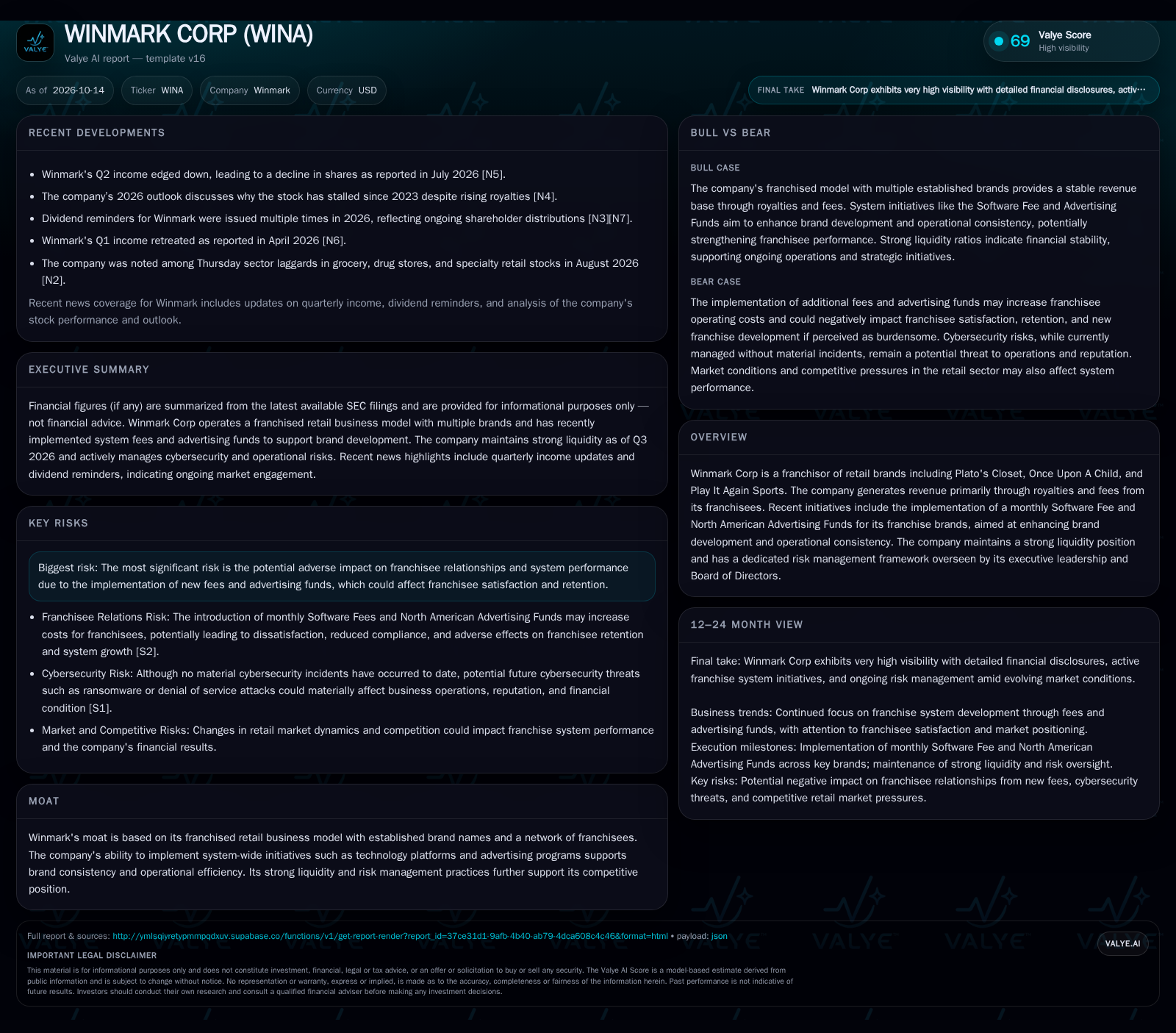
Winmark Corp’s Q3 2026 financials show strong profitability and liquidity, underpinned by a franchise model spanning multiple brands. Recently implemented monthly Software Fees and North American Advertising Funds are designed to reinforce brand consistency and operational discipline, but they also risk raising franchisee costs and straining relationships. The core question is whether these investments in system infrastructure will drive superior long-term network economics or trigger franchisee attrition and stall unit expansion. Vigilance around franchisee sentiment and unit-level economics will be critical to testing the thesis.[S2]
Winmark Corp stands at a crossroads where its system-wide initiatives—specifically new monthly Software Fees and North American Advertising Funds—are intended to strengthen its franchise brands and cement operational consistency. However, these measures also increase the cost burden for franchisees, sharpening the risk that operational improvements come at the expense of franchise network growth or satisfaction.
Recent Fee Initiatives and Financial Health: What’s New for Winmark
Winmark reported Q3 2026 revenue of $27.89 million and net income of $11.82 million, with basic and diluted EPS of $3.29 and $3.21, respectively. The company reported a current ratio of 3.2 for the period. [S2]
The most strategically significant development is the implementation of a monthly Software Fee and North American Advertising Funds across its franchise brands, including Plato's Closet, Once Upon A Child, and Play It Again Sports. These new charges are designed to support brand development and operational consistency, but they also increase the fixed cost base for franchisees, potentially impacting franchisee satisfaction, retention, and system growth.[S2]
Recent news coverage has highlighted both income volatility and a stock price that has stalled since 2023, despite rising royalties—a sign that investors are weighing whether new system initiatives will translate into sustainable network growth or introduce new risks.[N4] [N5] [N6]
Franchise Model Cash Flows and the Fee-Driven Economics
Winmark’s business model centers on collecting royalties and fees from a network of franchisees operating under well-known brands. In this model, the company’s revenue is largely recurring, with royalties typically structured as a percentage of franchisee sales, while system fees (such as the new Software Fee) and advertising funds represent additional, usually fixed, charges.
The introduction of monthly Software Fees and North American Advertising Funds could increase the company’s predictable, high-margin revenue streams, as these are often collected regardless of individual store performance. However, the key economic trade-off is that higher system fees may compress unit-level franchisee margins, especially for lower-volume locations, potentially making franchise ownership less attractive and increasing the risk of non-renewal or store closures.
Winmark’s capital needs are modest relative to asset-heavy retailers, as franchisees bear the brunt of store-level investment, working capital, and operational risk. This asset-light model underpins the company’s high operating leverage: incremental revenue from new or more productive stores typically flows through to the bottom line with minimal additional corporate overhead.
A secondary economic consideration is that pooled advertising funds and IT investments, if well-executed, can create positive network effects by driving customer traffic and operational efficiency—potentially lifting system sales and offsetting franchisee cost concerns over time.
Brand Strength and Franchise System Resilience in a Crowded Retail Landscape
Winmark’s primary competitive advantage lies in its portfolio of established, value-focused retail brands and a mature franchise system. The company’s scale allows for system-wide initiatives—such as technology upgrades and coordinated marketing—that smaller franchisors or independent operators may struggle to match.
However, the competitive landscape for resale and value retail is crowded, with both national chains and local independents targeting similar customer segments. Substitutes include online resale platforms, direct-to-consumer e-commerce, and other franchised or company-owned brick-and-mortar concepts. These alternatives can threaten both customer traffic and the perceived value of Winmark’s franchise proposition.
The introduction of additional system fees, while potentially enhancing brand consistency, also creates a wedge between Winmark and its franchisees. If franchisee margins are squeezed, the company risks losing its most capable operators to competing concepts or seeing a slowdown in new unit development. Winmark’s moat, therefore, is not purely about brand or scale, but about the health of its franchisee relationships and its ability to deliver sufficient value to justify ongoing fees.
If System Investments Drive Franchisee Success and Network Expansion
The bullish scenario is that Winmark’s new Software Fee and Advertising Funds catalyze a virtuous cycle: franchisees benefit from better technology, more effective marketing, and increased brand cohesion, leading to higher same-store sales and stronger unit economics. As franchisees see tangible returns on these investments, satisfaction and retention improve, encouraging existing franchisees to open additional locations and attracting new operators to the system.
Evidence that would confirm this scenario includes rising system-wide sales, increased franchisee renewal rates, new unit openings outpacing closures, and positive feedback from franchisees regarding the value of corporate initiatives. An uptick in multi-unit franchise ownership and higher royalty revenues without a commensurate rise in system-wide franchisee complaints would also support this case.
Conversely, if franchisee-level profitability and sentiment data (if disclosed) remain stable or improve after fee implementation, it would suggest that Winmark has struck the right balance between value creation and cost.
Fee Implementation Stabilizes, but Franchisee Sensitivity Caps System Growth
The most likely near-term outcome is that Winmark’s system-wide fees and advertising funds are absorbed by its franchisee base, but not without some friction. Franchisees may accept the higher costs as the price of ongoing brand support and technology upgrades, but unit-level economics could become more pressured, especially for marginal stores or in softer retail markets.
Under this scenario, core financial metrics—such as royalties and total system sales—remain steady or grow modestly, but the pace of new unit openings slows, and franchisee turnover edges up. Winmark’s revenue and profit growth decelerate as the system matures and incremental fee income is partially offset by higher franchisee support costs or selective fee concessions to retain key operators.
Confirmation would come from relatively flat net unit growth, stable royalty revenue, and news flow that continues to highlight both the benefits and challenges of the new system initiatives. Early signs of increased franchisee complaints or a rise in store closures would suggest the system is absorbing, but not thriving on, the new fee structure.
Franchisee Pushback and Attrition Trigger a Negative Feedback Loop
The risk case is that the additional monthly Software Fees and Advertising Funds prove too onerous for franchisees, especially in a competitive or sluggish retail environment. Franchisee margins erode, leading to increased dissatisfaction, non-renewals, and store closures. Negative sentiment could spread quickly through the network, stalling new unit development and even prompting legal or reputational challenges.
In this scenario, Winmark’s royalty revenue plateaus or declines, and the company is forced to offer concessions or roll back certain fees to stem attrition. Brand value may be impaired if underperforming stores close or if franchisee disputes become public. The asset-light, high-margin model becomes less robust as the company spends more to support a shrinking or restive franchisee base.
Evidence supporting this outcome would include a noticeable uptick in net store closures, declining royalty revenue, or news of franchisee litigation or organized pushback. Negative franchisee satisfaction surveys (if disclosed) or public commentary about fee burdens would also be strong confirmatory signals.
Franchisee Economics, Fee Impact, and Network Vitality: What Will Test the Winmark Thesis
System-wide net unit growth (openings minus closures) will indicate whether franchisees view the new fee structure as sustainable and attractive.
Franchisee renewal rates and average duration of franchise agreements (if disclosed) would provide insight into operator satisfaction and long-term system health.
Changes in royalty revenue and system-wide sales growth will help determine whether system initiatives are driving tangible economic benefits.
Franchisee-level profitability and sentiment metrics (if disclosed) would be key to assessing whether fee increases are offset by higher store-level returns.
The frequency and tone of franchisee complaints or requests for fee concessions, as mentioned in news flow or management commentary, could flag emerging tensions.
Incidence of store closures relative to historical averages would test whether the new cost structure is pushing marginal operators out of the system.
Any material cybersecurity incidents or disruptions, given the company’s increased reliance on technology platforms, would test risk management claims.[S1]
The pace and scale of new franchisee recruitment, especially among multi-unit operators, would help gauge the attractiveness of Winmark’s value proposition post-fee implementation.
Disclaimer: This is research-only, informational analysis and not investment advice. It may include AI-generated interpretation and general industry context. Always verify important details using primary sources.

Comments