
Jingbo Technology, Inc.: VIE Structure, Liquidity Strains, and Regulatory Headwinds in the China Tech Ecosystem
The company’s future hinges on navigating evolving regulatory risks, operational losses, and the fragility of its VIE-based model.
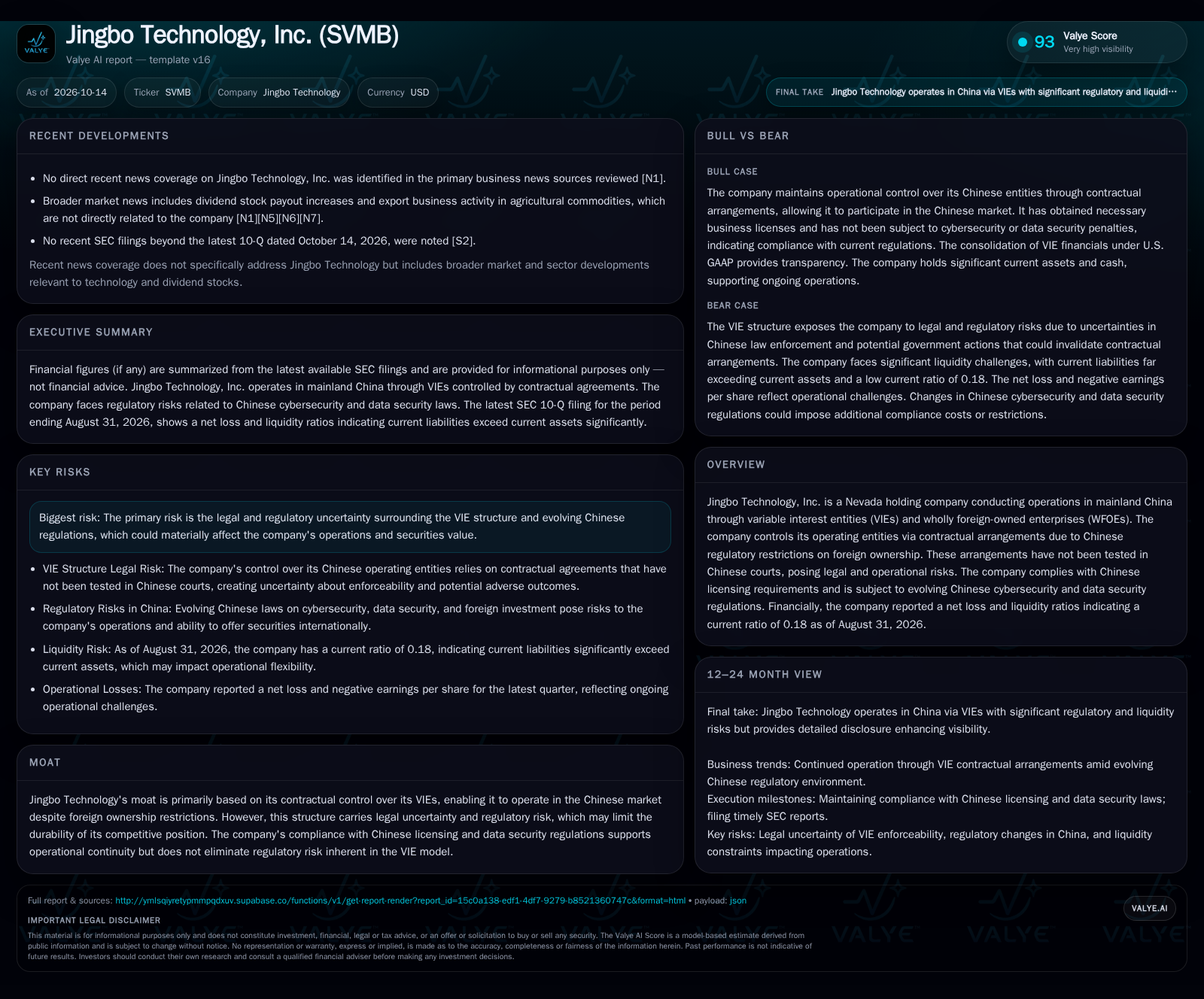
Jingbo Technology, Inc. operates in China through VIEs, exposing it to legal uncertainty and regulatory risk. The company is compliant with Chinese licensing and data regulations but faces operational losses and significant near-term liabilities, making its sustainability highly dependent on external factors and regulatory stability. [S2]
Jingbo Technology, Inc. exemplifies the promise and perils of foreign participation in China’s technology sector through variable interest entity (VIE) structures. For investors and stakeholders, Jingbo’s near-term trajectory is less about growth and more about survival amid regulatory, financial, and structural uncertainty. [S2]
Liquidity Crunch and Legal Uncertainty Define the Present
Jingbo Technology, Inc. is a Nevada holding company operating through VIEs and WFOEs in China, with contractual—not equity—control over its operating entities. As of August 31, 2026, the company reported $47.85 million in cash and cash equivalents against $2.23 billion in current assets and $12.59 billion in current liabilities, yielding a current ratio of 0.18 and a cash ratio of zero. These figures indicate severe short-term liquidity stress and suggest a risk of payment default absent external intervention or rapid improvement in operational cash flows. The company also posted a net loss of $507,431, with negative basic and diluted earnings per share for the period. The legal enforceability of Jingbo’s VIE agreements remains untested in Chinese courts, compounding operational and financial risks with a layer of regulatory uncertainty. [S2]
How the VIE Model Shapes Jingbo’s Financial Dynamics
Jingbo Technology’s economic engine is predicated on extracting cash flows from its Chinese operating entities via contractual arrangements. The VIE structure allows foreign-listed entities to participate in restricted sectors, but does not grant equity ownership—only contractual rights to financial benefits and control. This inherently limits capital flexibility and may hinder access to intercompany cash flows, especially under regulatory scrutiny or in the event of contractual disputes.
The company’s reported negative earnings and acute liquidity constraints suggest that its cost base, whether fixed or variable, currently overwhelms revenue generation. Without more granular disclosure, it is unclear whether this is due to margin compression, high operating expenses, or a lack of scale.
In the VIE context, capital infusions from the parent are often complicated by Chinese currency controls and regulatory approval requirements. This can impede the ability to shore up local operations or refinance maturing obligations, especially when the parent entity itself is liquidity-constrained. The economic model thus faces a double bind: operational leverage is difficult to achieve if scale is elusive, and financial leverage becomes perilous in the absence of robust cash flows.
Contractual Access vs. Durability in China’s Tech Arena
Jingbo’s competitive position is defined less by product or technology moats and more by its ability to maintain access to the Chinese market through VIE structures. This model is widely used by foreign-backed Chinese tech firms but is inherently fragile—subject to regulatory reinterpretation, legal challenge, or political shifts. While Jingbo holds the requisite licenses and is not currently under cybersecurity review, the sector is characterized by fast-moving regulatory developments that could upend the status quo.
Peer companies leveraging VIEs face similar structural vulnerabilities, but scale and brand recognition can create some resilience. In Jingbo’s case, the absence of evidence for either dominant market share or proprietary technology suggests limited pricing power or customer stickiness. Substitutes include fully domestic competitors not subject to foreign ownership restrictions, as well as international players able to navigate regulatory hurdles more effectively.
Switching costs for customers may be low if Jingbo’s offerings are commoditized or easily replaced. The company’s future ability to compete may thus hinge more on regulatory navigation and operational funding than on sustainable differentiation.
What Would It Take for Jingbo to Regain Financial and Regulatory Footing?
A positive inflection for Jingbo would likely require a multi-pronged improvement: (1) successful renegotiation or extension of near-term liabilities, (2) a demonstrable turnaround in operational cash flows, and (3) continued regulatory forbearance or even relaxation regarding VIE structures and foreign participation. New capital—whether via debt, equity, or strategic investment—would need to be secured, ideally from sources not deterred by the legal ambiguity of the VIE model.
Confirmation of this scenario would include sequential improvement in the company’s current ratio (approaching or exceeding 1.0), positive operating cash flow, and evidence of new business wins or expansion in market share. Regulatory signals—such as an explicit affirmation of the VIE model’s permissibility or the company’s inclusion in pilot programs for foreign investment—would also support the case.
Falsification would come in the form of continued deterioration in liquidity metrics, material adverse regulatory announcements, or inability to refinance or roll over obligations as they come due.
A Stalemate of Survival: Operational Strain and Regulatory Ambiguity
The most plausible near-term outcome is continued operational strain: Jingbo remains in business but struggles to meet obligations, with persistent net losses and little improvement in liquidity. The VIE structure remains intact, but the legal risks are neither resolved nor crystallized. The company maintains compliance with licensing and data security requirements but faces ongoing uncertainty about the regulatory environment.
Confirmation would come via continued—but not catastrophic—declines in liquidity ratios, repeated net losses in subsequent filings, and no major regulatory or legal interventions. The absence of new capital-raising or strategic investment, coupled with lackluster business development, would reinforce this base case.
A deviation from this scenario would be triggered by either a sudden regulatory crackdown (forcing VIE unwinding or restructuring) or successful recapitalization that materially improves the balance sheet and operational prospects.
A Cascade of Legal, Regulatory, and Liquidity Failures
The bear case for Jingbo involves a convergence of liquidity exhaustion and adverse regulatory action. In this scenario, the company is unable to refinance its liabilities or secure new funding, leading to payment defaults, creditor actions, or forced asset sales. Simultaneously, Chinese authorities could enforce new rules that either invalidate or severely constrain VIE structures, rendering Jingbo’s contractual control unenforceable.
This dual shock would likely precipitate rapid operational contraction, delisting, or even bankruptcy proceedings. Investors could face impaired recoveries due to the subordination of contractual claims in Chinese courts and the structural separation of onshore assets.
Evidence for this scenario would include regulatory pronouncements targeting VIEs, disclosure of payment defaults or legal actions by creditors, and a rapid drop in reported cash or asset balances. The absence of timely SEC filings or going-concern warnings would further corroborate this outcome.
Milestones That Could Shift Jingbo’s Survival Odds
Disclosure of positive or negative operating cash flow (if provided) would clarify whether the business is self-funding or reliant on external capital.
Announcements of new equity or debt financings, strategic investments, or asset sales would indicate Jingbo’s ability to access external funding and manage its liquidity crunch.
Updates on the status, renewal, or enforceability of VIE agreements—especially in light of regulatory or legal developments—would help test the durability of the business model.
Regulatory communications or new cybersecurity/data security investigations involving Jingbo or its VIEs could signal shifting compliance risk.
Any explicit statements from management regarding business model adaptation, risk mitigation, or contingency planning would provide insight into near-term strategy.
If disclosed, metrics on customer retention, revenue concentration, or product mix would shed light on the quality and resilience of Jingbo’s underlying operations.
Timely filing of SEC reports and absence of going-concern qualifications would be baseline indicators of continued business continuity.
Disclaimer: This is research-only, informational analysis and not investment advice. It may include AI-generated interpretation and general industry context. Always verify important details using primary sources.

Comments