
Ankam, Inc.: Early-Stage Expense Management Tech with Acute Liquidity Constraints and Unproven Market Adoption
Ankam, Inc. is developing proprietary mobile applications for personal finance, but persistent zero revenue, cancelled financing, and execution risk mean the company’s future hinges on achieving user traction and securing new funding before cash runs out.
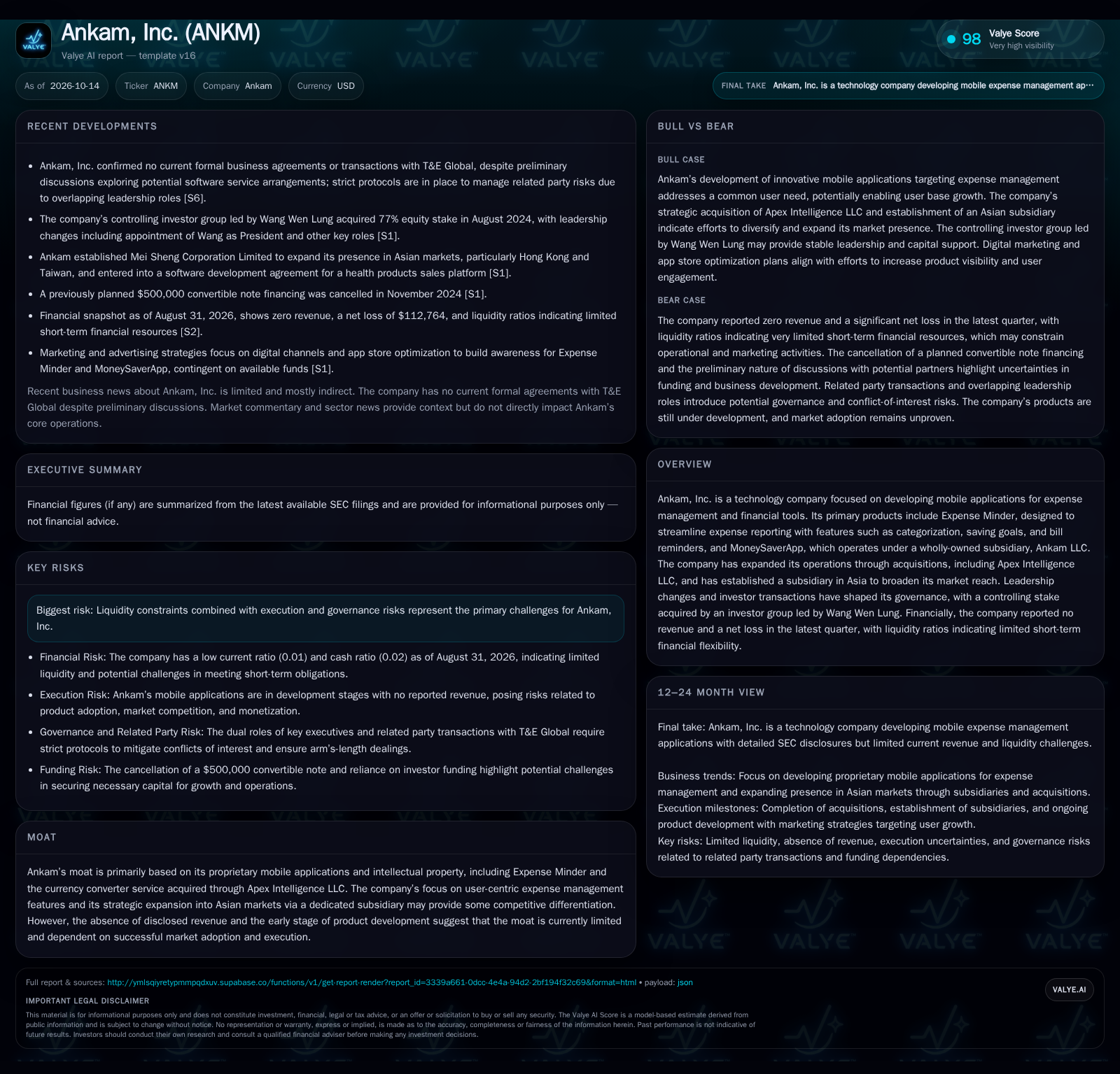
Ankam, Inc. is a pre-revenue technology company focused on mobile expense management and financial tools. Despite recent acquisitions and expansion into Asia, its latest filings show zero revenue, a net loss, and critically low liquidity. The business needs to prove product-market fit and access new capital to avoid insolvency and compete in a crowded market.
Ankam, Inc. is a Nevada-incorporated technology company developing proprietary mobile apps for expense management—Expense Minder and MoneySaverApp—while pursuing geographic expansion and product diversification through acquisitions and new subsidiaries. However, the latest disclosures reveal zero revenue, a significant net loss, and a near-absence of liquidity, following a cancelled financing. Execution risk is high: the company must rapidly validate product-market fit and secure new funding to survive in a competitive digital finance landscape.
Liquidity Crisis and Product Development Headwinds Define the Current State
Ankam, Inc. ended the quarter on August 31, 2026, with zero revenue, a net loss of $112,764, and only $19,185 in cash and cash equivalents. [S2] This precarious position is amplified by the cancellation of a $500,000 convertible note financing in late 2024 and the lack of any subsequent disclosed funding [S1].
Operationally, Ankam remains in the development phase with its core products, Expense Minder and MoneySaverApp, showing no evidence of commercial adoption or revenue generation [S1] [S2]. Meanwhile, the company’s acquisition of Apex Intelligence LLC and the establishment of an Asian-focused subsidiary, Mei Sheng Corporation Limited, signal strategic intent to diversify and expand, particularly into Hong Kong and Taiwan [S1]. However, without meaningful revenue or user traction, these moves have yet to translate into financial stability or market validation.
The strategic rationale behind Ankam's acquisition of Apex Intelligence LLC and the establishment of Mei Sheng Corporation Limited reflects a common early-stage approach to diversify product offerings and enter new geographic markets. However, such moves inherently increase operational complexity and capital requirements. The success of these initiatives depends on the company's ability to integrate acquired intellectual property effectively and tailor offerings to local market preferences, which often involves overcoming regulatory, cultural, and competitive hurdles. Without a stable financial base or proven revenue streams, these expansion efforts risk becoming distractions that drain limited resources rather than drivers of sustainable growth.
Mobile App Monetization Challenges and Capital Requirements
The core business model for Ankam’s mobile applications—Expense Minder and MoneySaverApp—likely relies on a blend of freemium features, in-app purchases, and potentially subscription tiers, as is standard for personal finance apps. Successful monetization in this segment generally requires achieving significant user scale, as average revenue per user (ARPU) tends to be modest and customer acquisition costs (CAC) can be high due to intense competition from established brands.
With no reported revenue, Ankam has yet to demonstrate either meaningful user adoption or effective monetization. Fixed costs are low—evidenced by a home office provided rent-free by the President [S1]—but development, marketing, and user support still require recurring investment. Operating leverage could be favorable if the company achieves app store traction, as incremental users typically add revenue with minimal marginal cost, but this remains hypothetical until user growth and monetization are proven.
The monetization challenges for mobile personal finance apps are compounded by the need for continuous feature innovation and user engagement to reduce churn. Given the low switching costs for consumers in this segment, Ankam must invest not only in acquiring users but also in retaining them through personalized experiences and reliable service. This dynamic implies ongoing marketing and development expenses that scale with user expectations. Additionally, the company’s ability to leverage data analytics to optimize user journeys and identify monetization opportunities—such as targeted financial product offers or partnerships—would be critical to improving ARPU and justifying capital deployment.
Competing in a Crowded Personal Finance App Market
Ankam faces formidable competition in the consumer finance app space, where incumbents include both large financial institutions and well-funded fintech startups. Expense management and budgeting apps are a mature category, with products like Mint, YNAB, and various bank-provided tools commanding user mindshare and benefiting from established brand trust, integration with financial institutions, and network effects.
Ankam’s potential differentiation lies in its proprietary features—customizable categories, saving goals, and bill reminders—and its recent acquisition of a currency converter service. Expansion into Asian markets through Mei Sheng Corporation Limited could offer a niche if localized offerings address specific user needs in Hong Kong or Taiwan. However, the absence of a proven user base, limited marketing resources, and no disclosed commercial partnerships or integrations leave Ankam at a disadvantage. The company’s ability to carve out market share will likely depend on execution speed, product usability, and the success of digital marketing strategies, all of which are currently constrained by funding.
In a saturated personal finance app market, differentiation often hinges on network effects and integration capabilities. Established competitors benefit from data aggregation partnerships with banks and financial institutions, enabling seamless user experiences and enhanced trust. For Ankam, building such integrations requires not only technical expertise but also relationship capital, which may be difficult to establish without a proven user base or financial backing. Furthermore, regulatory compliance related to data privacy and financial transactions can pose significant barriers to entry and ongoing operational risk, especially when expanding into multiple jurisdictions like Hong Kong and Taiwan.
Rapid User Adoption and New Funding Catalyze a Turnaround
The most favorable scenario for Ankam would involve the successful launch of its mobile applications, achieving rapid user adoption through effective digital marketing and app store optimization. If Expense Minder and MoneySaverApp resonate with users—perhaps through unique features or superior user experience—the company could build a significant user base, opening the door to meaningful subscription or freemium revenue.
A critical enabling factor would be the securing of new funding, either through equity investment, a new convertible note, or strategic partnerships. This capital could be used to accelerate marketing efforts, fund continued development, and support expansion in Asia via Mei Sheng Corporation Limited. Confirmation of this scenario would come from disclosed increases in downloads, daily active users, positive user reviews, and the announcement of a new funding round or commercial partnership. Failure to demonstrate these milestones within the next two quarters would likely falsify the upside case.
Survival-Oriented Cost Control and Limited Progress Absent Major Funding
The most plausible near-term outcome is that Ankam continues to operate in a capital-constrained mode, focusing on incremental product development while seeking additional funding. With minimal resources, the company may prioritize essential enhancements to its apps, attempt to secure low-cost marketing wins, and leverage the founder’s network for introductions to potential investors or partners.
Progress in user acquisition and revenue generation is likely to be slow, and the company may be forced to defer or scale back its Asian expansion plans. Evidence supporting this scenario would include continued low operating expenses, absence of large marketing initiatives, and no material change in user metrics or revenue. If the company fails to secure funding or show user growth after two subsequent quarters, the risk of insolvency will rise substantially.
Liquidity Exhaustion Forces Restructuring or Wind-Down
If Ankam is unable to raise additional capital or demonstrate any revenue traction, the company faces a high likelihood of exhausting its cash resources in the near term. The acute liquidity crisis—current ratio of 0.01 and cash ratio of 0.02—means the company is already operating on borrowed time [S2]. In this scenario, Ankam could be forced to halt product development, lay off remaining personnel, or enter restructuring proceedings.
If the company’s products remain pre-revenue and no external funding is secured, a formal wind-down or asset sale (such as the IP acquired from Apex Intelligence LLC) becomes increasingly likely.
Milestones That Will Determine Whether Ankam Survives and Grows
Disclosure of any non-zero revenue from Expense Minder, MoneySaverApp, or other products would be a key inflection point for business viability.
Announcement of a new funding round, debt facility, or strategic investment is critical to extending operational runway and supporting product development.
User acquisition metrics such as app downloads, daily/monthly active users, and retention rates would help gauge early traction and product-market fit.
Updates on the commercial launch of the health products sales platform via Mei Sheng Corporation Limited would clarify the company’s execution in Asian markets.
Material partnership or distribution agreements—especially with financial institutions or local Asian partners—would test the company's ability to overcome scale and trust barriers.
Evidence of governance improvements or independent oversight, given the related party and conflict-of-interest risks, would help validate risk controls.
Disclosure of any cost-cutting or restructuring actions would signal management’s response to ongoing liquidity stress.
Updates on the status or monetization of acquired IP (from Apex Intelligence LLC) would clarify the value and integration of non-core assets.
Disclaimer: This is research-only, informational analysis and not investment advice. It may include AI-generated interpretation and general industry context. Always verify important details using primary sources.

Comments