
Illumination Acquisition Corp. I: SPAC Economics and the Road to Value Creation
Illumination Acquisition Corp.
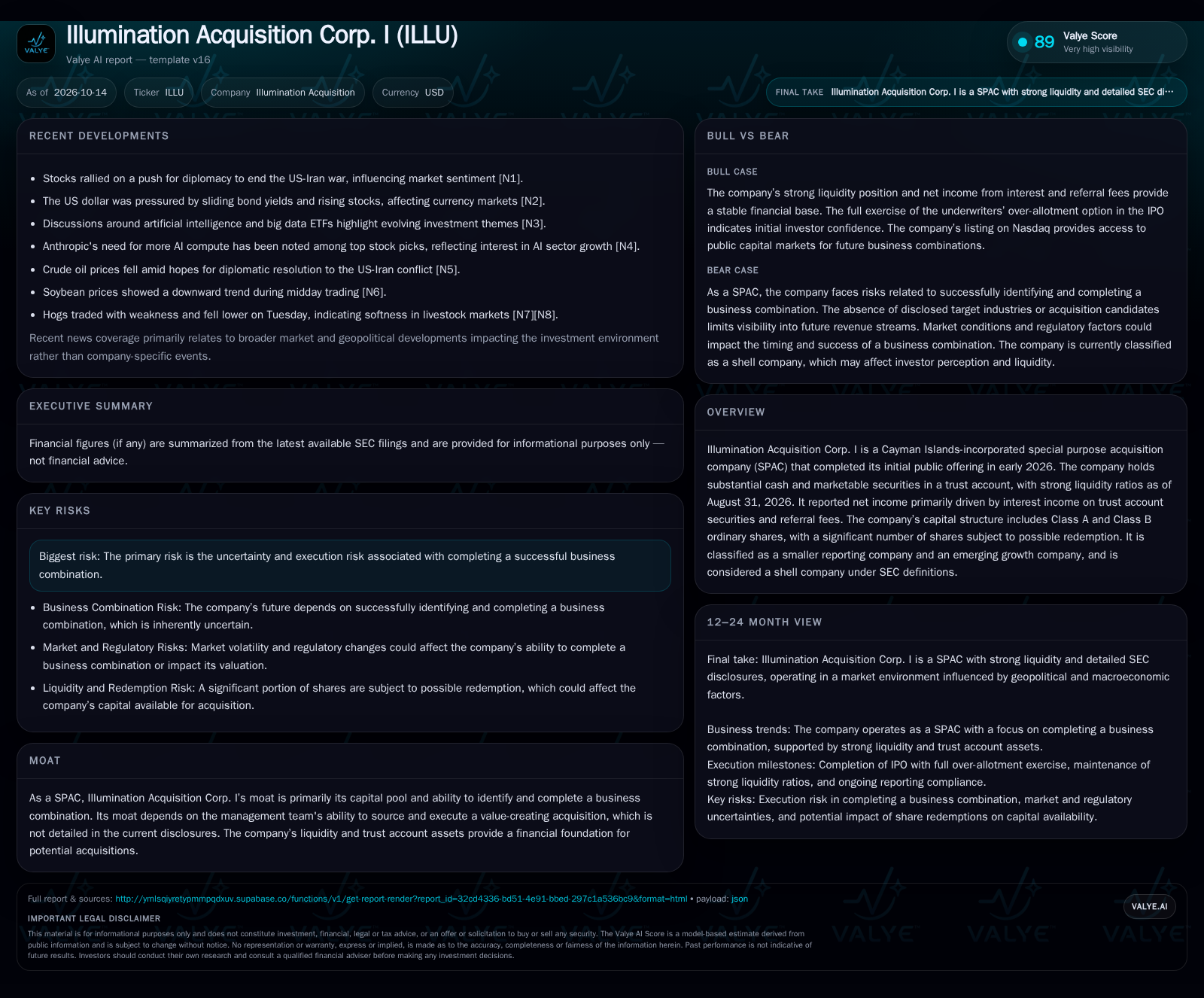
Illumination Acquisition Corp. I is a Cayman Islands-incorporated SPAC that completed its IPO in early 2026, holds over $234 million in trust, and reported significant net income from interest in the latest quarter. Its future hinges on sourcing and executing a value-creating business combination before regulatory or market headwinds erode capital or investor confidence. Execution risk around the acquisition is the central thesis variable. [S1]
Illumination Acquisition Corp. I, a Cayman Islands-based special purpose acquisition company (SPAC), stands at a familiar crossroads for blank check firms: flush with over $234 million in trust and reported liquidity position, but with its entire value proposition contingent on sourcing and closing a transformative business combination. With net income currently derived almost entirely from interest on its IPO proceeds, ILLU’s next phase will be defined by its ability to identify and negotiate a compelling acquisition before the SPAC’s regulatory time window narrows or redemption risk erodes its capital base. The company’s challenge is to convert its capital pool and public listing into a durable operating business, navigating both market volatility and intense competition for high-quality targets. [S1]
Current Financial Position and Operating Status
As of August 31, 2026, Illumination Acquisition Corp. I reported $819,260 in cash and cash equivalents, $944,481 in total current assets, and $204,100 in current liabilities, resulting in a current ratio of 4.63. The company held approximately $234.1 million in marketable securities within its trust account, the core capital base for a future business combination. Net income for the nine months ended August 31, 2026 was $3,843,507, almost entirely from interest income on the trust account, with only minor referral fee and bank interest contributions. The company completed its IPO (with full over-allotment) in March 2026 and has not yet identified or announced a merger target, remaining a shell company under SEC definitions. These facts establish ILLU as a well-capitalized SPAC with no operating business and a finite window to deploy its capital. [S1]
SPAC Value Chain and Economic Drivers
As a SPAC, Illumination Acquisition Corp. I’s economics are fundamentally different from an operating company. Pre-merger, its income is limited to interest earned on trust assets and any nominal referral or management fees. The overwhelming majority of its capital is held in trust and cannot be deployed for operations or investments until an acquisition is completed. Fixed costs are relatively modest, consisting primarily of legal, audit, regulatory, and administrative expenses, while variable costs may increase as the company ramps due diligence or enters negotiations with potential targets.
The core economic lever is the ability to identify, negotiate, and close a business combination that creates value for shareholders—typically through acquiring a high-growth or undervalued private operating company. Post-merger, the economics shift dramatically: the combined entity’s success will depend on the acquired company’s margin profile, growth rate, and capital intensity. However, until a target is announced and terms are disclosed, there is no visibility into future revenue, margin, or capital needs.
SPACs face a structural risk: if a suitable deal is not found within a specified period (often 18-24 months from IPO), the trust must be liquidated and returned to shareholders, typically resulting in the dissolution of the SPAC. Redemption risk—where shareholders opt to redeem their shares for cash at or before the merger vote—can further reduce the capital available for acquisition or operating runway.
Capital Pool as Competitive Asset—But Not a Moat
Illumination Acquisition Corp. I’s main competitive asset is its substantial pool of capital held in trust and its public listing on Nasdaq, which can make it an attractive partner for private companies seeking access to public markets. However, in the current environment, the SPAC landscape is highly competitive, with numerous blank check companies chasing a shrinking pool of high-quality targets. The value that ILLU can deliver depends heavily on the reputation, network, and deal-sourcing ability of its sponsor and management team—details not established in current disclosures.
Potential counterforces include: a crowded field of competing SPACs, increased regulatory scrutiny post-2024, and heightened shareholder activism around deal quality and dilution. Additionally, alternative routes to public markets (such as traditional IPOs or direct listings) and evolving private equity exit strategies can diminish the relative attractiveness of a SPAC merger for promising targets. There is also the risk that, as time passes, the best targets are acquired by earlier movers, leaving riskier or less attractive companies for later-stage SPACs.
How a Successful Business Combination Could Unlock Shareholder Value
In the favorable scenario, Illumination Acquisition Corp. I leverages its capital pool, sponsor network, and public listing to identify a high-quality private company seeking a rapid path to public markets. The SPAC negotiates a deal on reasonable terms, minimizing dilution and maximizing retained cash post-redemptions. The target company demonstrates strong growth prospects, attractive margins, and a compelling narrative for public investors.
Evidence that would confirm this path includes: a timely announcement of a letter of intent (LOI) or definitive agreement with a well-regarded private company, favorable market reaction to the deal terms, low redemption rates at the merger vote, and robust trading in the post-merger entity. Additional confirmation would come from post-deal financial disclosures showing rapid revenue growth, margin expansion, and clear capital allocation plans.
Most Likely Outcome: Execution Risk and Capital Erosion
The most plausible outcome is that Illumination Acquisition Corp. I spends the coming quarters engaged in target sourcing and due diligence, with interest income from the trust account as its only meaningful revenue. As the regulatory deadline approaches, the company may face increased pressure to announce a deal, possibly settling for a less attractive target or more shareholder-dilutive terms if market conditions remain challenging or redemptions mount.
This scenario would be confirmed by a lack of deal announcements deep into 2027, growing administrative costs, and a rising risk of shareholder redemptions as the deadline nears. If a deal is announced but accompanied by high redemption rates or tepid post-deal trading, it would suggest that ILLU was unable to secure a truly value-creating transaction. Conversely, a moderate redemption rate and a transaction with credible growth prospects would support a more neutral outcome.
Failure to Secure a Compelling Target or Severe Redemption Risk
The adverse scenario involves Illumination Acquisition Corp. I failing to identify and close a business combination within the allotted SPAC window. This could be due to an inability to find a willing and suitable target, excessive competition, regulatory hurdles, or unfavorable market conditions. In this case, the trust would be liquidated, and capital returned to shareholders, resulting in dissolution of the SPAC and little or no value creation for sponsors or non-redeeming shareholders.
Downside risk is amplified if a deal is rushed and poorly received, leading to extremely high redemption rates that strip the post-merger entity of capital, or if the chosen target underperforms after the merger due to operational or sector headwinds. Evidence here would include missed regulatory deadlines, public withdrawal of previously announced deals, or a proxy statement indicating overwhelming redemption intentions.
Testing the Thesis: Acquisition Progress, Redemption Dynamics, and Deal Quality
Announcement of a letter of intent (LOI) or definitive business combination agreement, including industry, target profile, and deal terms.
Shareholder redemption rates at the time of merger vote—if disclosed—to gauge how much capital remains available for the post-merger entity.
Timing and content of SEC filings indicating extension requests or deadline modifications, which would signal challenges in deal sourcing.
Administrative and due diligence expenses over time, as rising costs without deal progress may signal difficulties.
Market reaction to any announced deal, including trading volume and volatility in ILLU shares and warrants.
Disclosures regarding sponsor support, backstop arrangements, or PIPE (private investment in public equity) commitments, if any.
Updates on regulatory or macroeconomic factors that could affect the SPAC market environment.
If disclosed, management commentary on the target search process and acquisition criteria.
Disclaimer: This is research-only, informational analysis and not investment advice. It may include AI-generated interpretation and general industry context. Always verify important details using primary sources.

Comments