
CytoDyn’s Leronlimab: Oncology Ambitions, Clinical Progress, and the Financing Precipice
CytoDyn has advanced leronlimab into Phase 2 trials for colorectal and breast cancer, but persistent operating losses and a precarious liquidity position underscore the urgency of clinical and financial breakthroughs. The company’s future now hinges on the dual challenges of demonstrating therapeutic differentiation and securing sustainable capital.
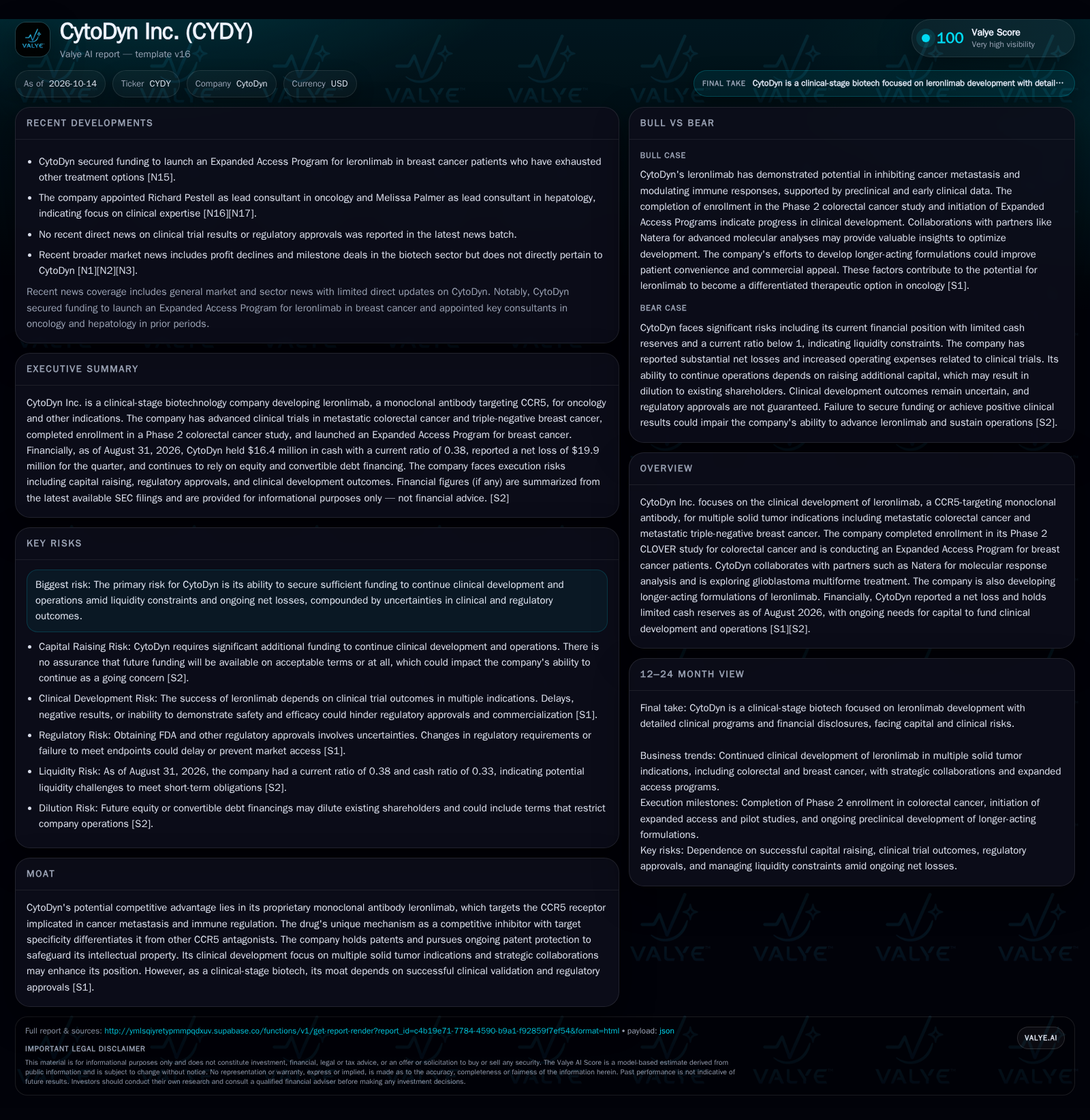
CytoDyn’s development of leronlimab for solid tumor oncology is at a pivotal stage, with Phase 2 enrollment complete for colorectal cancer and an Expanded Access Program underway for advanced breast cancer. However, the company’s reported cash balance, reported current ratio, and reliance on continued equity or convertible debt financing present significant hurdles. The success of its clinical programs and ability to secure fresh capital will determine whether CytoDyn can transition from clinical-stage aspirations to a viable commercial or partnership future. [S1] [S2]
CytoDyn Inc. is at a critical inflection point as it advances leronlimab, its proprietary CCR5-targeting antibody, through mid-stage clinical trials for solid tumor oncology. With Phase 2 enrollment completed in metastatic colorectal cancer and an Expanded Access Program launched for triple-negative breast cancer, CytoDyn is making tangible clinical progress. However, its financial situation is fraught: reported cash balance, a reported current ratio, and ongoing net losses necessitate urgent capital raising. The company’s fate now depends on whether it can generate compelling clinical data and secure the funding needed to sustain its ambitious development program.
Clinical Milestones and Financial Strain Define CytoDyn’s Present
CytoDyn has completed enrollment in its Phase 2 CLOVER study for relapsed/refractory microsatellite stable metastatic colorectal cancer, with over 60 patients recruited across U.S. sites as of April 2026. This marks a tangible step forward in establishing leronlimab’s clinical profile in oncology. In parallel, the company has initiated an Expanded Access Program (EAP) for metastatic triple-negative breast cancer, targeting patients with limited alternatives. These moves underscore CytoDyn’s attempt to broaden leronlimab’s reach and generate real-world data ahead of pivotal trials or potential regulatory submissions. [S1]
Financially, CytoDyn’s position is fragile: as of August 31, 2026, it reported $16.4 million in cash and cash equivalents, current assets of $18.98 million, and current liabilities of $49.7 million. This results in a current ratio of 0.38 and a net loss of $19.9 million for the quarter, driven by increased clinical trial expenses and stock-based compensation. The company’s ability to meet short-term obligations is in doubt, and it remains dependent on new equity or convertible debt financings to fund ongoing operations. [S2]
How CytoDyn’s Model Could Create Value—If Clinical and Commercial Hurdles Are Cleared
CytoDyn’s economics are typical of a clinical-stage biotechnology company: revenue is negligible, with value creation hinging on successful clinical development, regulatory approval, and eventual commercialization or partnership. The primary lever is leronlimab’s ability to demonstrate clinical efficacy and safety in solid tumor indications where CCR5 inhibition may disrupt cancer metastasis and modulate immune responses. If leronlimab proves effective, pricing could be benchmarked against other biologics in oncology, potentially commanding high per-patient annual costs typical of targeted cancer therapies.
Variable costs in the near term are dominated by R&D, clinical trial execution, and regulatory activities, while fixed costs are relatively modest but persistent. CytoDyn’s capital needs are acute: with no meaningful revenue inflows and high burn rates, the company relies on serial equity and convertible debt issuances. This structure creates significant dilution risk for existing shareholders, especially if capital is raised at depressed valuations. Operating leverage could theoretically emerge if leronlimab achieves regulatory approval and begins to scale, but until then, the economics are defined by negative cash flow and dependence on external financing. [S2]
The company’s bid to develop longer-acting CCR5 antagonists using generative AI tools reflects an attempt to enhance future product differentiation and lifecycle value, but these efforts are pre-commercial and add to near-term funding requirements. [S1]
Where CytoDyn Stands in the Oncology Innovation Race
CytoDyn’s competitive position is built around leronlimab’s unique targeting of the CCR5 receptor, a mechanism implicated in cancer cell migration, metastasis, and immune modulation. This approach is differentiated from most standard-of-care chemotherapies and immune checkpoint inhibitors, potentially allowing for combination strategies. However, the oncology field is crowded, with numerous established and emerging players developing monoclonal antibodies, small molecules, and next-generation immunotherapies.
CytoDyn’s patent estate offers some protection, but key formulation patents begin to expire in 2031, and antibody patents have already begun to expire, limiting long-term exclusivity unless new method-of-use or formulation patents are granted. The company’s collaborations for molecular response analysis (e.g., with Natera) may provide advanced biomarker-driven insights, which could enhance competitive positioning if leronlimab demonstrates a clear benefit in selected patient groups.
The primary counterforces are the high bar for clinical efficacy in oncology, regulatory scrutiny, and the risk of being outpaced by better-funded competitors with larger clinical pipelines or more established commercial infrastructure. Entry barriers remain high for new biologics, but regulatory and payer environments are increasingly demanding robust data and cost-effectiveness.
What Success Could Look Like: Clinical Data as the Catalyst for Transformation
In a favorable scenario, interim or final results from the Phase 2 CLOVER study in metastatic colorectal cancer show leronlimab provides a statistically significant improvement in progression-free survival or overall survival compared to standard care or historical controls. Simultaneously, the Expanded Access Program in triple-negative breast cancer generates compelling real-world evidence of benefit in a population with dire unmet need. These clinical milestones spark interest from larger pharmaceutical partners or investors, enabling CytoDyn to secure nondilutive funding, co-development deals, or even a licensing agreement.
The company’s ongoing collaboration with Natera yields biomarker or minimal residual disease data that clarify patient subgroups most likely to benefit, strengthening the case for a targeted registration trial. Positive proof-of-concept in glioblastoma or progress with longer-acting formulations provides further pipeline optionality.
Confirmation of this scenario would come from public disclosure of statistically significant Phase 2 data, new partnership announcements, successful capital raises at improved terms, and regulatory feedback endorsing progression to Phase 3.
Clinical Progress, but Capital Remains the Bottleneck
The most plausible middle path is that CytoDyn continues to advance leronlimab through ongoing Phase 2 and pilot studies, with results that are promising but not yet transformative. The company manages to raise additional capital, but only through further equity or convertible debt offerings at terms that are dilutive to existing shareholders. Operationally, progress is incremental: the Expanded Access Program generates useful data, but uptake is limited by resource constraints and absence of formal regulatory approval.
Collaborations yield some translational insights, but breakthrough biomarker findings or new strategic partnerships remain elusive. The business remains in a holding pattern, marked by ongoing net losses, high burn rates, and recurring financing needs.
This scenario would be confirmed by continued clinical activity without major inflection points in data, sequential dilution events, and the absence of non-dilutive partnerships or licensing deals.
When Science and Capital Both Fall Short: The Risk of Clinical or Financial Failure
In an adverse scenario, leronlimab’s Phase 2 data in colorectal cancer are equivocal or negative, failing to show a meaningful benefit over existing therapies. The Expanded Access Program in breast cancer struggles to generate actionable data or attract significant patient numbers. At the same time, CytoDyn’s precarious cash position deteriorates further, with attempts to raise new capital met by investor reluctance or prohibitive dilution.
The company is forced to curtail development activities, delay or halt new trials, and consider asset sales, licensing out pipeline assets on unfavorable terms, or even bankruptcy protection. Regulatory feedback may highlight deficiencies in trial design or data, further undermining prospects.
Key confirming evidence would include public disclosure of negative or inconclusive clinical results, missed regulatory milestones, failed or highly dilutive capital raises, and formal warnings about going concern status or the need to significantly scale back operations.
Milestones That Will Determine CytoDyn’s Next Chapter
Interim or final readouts from the Phase 2 CLOVER study in metastatic colorectal cancer—statistical significance, effect size, and regulatory implications.
Patient enrollment velocity and outcome data from the Expanded Access Program for metastatic triple-negative breast cancer. A useful metric would be the number of patients treated and observed response rates, if disclosed.
Updates on the company’s ability to secure additional funding—timing, terms, and degree of dilution associated with new equity or convertible debt offerings.
Evidence of new strategic partnerships, licensing deals, or nondilutive capital inflows.
Progress in developing longer-acting CCR5 antagonist formulations, including preclinical milestones and candidate advancement to clinical studies.
Regulatory feedback on trial design, endpoints, or readiness to advance to registration-enabling studies.
Cash burn rate and quarterly net losses, including any changes in operating expense trends or cost containment efforts.
Resolution and finalization of any outstanding legal or class-action settlements that could impact financial resources.
Disclaimer: This is research-only, informational analysis and not investment advice. It may include AI-generated interpretation and general industry context. Always verify important details using primary sources.

Comments