
EvoAir Holdings: Eco-Friendly HVAC Ambitions Confront Structural Financial Headwinds
EvoAir Holdings Inc. pursues innovation in sustainable HVAC and air purification technologies, targeting growth across Asia. Yet persistent net losses, minimal liquidity, and operational streamlining underline the company’s acute need for capital or commercial traction to bridge the gap between R&D promise and commercial viability.
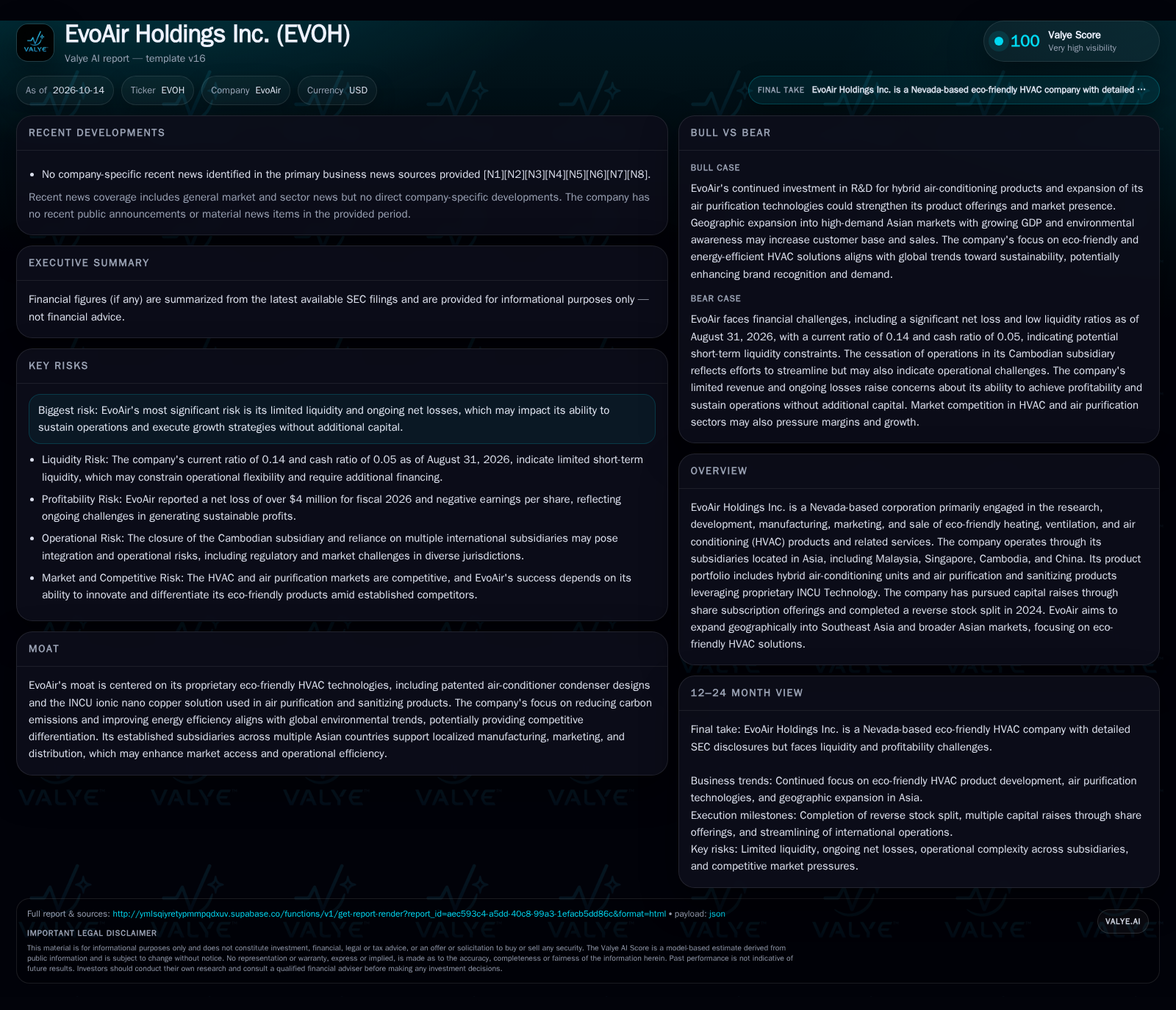
EvoAir Holdings Inc. is a Nevada-based HVAC technology company with a focus on eco-friendly and energy-efficient products, including hybrid air conditioners and proprietary air purification solutions. Despite active R&D and geographic expansion in Asia, the company faces significant net losses and a severe liquidity shortfall, with a current ratio of 0.14 and cash ratio of 0.05 as of August 31, 2026. Recent operational streamlining and minimal quarterly revenue highlight the urgency of achieving commercial traction or securing further capital to sustain operations and fund growth initiatives. [S1] [S2]
EvoAir Holdings Inc. is attempting to carve out a niche in the crowded HVAC landscape through eco-friendly air-conditioning and air purification solutions, underpinned by proprietary technology and a multi-national Asian footprint. However, the company’s operational ambitions are in stark tension with its financial reality: persistent net losses, minimal liquidity, and negligible revenue growth. As EvoAir navigates operational restructuring and seeks further market penetration, its ability to secure new capital or achieve a step-change in commercial adoption will likely determine whether its sustainability vision can translate into a sustainable business.
Liquidity Crunch and Ongoing Losses Define the Present
EvoAir Holdings’ financial position as of August 31, 2026, is marked by acute liquidity constraints, with just $277,547 in cash and equivalents against $5.3 million in current liabilities—a current ratio of 0.14 and cash ratio of 0.05. The company reported a net loss of $4,094,539 for fiscal 2026 and negative earnings per share. On the revenue front, operations remain nascent: the quarter ended May 31, 2025, saw revenues of only $5,979. In parallel, EvoAir has been streamlining its operations, exemplified by the closure of its Cambodian subsidiary, though this is not expected to be material to the group. These factors collectively signal a business under urgent financial strain, dependent on fresh capital or a commercial breakthrough to avoid further distress. [S1] [S2]
Unit Economics and the Path to Profit in the Eco-HVAC Market
EvoAir’s business model is predicated on the development, manufacturing, and sale of eco-friendly HVAC systems and air purification products, leveraging proprietary technologies such as its INCU ionic nano copper solution. Theoretically, the economics of this sector can be favorable: HVAC products often enjoy relatively high average selling prices, and eco-friendly differentiation could support premium pricing if regulatory or customer incentives align. The company reported cash and liquidity metrics for the period; these figures do not by themselves establish operating runway, investment capacity, financial flexibility, or financing capacity.
Given EvoAir’s negligible revenues and persistent losses, current fixed costs (R&D, manufacturing overhead, SG&A) appear to vastly exceed gross profit generation. Operating leverage could be significant if sales volume ramps up, but until then, the company is exposed to ongoing cash burn. The reverse split and multiple share subscription offerings suggest that external equity financing has been necessary to bridge operating deficits. If EvoAir cannot achieve scale—either through direct sales, OEM partnerships, or licensing—its current cost structure is unsustainable. The closure of non-core subsidiaries points to a focus on cost containment, but also highlights the pressure to rationalize operations in light of limited resources. [S1]
Competing for Relevance: Proprietary Tech Versus Established Rivals
EvoAir’s competitive thesis rests on proprietary eco-friendly HVAC technologies, including patented condenser designs and unique air-sanitizing solutions. In theory, these could provide a differentiator in markets where energy efficiency and indoor air quality are rising priorities—especially in urbanizing Asian economies facing pollution and climate concerns. However, the HVAC and air purification industries are crowded with established multinationals and local players, many of whom have deep R&D pipelines, well-developed distribution, and scale-driven cost advantages.
Brand credibility, after-sales service, and local regulatory approvals are critical in these markets, and new entrants often face protracted sales cycles. EvoAir’s multi-country subsidiary structure could support localized go-to-market strategies, but also adds complexity and cost. The company’s ability to demonstrate clear performance or cost-of-ownership advantages, secure reference customers, and navigate regulatory barriers will determine whether its technology can command a premium or simply compete on price. Without meaningful commercial traction or publicized contract wins, EvoAir’s moat remains more potential than proven. [S1]
Breakthrough Adoption of Proprietary Eco-HVAC Solutions
The most favorable scenario for EvoAir is a breakthrough in commercial adoption—either through a marquee contract, OEM partnership, or regulatory-driven demand surge for eco-friendly HVAC and air purification solutions in Asia. In this case, operating leverage could quickly improve as fixed costs are absorbed over higher sales volumes, and the company could use customer references to accelerate further market penetration. Proprietary INCU Technology and patented condenser designs may resonate with institutional buyers or government procurement programs focused on sustainability.
Confirmation of this scenario would come from a sharp increase in disclosed revenues, backlog, or contracted sales, as well as evidence of repeat customers or multi-year agreements. Gross margin expansion would be an additional sign that EvoAir is achieving pricing power or cost efficiencies. Conversely, if revenue remains negligible or contract announcements are absent, the thesis of commercial inflection would be falsified. [S1] [S2]
Incremental Progress, Ongoing Losses, and Reliance on External Funding
The most plausible near-term trajectory for EvoAir is one of incremental operational progress but continued financial fragility. Modest growth in sales—perhaps aided by targeted marketing or pilot deployments—could narrow losses but not eliminate them, given the company’s current scale and cost structure. Ongoing R&D and selective expansion into Southeast Asian markets may yield gradual product adoption, but without a step-change in commercial traction, EvoAir is likely to remain reliant on periodic capital raises to fund operations.
Evidence supporting this scenario would include slow but steady revenue growth, continued net losses, and further disclosures of equity or debt financing. Any additional streamlining—such as further subsidiary closures or cost reductions—would support the view that management is prioritizing survival and optionality over rapid expansion. This base case would be challenged by either a sudden commercial breakthrough or, conversely, a pronounced liquidity event such as default or bankruptcy. [S1] [S2]
Liquidity Exhaustion and the Consequences of Commercial Stagnation
The adverse scenario is that EvoAir fails to secure additional funding or meaningful commercial adoption, resulting in a depletion of cash reserves and an inability to meet obligations. In this situation, the company might be compelled to undertake highly dilutive financings, sell or license intellectual property at distressed valuations, or enter restructuring proceedings.
Signs pointing to this scenario would include further deterioration in liquidity ratios, disclosure of missed payments or going-concern warnings, and the absence of new revenue-generating contracts. Any regulatory or legal setbacks in key operating jurisdictions could accelerate this outcome. The company’s recent operational streamlining may help extend runway, but without a change in the revenue trajectory or access to new capital, downside risk dominates. [S1] [S2]
Milestones That Will Determine Whether EvoAir's Sustainability Story Holds Up
Quarterly and annual revenue growth: Any material increase would indicate commercial traction and begin to validate the technology’s market fit. [S2]
Gross margin trends (if disclosed): Improvements would suggest the company is achieving pricing power or cost efficiencies, not just revenue growth.
Disclosure of signed contracts, backlog, or reference customers: Announcements here would provide evidence of market adoption, especially in target Asian markets.
Updates on further equity or debt financing: Additional capital raises, their terms, and investor composition will reveal market confidence and dilution risk. [S1]
Subsidiary performance and further operational streamlining: Whether other international entities are shuttered or refocused will speak to management’s ability to rationalize the cost base.
R&D milestones or new product launches: Progress here could renew interest in EvoAir’s technology and open new revenue channels.
Liquidity and going-concern disclosures in future filings: Any warnings or auditor flags would foreshadow financial distress.
Regulatory developments in key Asian markets: Shifts in environmental standards or subsidies could create tailwinds or obstacles for eco-friendly HVAC adoption.
Disclaimer: This is research-only, informational analysis and not investment advice. It may include AI-generated interpretation and general industry context. Always verify important details using primary sources.

Comments