
Sono-Tek’s Ultrasonic Coating Platform: Navigating Diversified Growth and Competitive Complexity
Recent multi-million dollar orders and consistent profitability underscore Sono-Tek’s niche leadership in precision coating, but long-term growth hinges on expanding industrial adoption, fending off alternative technologies, and sustaining innovation momentum.
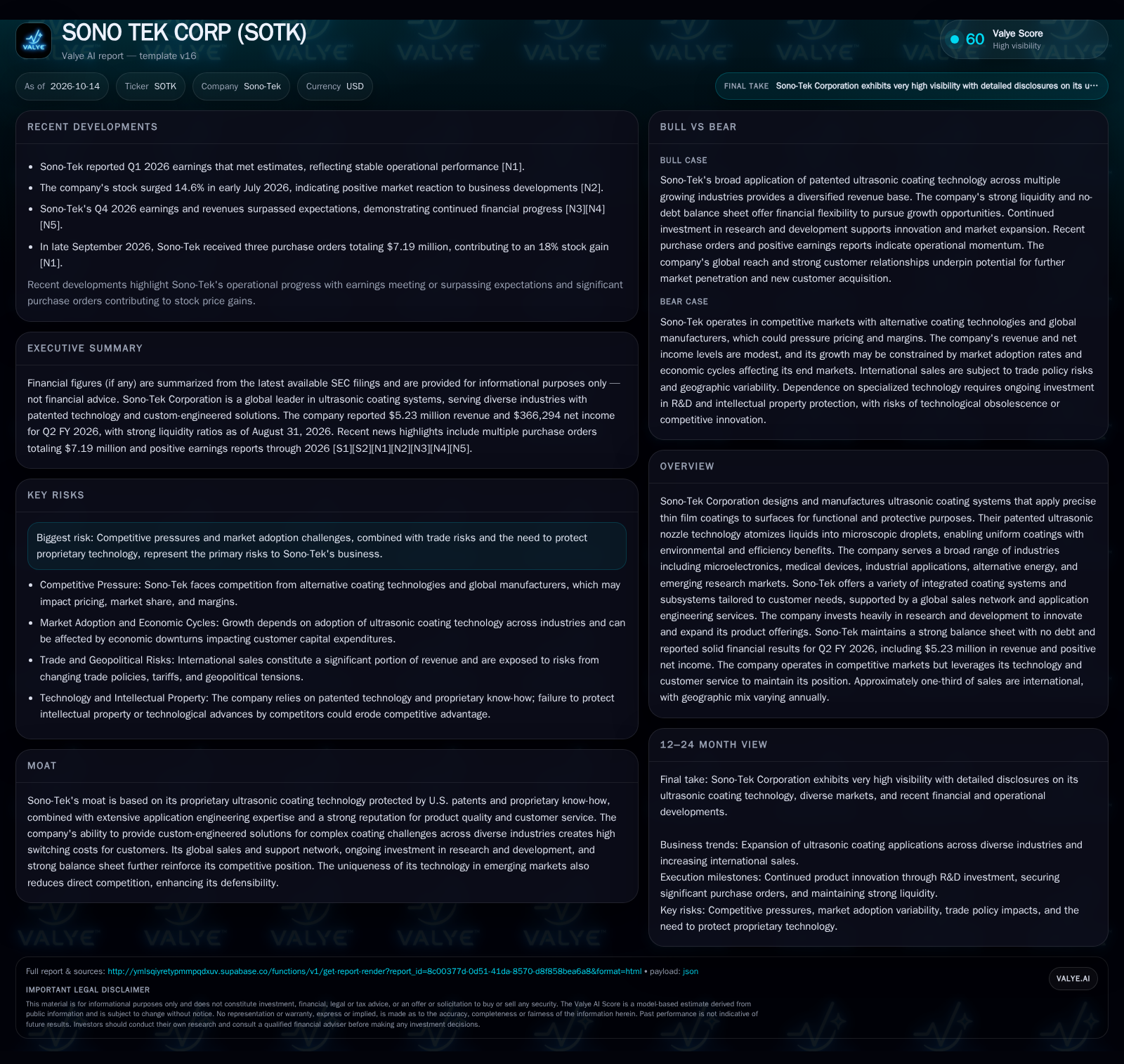
Sono-Tek’s patented ultrasonic coating systems generated $5.23 million in Q2 FY2026 revenue and positive net income, with new purchase orders totaling $7.19 million in late Q3. Sustained R&D investment and successful customer wins will be critical for maintaining its edge and scaling revenue.[S2] [N1]
Sono-Tek Corporation sits at a critical juncture in the evolution of industrial coatings, leveraging its proprietary ultrasonic nozzle technology to deliver precision thin-film applications across diverse and growing end-markets. The company’s recent financial performance—marked by $5.23 million in quarterly revenue, positive net income, and a series of multi-million dollar purchase orders—demonstrates both the traction and the challenges inherent in scaling a specialized, engineering-driven business. As Sono-Tek targets expansion in medical devices, microelectronics, and alternative energy, its success will be determined by its ability to deepen customer reliance, fend off competitive and technological threats, and convert its R&D investment into sustainable, defensible growth.[S2] [N1]
Recent Orders and Consistent Profitability Highlight Momentum
Sono-Tek’s Q2 FY2026 revenue reached $5.23 million with positive net income, confirming the company’s ability to operate profitably even in a competitive environment.[S2] In late September 2026, three significant purchase orders totaling $7.19 million were secured, contributing to an 18% stock gain and signaling robust customer demand for Sono-Tek’s ultrasonic coating systems.[N1] The company’s debt-free balance sheet further enhances its operational flexibility and ability to pursue growth opportunities.[S2]
Approximately one-third of Sono-Tek’s revenue comes from international markets, reflecting both a diversified customer base and exposure to global economic and geopolitical risks. The company’s positive quarterly financials and recent contract wins provide tangible evidence of market traction, but the scale and sustainability of this momentum remain key questions.
How Sono-Tek’s Business Model Converts Precision into Profits
Sono-Tek generates revenue by designing, manufacturing, and selling ultrasonic coating systems—highly specialized capital equipment tailored to sectors such as microelectronics, medical devices, and alternative energy. These systems command premium pricing due to their ability to deliver precise, uniform, and environmentally efficient coatings, often enabling customers to reduce material waste and improve product performance.
The economics of the business are shaped by a mix of high-margin proprietary hardware, integration services, and recurring support or application engineering. While the capital equipment model is lumpy—with large orders impacting quarterly results—aftermarket service and potential consumables could provide some revenue smoothing if the company expands these offerings.
Fixed costs are driven by ongoing R&D and a specialized engineering workforce, but the company’s debt-free position reduces financial risk and interest burden. The ability to scale depends on increasing sales volume and leveraging R&D investment, which, if successful, could drive operating leverage as revenue grows faster than fixed cost increases.
The capital intensity is moderate: significant investment is required for product development and customer-specific engineering, but manufacturing is not as asset-heavy as some industrial peers. The main funding needs are internal—supporting innovation, sales expansion, and global customer support—rather than large-scale plant or equipment buildouts.
Defending a Niche: Technology Moat Meets Global Rivals and Substitutes
Sono-Tek’s competitive positioning rests on its patented ultrasonic nozzle technology and proprietary process know-how, which enable differentiated coating performance, especially in applications where precision and efficiency are critical. The company’s reputation for quality, custom engineering, and customer service creates switching frictions, particularly for clients with complex, high-value manufacturing processes.
However, the market is crowded with alternative coating solutions—including spray, dip, chemical vapor deposition, and other precision dispensing systems—often offered by larger, well-funded global manufacturers. These competitors may exert pricing pressure or offer bundled solutions, challenging Sono-Tek’s ability to maintain premium pricing.
The risk of technological substitution is significant: advances in alternative coating technologies or process automation could erode Sono-Tek’s differentiation over time. The company’s moat is therefore strongest in niche or emerging applications where ultrasonic coating provides unique advantages, but may be thinner in more commoditized industrial segments.
Internationally, the company faces challenges from local competitors and trade barriers, making continued investment in IP protection, application engineering, and global sales support essential to defend and extend its position.
If R&D Converts to Adoption: Unlocking New Markets and Margin Expansion
The most favorable scenario for Sono-Tek is one in which ongoing R&D investment delivers meaningful innovation—new nozzle designs, broader process compatibility, or software-enabled customization—that opens up additional high-value markets. Success would be marked by larger and more frequent purchase orders from medical device, microelectronics, and alternative energy customers, as well as increased penetration into emerging geographies.
This growth could be amplified if the company expands its aftermarket service and consumable offerings, increasing recurring revenue and smoothing the capital equipment cycle. Margin expansion would result from both higher volumes (operating leverage) and sustained premium pricing on differentiated solutions.
Evidence for this scenario would include a rising order backlog, new customer wins in growth industries, increasing international sales as a percentage of revenue, and the launch of new product lines or platforms. Confirmation would also come from expanding gross margins and positive operating leverage in subsequent quarters.
Falsification would occur if innovation fails to translate into tangible product launches or if new entrants quickly commoditize ultrasonic coating, limiting Sono-Tek’s pricing power.
Sustained Niche Leadership Amid Cyclical Demand and Competitive Pressures
The most plausible medium-term outlook for Sono-Tek is continued profitable operation, anchored by its established niche in precision ultrasonic coating and a steady cadence of orders from existing and repeat customers. Revenue growth is likely to be moderate, reflecting the lumpy nature of capital equipment sales and the company’s exposure to customer capital expenditure cycles.
The company should be able to defend its position in specialized applications—particularly in medical and microelectronics—where switching costs and process integration create customer stickiness. However, competitive and technological pressures will limit pricing power in more generic or price-sensitive industrial segments.
International sales will remain an important growth lever, but volatile geopolitical and trade conditions could introduce quarter-to-quarter variability. The company’s R&D-driven innovation pipeline will need to deliver incremental, rather than breakthrough, differentiation to sustain existing customer relationships.
This scenario would be confirmed by continued modest revenue and net income growth, a stable or gradually rising base of repeat business, and the maintenance of a debt-free balance sheet. It would be challenged if order momentum stalls or if margins compress in response to competitive pricing.
Margin Erosion and Market Share Loss If Technology Falls Behind
The adverse scenario centers on Sono-Tek’s technology being leapfrogged by alternative coating methods or by global competitors capable of undercutting on price or bundling additional value for customers. In this outcome, key accounts may migrate to rival solutions, especially if switching costs prove lower than expected or if new entrants dilute the perceived uniqueness of ultrasonic coating.
Such erosion would likely lead to margin compression, reduced order sizes, and increased customer churn, particularly in price-sensitive or rapidly evolving end-markets. International sales could also be impacted by adverse trade policy changes or local competition outpacing Sono-Tek’s global support capabilities.
Evidence supporting this scenario would include consecutive quarters of declining revenue or net income, shrinking gross margins, or a marked slowdown in new purchase orders. Falsification would require sustained order wins, stable or expanding margins, and ongoing R&D-led product launches that keep the company ahead of substitution risk.
What Will Determine Sono-Tek’s Next Chapter in Precision Coating?
Quarterly order flow and announced purchase order values: Sustained multi-million dollar contracts would indicate robust demand and customer confidence.
Gross margin trends: Stability or expansion would signal continued pricing power and differentiation; compression could indicate rising competition or cost pressures, if disclosed.
New product launches or major platform upgrades: Evidence of R&D translating into commercial offerings would support the innovation thesis.
Geographic sales mix: Shifts in international revenue as a percentage of total sales could reveal both opportunity and risk exposure.
Repeat versus new customer revenue: A rising share of sales from new customers would indicate successful market expansion, if disclosed.
Aftermarket service and consumables revenue: Growth in these areas would enhance revenue visibility and reduce capital equipment cyclicality, if disclosed.
Intellectual property litigation or new patent filings: Activity here would be a leading indicator of both competitive threats and ongoing innovation.
Macro indicators for end-markets: Trends in medical device, microelectronics, and renewable energy capital spending will directly impact Sono-Tek’s addressable demand.
Disclaimer: This is research-only, informational analysis and not investment advice. It may include AI-generated interpretation and general industry context. Always verify important details using primary sources.

Comments