
Elventix Technology: Early-Stage News Aggregation Ambitions Confront Financial and Competitive Hurdles
Its path forward depends on executing product enhancements, successfully raising capital, and demonstrating the commercial value of AI-driven personalization in a market dominated by larger incumbents.
Its path forward depends on executing product enhancements, successfully raising capital, and demonstrating the commercial value of AI-driven personalization in a market dominated by larger incumbents. [S1] [S2]
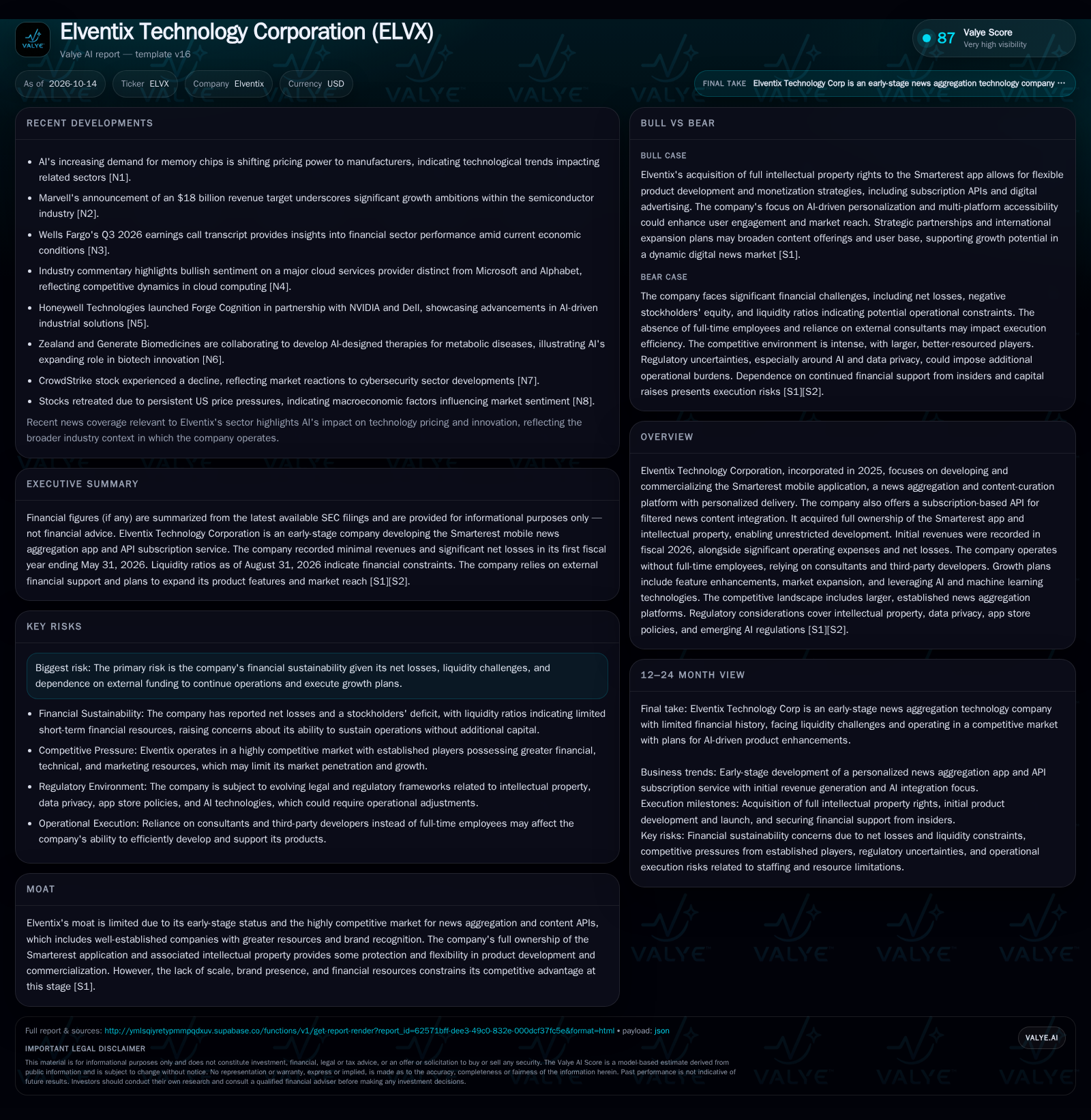
Elventix Technology Corporation, a Wyoming-incorporated startup, is attempting to break into the crowded digital news aggregation space with its Smarterest platform—a mobile app and API designed to deliver personalized, curated news content. The company has secured full ownership of the Smarterest IP and launched initial commercial offerings, but faces daunting financial realities: minimal early revenues, a severe cash shortfall, and reliance on external support. With ambitious plans for AI-powered features and expanded monetization, Elventix must prove it can overcome execution and funding hurdles while competing against much larger incumbents.
Liquidity Crunch and Minimal Early Revenue Define the Starting Point
Elventix Technology’s financial snapshot reveals both the promise and the peril of its early-stage ambitions. The company reported its first revenues—$3,359 from software and API sales—in the fiscal year ending May 31, 2026, but operating expenses far outpaced top line, reaching $111,915, and resulting in a net loss of $108,556. By August 31, 2026, cash had dwindled to $630, with current assets of $19,030 against $192,157 in current liabilities, yielding a current ratio of only 0.1 and a cash ratio of zero. This acute liquidity pressure means Elventix’s ability to operate and invest is tightly constrained, and its dependence on financial support from insiders and new capital is explicit. [S1] [S2]
Beyond the financials, Elventix’s acquisition of full ownership of the Smarterest app and its IP creates a foundation for unrestricted product development, which is central to its growth narrative. However, the absence of full-time employees and reliance on consultants signals both a flexible cost structure and a potential limitation in execution bandwidth. [S1]
Monetization Paths and Cost Structure: Early Signals and Open Questions
Elventix’s business model is built around two core monetization paths: direct-to-consumer via the Smarterest mobile app and business-to-business through a subscription-based API enabling third-party platforms to access personalized news feeds. The company’s initial revenues suggest at least minimal commercial validation for the API, but the absolute scale is minuscule. The deferred revenue figure ($18,090 as of May 31, 2026) indicates some level of advance customer commitment, but not enough to offset ongoing expenses. [S1]
The economics of news aggregation apps typically depend on achieving scale—either through a large user base monetized via advertising, premium subscriptions, or by licensing content/data capabilities to partners. Elventix’s stated plans to add offline reading, multi-tiered subscriptions, and digital advertising reflect standard industry levers, but the company will need to prove it can drive both user growth and engagement. Given its lack of full-time staff and reliance on consultants, Elventix’s cost structure is relatively variable, but this model can also limit institutional knowledge, speed, and product iteration—factors critical to success in fast-moving consumer tech. The capital-light approach postpones fixed costs but heightens the importance of rapid revenue traction to cover ongoing development and support expenses.
Can Smarterest Stand Out in a Market Dominated by Giants?
Elventix is entering a highly competitive landscape for news aggregation and content APIs, where established platforms—often backed by major technology or media firms—benefit from entrenched user bases, robust AI/ML capabilities, and strong brand recognition. The company’s full ownership of the Smarterest IP provides some strategic flexibility, but does not in itself confer material defensive advantages. Without a unique data asset, differentiated technology, or a viral distribution channel, smaller entrants in this space often struggle to achieve visibility and stickiness.
The company’s focus on AI-driven personalization is a necessary but not sufficient differentiator—incumbents are already heavily invested in machine learning for content recommendation. Elventix’s ability to establish meaningful switching frictions or network effects will depend on whether it can deliver substantially better or more relevant news experiences than rivals, or carve out a defensible niche (e.g., through specialized content partnerships, superior API integration, or privacy-centric positioning). For now, the balance of power remains with larger, better-resourced competitors. [S1]
What Could Drive a Breakout: Rapid Feature Expansion and Strategic Partnerships
A favorable scenario for Elventix would see the company quickly rolling out planned product enhancements—such as offline reading, advanced personalization, multi-tiered consumer subscriptions, and advertising integration—leading to accelerated user adoption and API uptake. Early traction could be amplified through strategic partnerships with content providers or third-party platforms seeking differentiated news feeds, particularly if Elventix’s AI/ML features genuinely outperform generic aggregators.
In this scenario, successful capital raising would fund aggressive development and marketing, enabling the company to build momentum before competitors can react. Evidence supporting this trajectory would include a sharp increase in deferred revenue, publicized B2B deals, user growth metrics, and positive user engagement trends. Falsification would come from stagnant revenue, slow feature rollout, or an inability to secure new funding.
Sustained Struggle for Traction and Capital in a Crowded Field
The most plausible outcome is that Elventix continues to iterate on Smarterest’s features and seeks to expand both its B2C and B2B customer base, but faces ongoing challenges in breaking through the noise of a crowded marketplace. Revenue growth may be incremental, with new features and partnerships slow to translate into material top-line gains. The company’s capital-light structure keeps fixed costs lower, but the lack of scale makes it difficult to achieve operating leverage, and recurring liquidity shortfalls force management to prioritize short-term survival over strategic investment.
Confirmation of this scenario would be persistent net losses, modest revenue increases, and continued reliance on external funding. Evidence of accelerating user or API customer growth, or a significant funding round, would tilt the balance toward a more optimistic trajectory.
Liquidity Exhaustion and Execution Gaps Lead to Strategic Setbacks
A negative outcome would see Elventix unable to raise sufficient new capital to fund ongoing operations, forcing a reduction in development activity, delays in product enhancements, and possible loss of key consultants or partners. In this scenario, user and customer acquisition stalls, and the company risks falling further behind competitors with deeper pockets and faster product cycles.
Signs confirming this scenario would include further declines in cash and current assets, missed product development milestones, or public disclosure of going-concern or operational continuity warnings. Falsification would require a successful capital raise, a major commercial contract, or a significant uptick in user or API customer numbers.
Milestones That Will Shape Elventix’s Commercial Viability
Deferred revenue growth: A rising deferred revenue balance would signal increasing customer prepayments and commercial traction for the API or app subscriptions. [S1]
User and API customer growth: If disclosed, monthly active users, subscriber counts, and API client numbers would provide direct evidence of market adoption and stickiness.
Product enhancement delivery: Progress on planned features—such as offline reading, multi-tiered subscriptions, and advertising—would test the company’s execution capability.
Partnership announcements: New or expanded content, distribution, or technology partnerships would indicate progress on the company’s go-to-market strategy.
Churn and retention: If disclosed, user or API customer retention rates would reveal the platform’s ability to deliver ongoing value versus competitors.
Gross margin trends: As revenue grows, tracking gross margin (if disclosed) would help assess the scalability and profitability of the business model.
Regulatory or compliance disclosures: Any developments regarding data privacy, IP disputes, or AI-related regulation could materially affect operational risk and cost structure.
Disclaimer: This is research-only, informational analysis and not investment advice. It may include AI-generated interpretation and general industry context. Always verify important details using primary sources.

Comments