
Jubilant Flame International: Overcoming Illiquidity and Information Barriers to Establish Viability
Jubilant Flame International, Ltd’s latest filings reveal a company with no revenues, ongoing net losses, and a balance sheet deeply underwater—while providing minimal transparency around its underlying business or strategy.
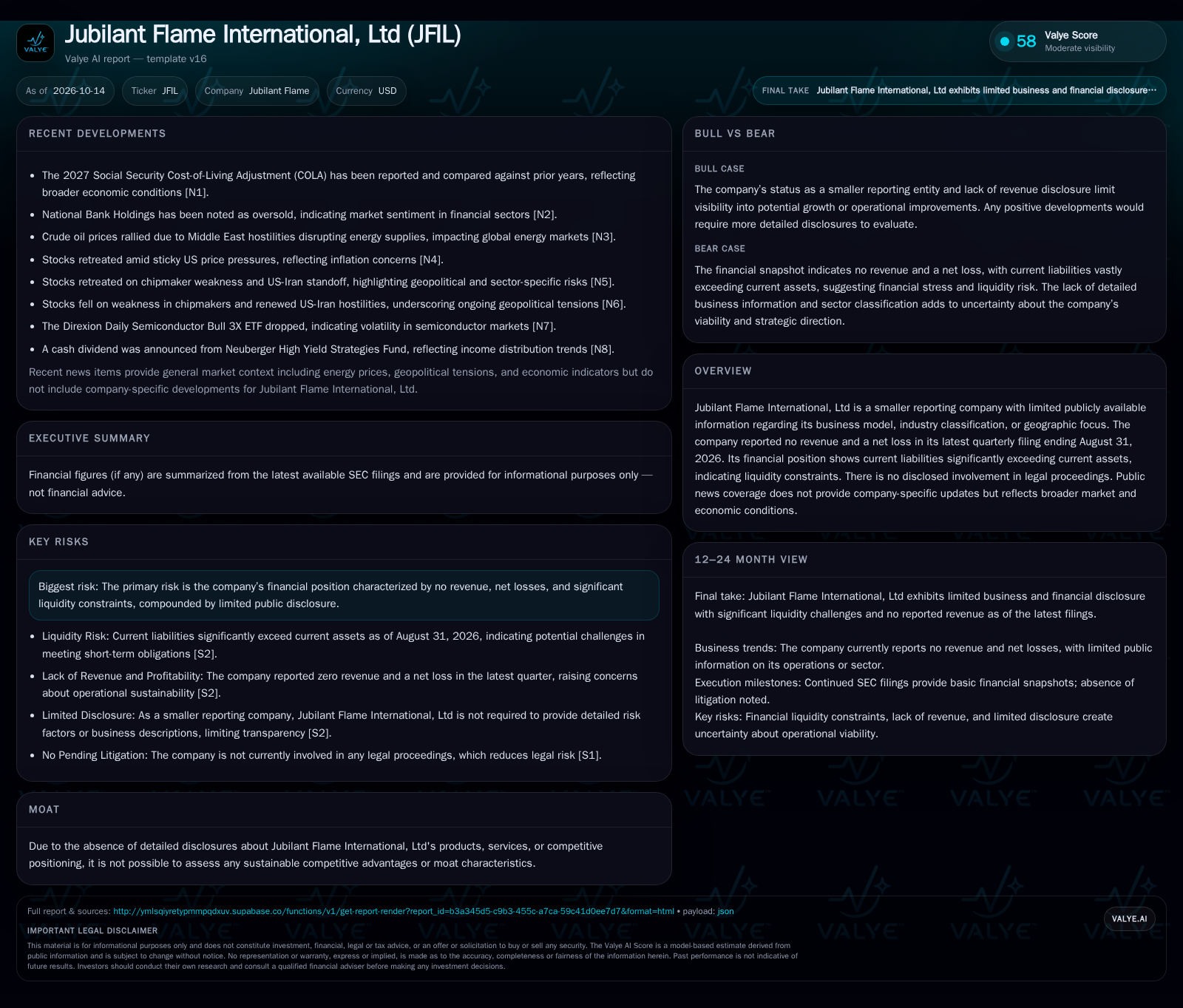
Jubilant Flame International, Ltd currently reports zero revenue and a net loss, with liabilities vastly exceeding assets and a bare minimum of cash on hand. The company provides little public information on its business model or sector, raising substantial uncertainty about its ability to continue as a going concern or pivot to a viable operation. Any future upside would require a dramatic shift in disclosure, financing, and operating execution.[S2]
Jubilant Flame International, Ltd presents an unusual challenge for fundamental analysis: the company’s disclosures reveal no revenue, mounting losses, and a balance sheet with liabilities dwarfing assets, while providing virtually no insight into its business activities, strategy, or sector exposure. The extreme lack of transparency, combined with acute liquidity distress, raises existential questions about its operational viability and the plausibility of any turnaround or pivot. For investors and analysts, the current evidence base suggests a company on the precipice, with little to anchor a thesis beyond survival uncertainty.
Severe Liquidity Constraints and Limited Transparency Shape Current Conditions
Jubilant Flame International, Ltd’s most recent financials show zero revenue and a net loss of $15,277 for the quarter ending August 31, 2026. The company reported cash and liquidity metrics for the period; these figures do not by themselves establish operating runway, investment capacity, financial flexibility, or financing capacity. Cash and cash equivalents were last reported at $2,502 as of November 30, 2023, with no evidence of any material improvement since then. The company provides no substantive disclosure on its business model, sector, or revenue sources, and there is no indication of any pending litigation. In sum, the most material facts are a near-total absence of revenue, persistent net losses, and a balance sheet that signals acute distress, all compounded by a lack of operational transparency.[S1] [S2]
The interplay between liquidity constraints and transparency deficiencies creates a feedback loop that exacerbates the company's operational challenges. Limited financial resources restrict the ability to invest in growth initiatives or strategic pivots, while the opacity surrounding the business model undermines investor confidence and access to capital markets. This dynamic often leads to a cycle where the absence of clear information deters potential funding sources, which in turn deepens liquidity stress and heightens the risk of insolvency. Understanding this mechanism is critical, as any improvement in the company's outlook hinges on breaking this cycle through enhanced disclosure and capital infusion.
Lack of Revenue Streams Coupled with Substantial Capital Requirements
The absence of business model disclosure makes it impossible to determine whether the company aspires to generate revenue through product sales, services, licensing, or another mechanism. In this context, all fixed and variable cost structures are purely speculative, but the ongoing losses suggest at least some ongoing administrative or compliance expenses. Without access to fresh capital—whether through equity, debt, or asset sales—continued operation appears unsustainable. Any plausible turnaround would require not only new financing but also a clearly articulated and executable business model.
In the absence of disclosed revenue streams, analyzing the company's cost structure requires consideration of typical fixed and variable expenses for early-stage or distressed entities. Fixed costs may include regulatory compliance, audit fees, and administrative overhead, which persist irrespective of operational scale. Variable costs, if any, could relate to minimal operational activities or exploratory efforts. The substantial capital requirements to transition from a non-revenue position to a sustainable operation imply a need for significant investment in product development, marketing, or infrastructure. This capital intensity, coupled with the current financial state, underscores the criticality of securing external funding aligned with a credible business model to avoid value erosion through dilution or forced asset sales.
Evaluating Market Position Hindered by Insufficient Operational Insight
Jubilant Flame’s lack of public disclosure on its industry, products, or services makes it impossible to evaluate its market position, potential customer value proposition, or competitive moats. In most sectors, a company with no revenue and severe liquidity constraints would face existential threats from more capitalized, better-positioned competitors. The lack of a disclosed business model also means there is no way to assess switching costs, pricing power, or barriers to entry. In theory, if the company were to declare a viable product or service with unique attributes, it could attempt to carve out a niche, but the current lack of information leaves its competitive standing entirely opaque. For now, Jubilant Flame appears to be a non-player in any competitive market context.
Competitive positioning fundamentally depends on the ability to demonstrate unique value propositions and defendable market advantages, neither of which can be assessed without operational transparency. In sectors characterized by rapid innovation or high capital intensity, incumbents with established customer bases and scale economies can quickly marginalize undercapitalized entrants. Without clarity on the company's strategic differentiators or market focus, it is challenging to evaluate potential barriers to entry or switching costs that might protect future revenues. Moreover, the absence of disclosed intellectual property, partnerships, or customer engagements further weakens the theoretical case for competitive resilience, making the company vulnerable to competitive displacement should it attempt market entry.
Successful Recovery Hinges on Securing Funding and Enhancing Disclosure
For any upside scenario to materialize, Jubilant Flame would need to secure substantial new funding to address its acute liquidity shortfall. This capital would be a prerequisite to maintaining operations and providing the runway to articulate and execute a viable business model. In parallel, the company would have to dramatically increase transparency, disclosing its product plans, target markets, and commercialization strategy. Upside could plausibly emerge if management were to announce a clear pivot—potentially via acquisition, asset injection, or new business line—coupled with evidence of financing and early customer traction. Confirming evidence would include SEC filings disclosing new capital raises, business partnerships, revenue contracts, or a detailed business plan. Conversely, continued opacity and lack of funding would quickly falsify any upside thesis.
Without Strategic Action, Business Continuity Risks Becoming Unfeasible
The most probable outcome, based on current facts, is that Jubilant Flame continues to report minimal activity, ongoing losses, and no revenue, while deferring material operational or strategic disclosures. In this scenario, the company may attempt to maintain listing compliance through minimal administrative functions and periodic SEC filings, but without new capital or a business pivot, the risk of defaulting on obligations or entering dissolution proceedings increases over time. Confirmation would come from continued filings showing negligible revenue, persistent net losses, and no material change in liquidity or business description. Falsification would require evidence of fresh financing, a disclosed operating plan, or initial revenue generation.
Depletion of Cash and Compliance Failures May Lead to Swift Downturn
If Jubilant Flame fails to secure immediate financing or articulate a business plan, the company faces a high risk of exhausting its remaining cash and defaulting on its liabilities. This could lead to bankruptcy, forced asset sales, or involuntary delisting. Regulatory non-compliance is also a material risk if the company cannot meet periodic reporting or listing requirements due to resource constraints. Downside confirmation would include disclosures of insolvency, missed filings, or formal dissolution proceedings. The absence of any change in capital or business activity over subsequent quarters would also support a downside view.
Indicators That Could Reveal Business Viability and Strategic Direction
Disclosure of any new capital raise, whether through equity, debt, or other financing mechanisms, would be critical to testing the company’s ability to remain a going concern.
Filing of a detailed business description or plan, including target markets and products, would help establish the company’s operational intentions.
Evidence of revenue generation—such as signed customer contracts, invoices, or product launches—would indicate a shift toward a viable operating model.
Reduction in current liabilities or a material increase in current assets would signal improvement in the liquidity profile.
Changes in management or board composition, if disclosed, could indicate a strategic pivot or new direction.
Announcements of business partnerships, joint ventures, or acquisitions would provide evidence of active operational strategy.
Disclosure of any regulatory or listing compliance issues would serve as a warning signal for further deterioration.
If disclosed, tracking cash burn rate and runway projections would help assess the urgency of financing needs.
Disclaimer: This is research-only, informational analysis and not investment advice. It may include AI-generated interpretation and general industry context. Always verify important details using primary sources.

Comments