
Blue Chip Capital Group: Financial Strain, Control Remediation, and the Search for a Sustainable Operating Model
Blue Chip Capital Group faces mounting financial pressures amid soaring operating expenses and a deepening working capital deficit, relying on interim capital infusions while executing a remediation plan for material internal control weaknesses. The company’s near-term trajectory will likely hinge on its ability to stabilize costs, strengthen governance, and secure sustainable funding sources.
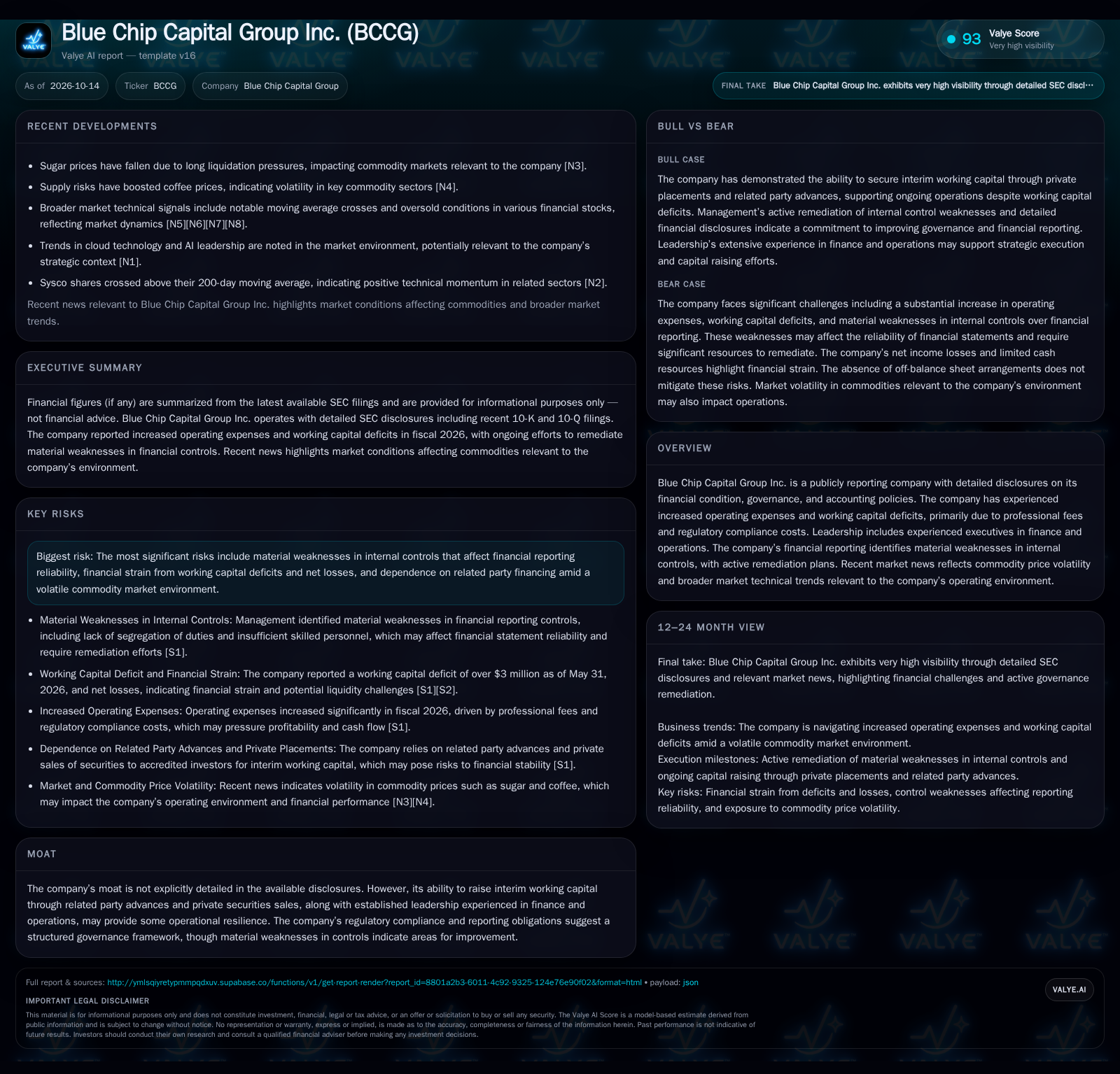
Blue Chip Capital Group’s financial position has deteriorated, with a working capital deficit exceeding $3 million and a sharp rise in operating expenses, mostly due to regulatory and professional fees. The company is funding operations via related party advances and private placements, but persistent net losses and material control weaknesses present acute risks. Successful remediation of controls and a shift to a more sustainable cost structure are critical to future viability. [S1] [S2]
Blue Chip Capital Group Inc. stands at a financial crossroads. Despite detailed SEC disclosures and a leadership team with experience in finance and operations, the company’s operating expenses have spiked dramatically, driving a substantial working capital deficit and recurring net losses. Reliance on related party funding and private placements, alongside persistent material weaknesses in internal controls, raises questions about the sustainability of current operations. With cash reserves nearly exhausted and remediation of governance issues still underway, Blue Chip’s next phase will depend on whether it can meaningfully reduce costs, secure new capital on favorable terms, and restore confidence in its financial reporting.
Mounting Deficits, Rising Costs, and Control Weaknesses Define the Present
Blue Chip Capital Group’s financial condition has sharply deteriorated in the most recent fiscal year. As of May 31, 2026, the company reported a working capital deficit of $3,139,122—more than five times higher than the prior year—driven primarily by increased payables to related parties and other accounts payable. [S1] Operating expenses surged to $21,739,600 for the year, nearly quadrupling year-over-year, with much of the increase tied to higher compensation and professional fees related to SEC reporting and regulatory compliance. [S1] Liquidity is severely constrained: as of August 31, 2026, cash and cash equivalents stood at just $1,403, and the company posted a quarterly net loss of $899,933. [S2] Material weaknesses in internal controls remain unresolved, with management citing lack of segregation of duties and insufficient skilled personnel as key issues. [S1] The company continues to fund its operations through related party advances and private placements of restricted securities and convertible notes. [S1]
Operating Model Under Strain: Expense Structure, Cash Burn, and Funding Mechanics
Blue Chip’s economic model is currently defined by high fixed costs—especially professional fees and compensation linked to regulatory compliance—relative to extremely modest cash inflows. The company’s cash burn rate increased in tandem with elevated general and administrative expenses, as evidenced by the doubling of cash used in operating activities year-over-year. The company reported cash and liquidity metrics for the period; these figures do not by themselves establish operating runway, investment capacity, financial flexibility, or financing capacity. [S1] [S1]
The reliance on private placements and convertible notes, while providing short-term runway, raises concerns about dilution and the sustainability of this funding model. The fact that convertible notes are accounted for at amortized cost with no derivative liability suggests relatively straightforward conversion terms, but the ultimate impact on existing shareholders could be significant if conversion occurs at low share prices. [S1] [S1]
With no established revenue-generating operations detailed in the supplied evidence, the company faces a classic pre-revenue or early-stage financial structure: high administrative overhead, negative operating cash flow, and a dependency on capital markets or insiders for survival. Unless the company can pivot to a model with recurring revenue or meaningfully reduce overhead, the business economics will remain unfavorable.
Governance, Capital Access, and Regulatory Discipline as (Fragile) Differentiators
Blue Chip Capital Group’s current competitive position is defined less by market-facing products or services than by governance, capital access, and regulatory discipline. The company’s detailed SEC disclosures and ongoing remediation of internal control weaknesses suggest a commitment to transparency and regulatory compliance, which could eventually support investor confidence and capital-raising efforts. [S1]
However, the acute dependence on related party funding and accredited investors is a structural vulnerability, not a moat. In the absence of differentiated products, proprietary technology, or recurring revenue, Blue Chip’s competitive advantage appears limited to its ability to navigate capital markets and regulatory frameworks. Peer companies in similar situations—pre-revenue investment vehicles, early-stage holding companies, or shell entities seeking a business combination—often compete on the basis of sponsor reputation, governance quality, and speed of regulatory remediation.
If Blue Chip can successfully remediate its control weaknesses and establish a credible track record of financial reporting, it may gain a modest advantage in attracting new capital or negotiating future business combinations. However, these advantages are tenuous and easily eroded by ongoing financial strain or further governance lapses.
From Survival Mode to Platform for Growth: What a Positive Turn Would Require
The path to a favorable outcome for Blue Chip Capital Group would require rapid remediation of internal control weaknesses, effective cost containment, and successful capital raising to restore liquidity. These steps could restore credibility with investors, reduce financing costs, and position the company as a credible platform for future business combinations or asset acquisitions.
Confirmation of this scenario would come via SEC filings that demonstrate resolved control issues (such as clean auditor attestations and the hiring of skilled financial personnel), a visible reduction in professional fees and compensation costs, and new capital raised on less dilutive terms. Additional evidence would include the announcement of a revenue-generating business line, acquisition, or strategic partnership that signals a shift from pure administrative overhead to operating leverage.
Falsification would occur if remediation efforts stall, costs remain elevated, or capital-raising efforts result in highly dilutive financings or fail to close altogether.
Incremental Progress Amid Continued Strain: The Most Likely Trajectory
The most plausible scenario is that Blue Chip continues to operate in a constrained mode, raising interim capital via related parties and private placements while making incremental progress on internal control remediation. Expenses may remain elevated due to the ongoing need for professional services, with periodic reductions as remediation efforts take hold.
The company is likely to experience continued net losses and negative cash flow absent a fundamental change in its business model or a successful pivot to revenue-generating activities. Over time, persistent financial strain could force further dilution, asset sales, or a strategic review, but the company may avoid immediate insolvency as long as related party support and investor interest persist.
This scenario would be confirmed by continued SEC disclosures of incremental improvements (e.g., hiring, process upgrades) alongside ongoing working capital deficits and reliance on private placements. Falsification would occur if the company either dramatically improves its cost structure and control environment (upside), or loses access to interim funding (downside).
Liquidity Exhaustion and Governance Stalls: How Acute Distress Could Unfold
A negative scenario would be catalyzed by the exhaustion of related party and private placement funding, coupled with persistent material weaknesses in internal controls and continued operating losses. Should investor appetite wane or regulatory scrutiny increase due to unresolved governance issues, the company could face a liquidity crisis.
Evidence for this pathway would include SEC filings disclosing inability to raise new capital, further deterioration in working capital, or resignations/turnover among key financial personnel. Regulatory actions or qualified audit opinions would further erode confidence, potentially leading to delisting or forced asset sales.
This scenario could be falsified if the company secures a non-dilutive capital infusion, demonstrates clear progress on control remediation, or successfully pivots to a business model with positive cash flow.
Milestones That Will Clarify Blue Chip’s Financial and Governance Trajectory
Updates on the remediation of internal control weaknesses, including auditor attestations and new hires in finance or compliance roles.
Quarterly changes in working capital deficit and the composition of payables, especially to related parties.
Trends in operating expenses, particularly professional fees and compensation, as a percentage of total spend.
SEC disclosures on the terms, size, and investor composition of new capital raised via private placements or convertible notes.
Announcements of any new business combinations, asset acquisitions, or revenue-generating initiatives.
Turnover or additions to senior management, especially those with expertise in financial reporting and internal controls.
If disclosed, details on revenue sources, customer contracts, or operating segment performance would help test the thesis.
External regulatory developments or market events (e.g., commodity price shocks) that could impact the company’s funding environment or cost base.
Disclaimer: This is research-only, informational analysis and not investment advice. It may include AI-generated interpretation and general industry context. Always verify important details using primary sources.

Comments