
Mobile Global Esports: Proprietary Fantasy Tech Meets Acute Liquidity Hurdles
Mobile Global Esports, Inc. is betting on data-driven scoring engines and behavioral personalization to carve out a niche in fantasy sports and digital entertainment.
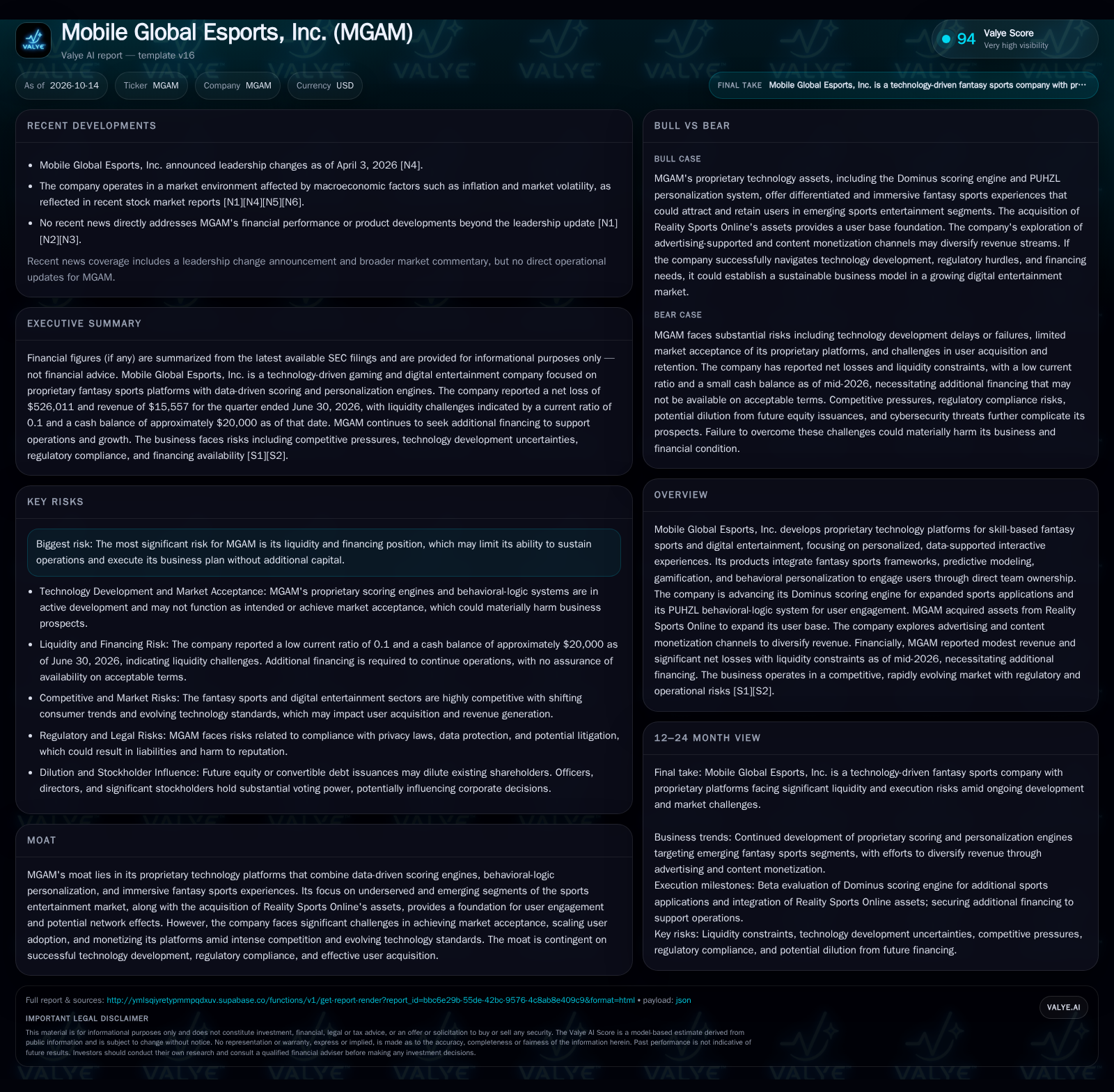
MGAM is a technology-driven fantasy sports company developing proprietary engagement and scoring platforms for emerging sports segments. With minimal revenue, significant net losses, and urgent financing needs, MGAM's ability to scale and monetize its platforms remains highly uncertain in a crowded digital entertainment market [S1] [S2].
Mobile Global Esports, Inc. (MGAM) is attempting to disrupt the fantasy sports and digital entertainment landscape with proprietary, data-driven platforms that promise deeper engagement and personalization. As MGAM pushes to commercialize its Dominus scoring engine and behavioral personalization tools, its future hinges on whether it can convert technological differentiation and a newly acquired user base into sustainable growth—and, critically, whether it can secure the funding needed to survive the next year [S2].
Liquidity Crisis and Technology Development: The Immediate Stakes
The most material facts shaping MGAM’s outlook are its financial distress and ongoing technology build-out. The company reported cash and liquidity metrics for the period; these figures do not by themselves establish operating runway, investment capacity, financial flexibility, or financing capacity. Quarterly revenue was only $15,557, with a net loss of $526,011, highlighting severe cash burn and a lack of operating scale [S2]. MGAM has acknowledged the need for substantial additional funding to continue operations, with no assurance that such capital will be available on acceptable terms. Meanwhile, the company is in the beta phase of adapting its Dominus scoring engine for broader sports applications and is integrating assets from Reality Sports Online to build a user base. These facts underscore that MGAM’s survival depends on both rapid technology and user adoption progress and immediate financing.
The interplay between MGAM's technology development and liquidity constraints creates a feedback loop that could either accelerate or stifle progress. If the company fails to secure timely financing, resource limitations may delay critical product enhancements and user acquisition initiatives, undermining the attractiveness of its platforms. Conversely, successful incremental technology milestones could improve investor confidence, facilitating capital raises. This dynamic underscores the importance of not only the absolute availability of funds but also the sequencing and timing of technology rollouts relative to financing events. The company's ability to prioritize development efforts that most directly improve user experience and retention will be key to optimizing this balance under capital scarcity.
How MGAM Could Monetize Engagement: Platform Economics and Revenue Levers
MGAM’s economics are predicated on the commercial viability of proprietary digital platforms that combine fantasy sports frameworks, predictive modeling, and personalized engagement. Potential revenue streams include user participation fees, advertising placements, and content monetization—each with distinct volume, pricing, and scalability characteristics. The acquisition of Reality Sports Online’s user assets provides a starting point for migration and cross-selling, but user activation, retention, and willingness to pay are not yet proven. The company’s planned shift toward advertising-supported models in 2026 could introduce variable revenue tied to audience size and engagement, but advertising yields in early-stage or niche fantasy sports segments are typically modest unless user growth achieves critical mass. Capital requirements are high: MGAM must invest in technology refinement, marketing, and regulatory compliance, all while managing negative operating leverage due to fixed development and administrative costs outpacing minimal revenue. Until the user base scales and monetization channels mature, the business will likely remain cash-consumptive and funding-dependent.
In addition to direct revenue streams, MGAM’s platform economics hinge on network effects and data monetization potential. As user engagement deepens, the platform could generate valuable behavioral data enabling refined predictive models and targeted personalization, enhancing user retention and monetization opportunities. However, realizing these benefits depends on scale and data quality, which are uncertain at early stages. Furthermore, the cost structure includes ongoing expenses for data acquisition, compliance with data privacy regulations, and infrastructure scalability, which may grow disproportionately if user growth is rapid but monetization lags. Therefore, the path to profitability requires careful calibration of growth investments against achievable revenue per user benchmarks.
Competing for Attention: MGAM’s Niche Versus Established Fantasy and Gaming Giants
MGAM operates in one of the most saturated corners of digital entertainment, where established fantasy sports platforms, large gaming companies, and new entrants compete for user engagement. Its potential advantage lies in proprietary technology—the Dominus scoring engine and PUHZL behavioral logic—which aims to deliver more immersive and personalized experiences, especially in underserved or emerging sports segments. However, switching costs in digital entertainment are low, and user loyalty is fragile unless the platform offers a distinctly superior or novel value proposition. Additionally, competitors with larger budgets can outspend MGAM in both user acquisition and product development. Data licensing, regulatory hurdles, and evolving consumer preferences represent ongoing counterforces. Without rapid demonstration of user traction and differentiated engagement, MGAM risks being overshadowed by better-capitalized incumbents and fast-moving startups alike.
MGAM’s niche strategy relies heavily on differentiation through proprietary technology, yet the sustainability of this advantage depends on continuous innovation and defensibility of intellectual property. Competitors may attempt to replicate or circumvent MGAM’s scoring and personalization algorithms, especially if they prove effective at driving engagement. Additionally, the fragmented nature of emerging sports segments presents both an opportunity and a challenge: while less competition may facilitate penetration, smaller audience sizes limit scalability and advertiser appeal. Strategic partnerships or exclusive data licensing agreements could strengthen MGAM’s position but also require resources and negotiation acumen. Ultimately, the company’s competitive resilience will be tested by its ability to maintain technological leadership and adapt rapidly to shifting consumer preferences.
If Proprietary Tech Drives Viral Adoption and Monetization
The bull case hinges on MGAM successfully leveraging its Dominus and PUHZL platforms to attract and retain a critical mass of users, particularly by targeting sports and engagement formats underserved by mainstream fantasy operators. If user migration from Reality Sports Online is successful and engagement metrics—such as daily active users, session length, and conversion to paying or ad-engaged users—show robust growth, MGAM could establish a defensible niche. The addition of advertising and content monetization could diversify revenue, especially if the company can demonstrate high user engagement to advertisers. Evidence that would confirm this scenario includes accelerating user growth, successful beta launches in new sports verticals, and early signs of positive unit economics (e.g., rising ARPU, declining user acquisition costs, or improving retention).
Incremental User Gains and Ongoing Funding Strain Define the Near Term
The most plausible middle path is one in which MGAM achieves incremental user growth through the integration of RSO assets and continued product development, but struggles to reach scale or break even. Under this scenario, the company remains reliant on periodic external financing to cover operating losses as user monetization lags technology investment and marketing spend. Engagement metrics may improve modestly, but without a viral inflection point or major partnership, revenue remains modest and liquidity risks persist. Validation of this scenario would include continued modest revenue growth, ongoing net losses, and a pattern of small, dilutive capital raises. Falsification would require a sudden step-change in user or revenue growth, or, conversely, a failure to secure needed funding leading to business interruption.
Liquidity Exhaustion or Technology Shortfalls Trigger Disruption
The bear case materializes if MGAM fails to secure sufficient new capital, forcing a halt to development, layoffs, or even insolvency. Alternatively, if the Dominus or PUHZL platforms encounter technical delays, lack market fit, or fail to differentiate versus established competitors, user acquisition could stall, compounding financial distress. Additional risks include regulatory setbacks, cybersecurity incidents, or litigation that sap resources and dampen investor or partner confidence. Confirmation would take the form of missed payroll, halted product launches, or public disclosures of going-concern risk. Conversely, a successful bridge financing or strategic partnership could delay—but not necessarily resolve—the underlying structural challenges.
Milestones and Metrics That Will Define MGAM’s Survival and Scaling Trajectory
User migration and activation rates from Reality Sports Online assets—tracking how many former RSO users register and actively engage with MGAM’s platforms.
Progress updates and beta launch outcomes for the Dominus scoring engine across new sports categories, including feedback from pilot users or partners.
Monthly and quarterly cash burn, and the timing, size, and terms of any new debt or equity financings.
Average revenue per user (ARPU) and user retention/churn rates, if disclosed, to indicate whether engagement is translating into sustainable monetization.
Audience growth and advertising participation metrics as MGAM moves to content-monetization and ad-supported models.
Any material regulatory or legal developments, including data privacy compliance or litigation, that could introduce new costs or restrictions.
Disclosures regarding product roadmap delays, technology setbacks, or missed development milestones.
Changes in the competitive landscape—such as new entrant launches or strategic moves by established digital entertainment platforms—that could affect MGAM’s user acquisition strategy.
Disclaimer: This is research-only, informational analysis and not investment advice. It may include AI-generated interpretation and general industry context. Always verify important details using primary sources.

Comments