
Surge Components Inc: Financial Stability Amid Sectoral Opacity and Margin Constraints
Surge Components Inc enters late 2026 with reported liquidity position and steady, albeit modest, profitability. Yet, the lack of sector and operational detail clouds visibility into its sustainable earnings power and competitive positioning.
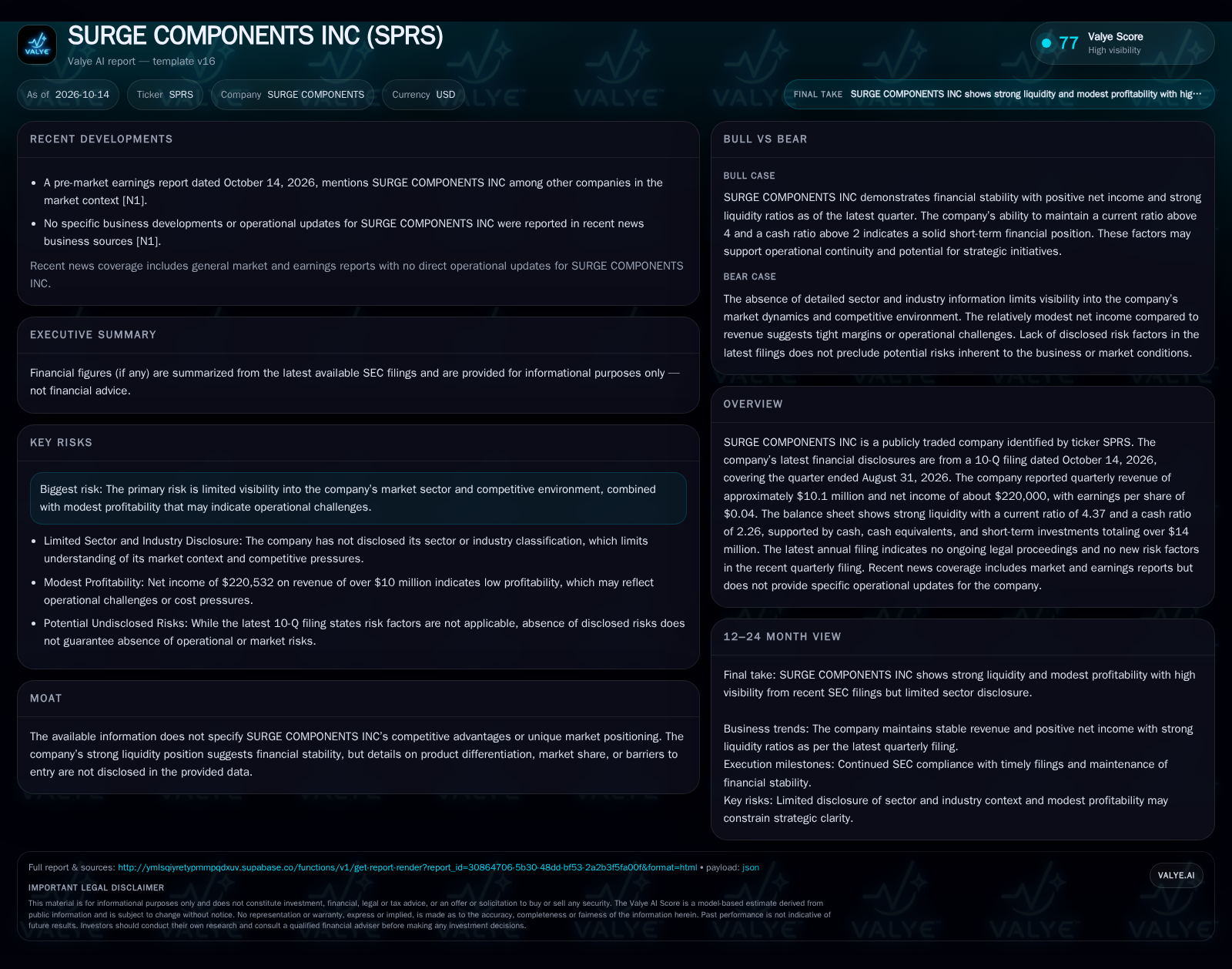
Surge Components Inc (SPRS) reported $10.1M in revenue and $220K in net income for the quarter ended August 31, 2026, supported by over $14M in cash and short-term investments and a current ratio of 4.37. Investors must focus on margin evolution, customer mix, and any future disclosures clarifying its core markets and value proposition. [S2]
Surge Components Inc (SPRS) presents a classic case of financial stability offset by strategic opacity. The challenge lies in discerning whether this is a conservatively managed distributor, an asset-light manufacturer, or a niche component play with latent pricing power. Until more is known about its customer base, products, and industry context, the investment case rests on monitoring changes in margin structure, disclosure practices, and any signals of strategic intent.
Recent Financials Highlight Liquidity Strength, Margin Weakness
As of August 31, 2026, Surge Components Inc reported $10.1 million in quarterly revenue and $220,532 in net income, resulting in an earnings per share of $0.04. The company’s balance sheet is notably liquid, with $4.7 million in cash and $9.5 million in short-term investments, supporting a current ratio of 4.37 and a cash ratio of 2.26. The company reported cash and liquidity metrics for the period; these figures do not by themselves establish operating runway, investment capacity, financial flexibility, or financing capacity. However, with net income representing just over 2% of revenue, the business is operating with narrow margins, raising questions about cost structure, pricing power, and scalability. [S2]
The absence of any sector or industry classification in the filings further complicates the assessment of Surge Components’ business fundamentals. While the company’s liquidity metrics are robust, the lack of context around its revenue sources, customer base, or product mix means that the sustainability of these financials remains uncertain. Investors are left to interpret the numbers without the benefit of knowing whether the company is exposed to cyclical end-markets, operates in a commoditized segment, or has any structural advantages.
Interpreting the Economics: Margin Structure and Operating Leverage
With no disclosure of sector or product lines, Surge Components’ business model could plausibly range from electronic component distribution to light manufacturing or contract assembly. In such businesses, revenue is typically driven by volume rather than pricing power, and gross margins can be tight due to competitive sourcing and commoditization. The reported net margin of just over 2% suggests either limited pricing flexibility, significant operating expenses, or both. Without clarity on customer concentration, contract terms, or product mix, it is difficult to ascertain whether the company can meaningfully improve its earnings through scale or efficiency.
If Surge Components operates in a highly competitive, low-margin segment, its ability to generate incremental profit may depend on cost discipline, supply chain optimization, or selective customer targeting. Conversely, if the company has access to specialized products or captive customers, there may be latent potential for margin expansion. However, the lack of disclosure on these fronts means that any such upside remains speculative. Investors must therefore focus on reported margin trends and any future commentary that could clarify the underlying economic drivers.
Competitive Ambiguity: Potential Advantages and Market Pressures
The absence of sector and industry disclosure makes it challenging to pinpoint Surge Components’ competitive landscape. If operating as a distributor, the business may face intense competition from larger, more diversified peers with scale advantages and digital procurement platforms. If more aligned with niche component manufacturing, differentiation would likely hinge on proprietary designs, customer integration, or responsiveness. However, the low net margin and lack of disclosed intellectual property suggest price-based competition and limited barriers to entry. Without evidence of recurring revenue, customer lock-in, or exclusive supplier relationships, competitive threats from both traditional rivals and digital disruptors remain plausible.
In addition, the company’s filings do not mention any strategic partnerships, exclusive distribution agreements, or technology differentiators. This lack of detail leaves open the possibility that Surge Components is vulnerable to both upstream supplier pricing and downstream customer bargaining power. The company’s ability to defend or expand its market share may therefore depend on operational agility, cost management, or the eventual disclosure of a more defensible business niche.
Margin Expansion via Operational Efficiencies or Product Differentiation
A favorable scenario for Surge Components would emerge if the company can convert its reported liquidity position into operational improvements—through automation, better sourcing, or selective product innovation—that raise gross and net margins. Alternatively, if the company occupies a niche with latent pricing power or sticky customer relationships, disclosure of such dynamics could prompt a re-rating of its earnings quality. Evidence supporting this scenario would include upward movement in gross and operating margins, new product or customer concentration disclosures, or commentary on proprietary offerings. Conversely, continued margin compression or lack of strategic disclosure would weaken the upside case.
Another potential upside lever could be the identification of a core market segment where Surge Components holds a competitive advantage, such as serving a specialized industrial vertical or providing value-added services. Should future filings or management commentary reveal such positioning, the company’s earnings power and growth prospects could be reassessed more favorably.
Sustained Modest Profitability with Limited Growth Visibility
The most plausible near-term outlook is continued stable operations with modest profitability. Revenue may remain range-bound absent new growth levers, and margins are likely to remain thin unless operational changes or market conditions shift meaningfully. Confirmation of this scenario would come from consistent quarterly results with little variation in revenue or net margin, ongoing reported liquidity position, and no major changes in disclosure or business mix. A deviation—such as a step-change in margins or a sector-specific announcement—would signal movement away from this baseline.
Given the lack of sector and customer detail, it is also possible that the company is exposed to end-markets with limited growth potential or faces structural headwinds that cap its upside. In this scenario, the investment case would rest on the company’s ability to preserve capital, maintain operational discipline, and avoid negative surprises, rather than on outsized earnings growth.
Margin Compression or Competitive Encroachment Erode Earnings
The primary risk is that Surge Components’ slim profitability is symptomatic of deteriorating market power or rising costs, rather than temporary pressures. In a downside scenario, intensifying competition, supplier price increases, or customer concentration could further compress margins, potentially pushing the company to breakeven or loss-making territory. Signs of this trajectory would include declining net income despite steady or rising revenue, increased operating expenses, or a drawdown in liquidity not matched by asset investment or growth. A sudden need for external financing or negative working capital shifts would also signal stress.
Additionally, the lack of disclosed risk factors in the latest filings does not guarantee the absence of operational or market risks. Unanticipated disruptions—such as supply chain shocks, customer losses, or regulatory changes—could have an outsized impact on a company with limited margin for error. Investors should be alert to any future filings that introduce new risk disclosures or highlight emerging threats.
Milestones That Could Shift the Surge Components Thesis
Quarterly gross and operating margin trends—if disclosed—would clarify whether margin expansion or compression is underway and help test the company’s ability to improve earnings quality.
Any sector, industry, or product line disclosure would materially improve visibility into the company’s addressable market, peer set, and growth levers.
Customer concentration data—if provided—would indicate earnings volatility risk and potential for recurring revenue or pricing leverage.
Inventory turnover and working capital trends could illuminate demand stability, supply chain agility, and operational discipline.
Disclosure of new product launches, strategic partnerships, or acquisitions would signal management’s intent to pursue growth or diversification.
Quarterly cash flow from operations, rather than simply cash balances, would help assess the sustainability of the company’s liquidity.
Management commentary on competitive positioning or strategic priorities would be crucial for understanding long-term viability and the potential emergence of a moat.
Any material change in risk factors or legal proceedings in future filings would signal emerging threats or disruptions.
Disclaimer: This is research-only, informational analysis and not investment advice. It may include AI-generated interpretation and general industry context. Always verify important details using primary sources.

Comments