
Ekso Bionics (ChronoScale): High-Stakes Pivot to AI Cloud Infrastructure Amid Liquidity and Execution Strains
Ekso Bionics, now operating as ChronoScale, has exited its legacy exoskeleton business to focus exclusively on GPU-powered cloud infrastructure for AI workloads.
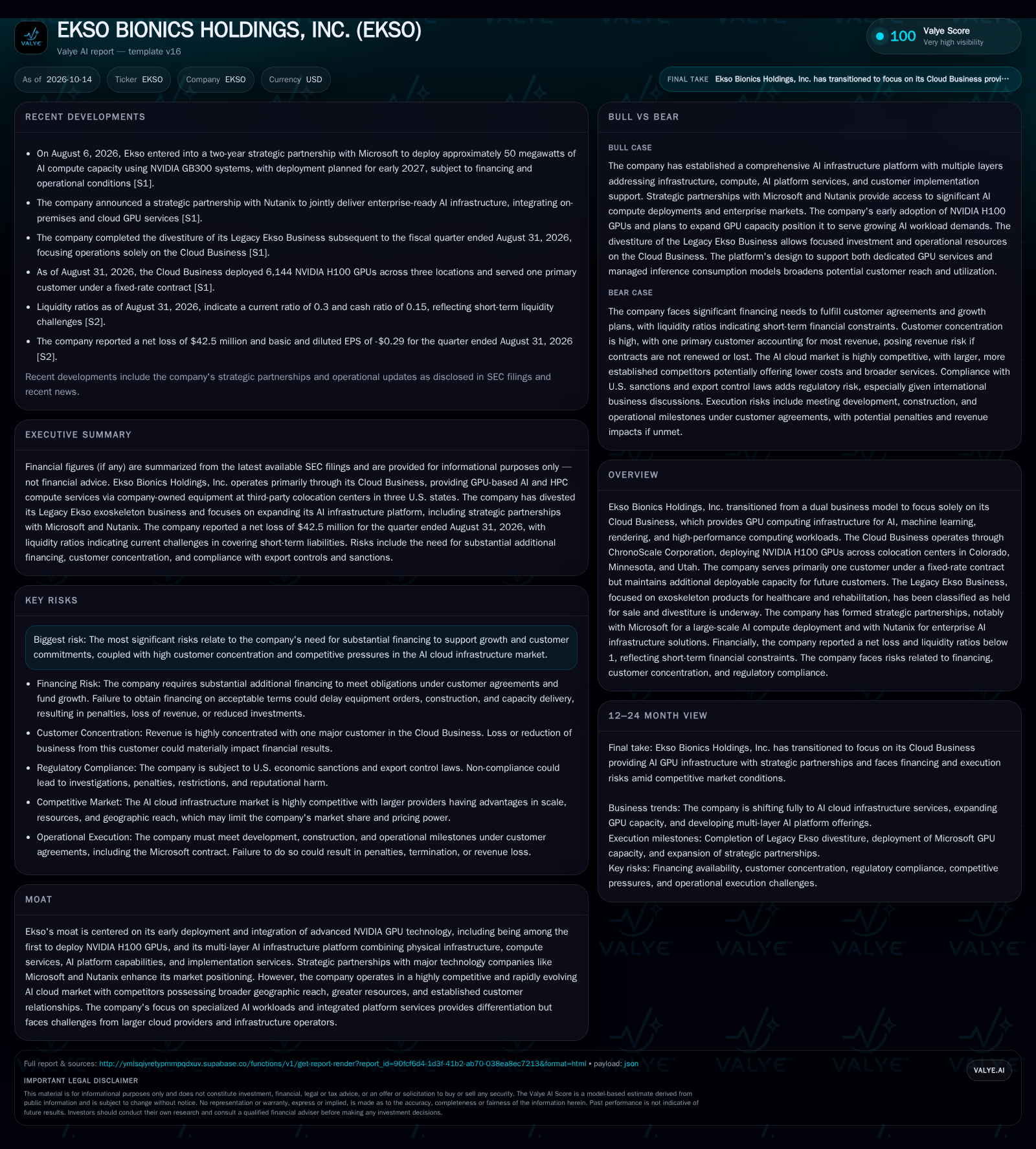
Ekso Bionics, now operating as ChronoScale, has exited its legacy exoskeleton business to focus exclusively on GPU-powered cloud infrastructure for AI workloads. The company’s near-total revenue dependence on a single customer and aggressive expansion ambitions—highlighted by a major Microsoft partnership—contrast sharply with its low liquidity and high quarterly losses. Success depends on access to substantial new financing and rapid execution, as competition intensifies and operational milestones loom. [S1] [S2]
Ekso Bionics Holdings, now rebranded as ChronoScale, has executed a dramatic strategic pivot—abandoning its exoskeleton roots to bet the company on delivering GPU-powered cloud infrastructure for AI and high-performance computing. With nearly all revenue tied to a single customer and an ambitious Microsoft partnership on the horizon, ChronoScale is at a crossroads: the transition offers a route to relevance in the booming AI infrastructure market, but liquidity shortfalls and looming execution demands threaten both its competitive stance and operational continuity. The next year will test whether ChronoScale can transform strategic promise into a sustainable, diversified business—or become another cautionary tale of overreach in a capital-intensive, hyper-competitive sector.
Strategic Refocus, Customer Concentration, and Looming Capital Needs
ChronoScale (formerly Ekso Bionics) has shed its exoskeleton business to concentrate entirely on providing GPU-based cloud infrastructure for AI, machine learning, and HPC workloads. This pivot is underscored by the recent completion of the Legacy Ekso divestiture and the company’s operational focus on its Cloud Business. As of August 2026, nearly all revenue comes from a single customer, Together AI, which is served under a fixed-rate agreement utilizing 6,144 NVIDIA H100 GPUs. The company’s future ambitions are embodied in a two-year partnership with Microsoft for a planned 50 MW AI compute deployment, but this is contingent on securing additional capital and flawless execution. Financially, ChronoScale’s liquidity is acutely strained, with a current ratio of 0.3 and a quarterly net loss of $42.5 million. The materiality of these facts lies in their combined effect: a high-risk, high-reward transformation that leaves the company vulnerable to execution missteps, financing gaps, and revenue shocks. [S1] [S2]
GPU Cloud Economics: Fixed Costs, Utilization, and the Leverage Equation
ChronoScale’s business model—offering GPU compute as a service—centers on high upfront capital outlays for hardware (NVIDIA H100s), long-term data center commitments, and the pursuit of high utilization rates. Revenue is primarily generated through contracted GPU infrastructure and usage-based AI platform services. The economics hinge on spreading substantial fixed costs (hardware, colocation, power, and network) over as many high-value AI workloads as possible, driving operating leverage as utilization increases. However, with only one major customer, utilization risk is elevated: excess capacity translates directly into underused assets and margin erosion. The planned Microsoft deployment, if financed and executed, could dramatically improve scale and absorption, but also raises the stakes for capital intensity and execution complexity. Margins in GPU cloud services are sensitive to hardware depreciation schedules, power prices, and the ability to secure premium pricing for high-performance workloads—factors often dictated by competitive intensity and customer bargaining power. In the near term, the need for substantial external funding to meet both existing obligations and growth ambitions is likely to dilute current shareholders or require creative financing solutions.
Specialization Versus Scale: Navigating Giants in the AI Infrastructure Arena
ChronoScale’s differentiation is built on early access to cutting-edge NVIDIA GPUs and a multi-layered platform architecture (infrastructure, compute, managed inference, and implementation services). Strategic partnerships with Microsoft and Nutanix provide potential credibility and market access. However, the company faces formidable competition from hyperscalers (such as AWS, Google Cloud, and Microsoft Azure) and specialized GPU cloud operators, all with deeper pockets, established customer bases, and broader geographic reach. The risk is that ChronoScale’s scale and capital constraints may limit its ability to compete on price, service breadth, or geographic coverage. Its focus on customizable, high-performance AI workloads and enterprise integration could appeal to a subset of customers seeking alternatives to the largest cloud providers, but customer acquisition and retention will be challenging without a broader installed base or unique platform capabilities. The reliance on NVIDIA as a primary GPU supplier also exposes the company to supply chain and pricing risks, though the intention to add AMD as a supplier could help mitigate this over time. Ultimately, ChronoScale’s competitive position will depend on its ability to carve out a defensible niche and demonstrate reliable, differentiated execution.
From Single-Customer Reliance to Platform Scale: What a Winning Trajectory Looks Like
The most favorable outcome for ChronoScale would follow a sequence where the company successfully secures the necessary financing to deploy the Microsoft 50 MW project, executes on existing and new customer commitments without major delays, and leverages its partnerships to attract additional enterprise customers. As capacity utilization rises, fixed costs are absorbed more efficiently, gross margins improve, and customer concentration diminishes. A successful build-out would also validate ChronoScale’s platform strategy, enhancing its credibility and opening doors to additional strategic partnerships or enterprise contracts. Evidence supporting this scenario would include announcements of new customer wins beyond Together AI, confirmation of financing for the Microsoft deployment, and sequential improvements in utilization rates and gross margin. If the company demonstrates consistent operational execution and begins to diversify its revenue base, its perceived risk profile could improve, potentially unlocking better financing terms and higher valuation multiples.
Balancing Growth Ambitions with Financial Realities in a Crowded Market
A more probable scenario is that ChronoScale manages to secure partial financing for its near-term commitments, allowing incremental deployment of new capacity but at a slower pace than initially envisioned. Customer concentration remains high in the short term, with Together AI providing the majority of revenue, while the Microsoft deployment proceeds in phases as capital becomes available. Competitive pricing pressure from larger cloud providers constrains margin expansion, and the company must continually weigh growth investments against liquidity preservation. Under this scenario, ChronoScale’s survival depends on careful cash management, disciplined capital allocation, and the ability to demonstrate enough operational progress to attract new customers and incremental funding. Confirmation would come from steady, if modest, increases in GPU utilization, evidence of cost control, and gradual onboarding of additional enterprise or mid-market customers. Any material operational or financing setbacks would threaten this delicate balance.
Liquidity Crunch and Customer Loss: The Double-Edged Threat to Continuity
The adverse scenario materializes if ChronoScale is unable to secure the necessary financing to meet its Microsoft and other contractual obligations, forcing delays or cancellations of key deployments. In this event, the company may face penalties, reputational damage, and the risk of customer churn—including the loss or non-renewal of its primary customer, Together AI. Underutilized GPU assets would exacerbate cash burn and margin compression, while high fixed costs and low liquidity could trigger restructuring or distressed asset sales. Competitive pressures could further erode pricing or make it difficult to win new contracts, particularly if hyperscalers or better-funded competitors undercut ChronoScale’s offerings. In the extreme, the company could be forced to seek strategic alternatives or face insolvency.
Milestones and Metrics That Will Determine ChronoScale’s Trajectory
Confirmation of committed financing for the Microsoft 50 MW AI compute deployment—timing, structure, and any material changes to terms.
Expansion of the customer base beyond Together AI, including new enterprise contract announcements or pilot deployments.
Disclosure of GPU utilization rates and trends—if disclosed, this would provide insight into operating leverage and margin trajectory.
Gross margin progression and cost absorption as additional capacity comes online.
Operating cash flow trends and any updates to liquidity management plans or capital-raising efforts.
Progress updates on the Nutanix partnership and any resulting customer wins or platform integrations.
Any regulatory developments or compliance disclosures related to U.S. export controls or international business expansion.
Timely achievement of operational milestones for major deployments, especially the Microsoft contract, and any associated penalties or delays.
Disclaimer: This is research-only, informational analysis and not investment advice. It may include AI-generated interpretation and general industry context. Always verify important details using primary sources.

Comments