
Educational Development Corp: Distribution Reliance, Margin Pressures, and the Path Forward in Children’s Publishing
Educational Development Corp’s financials reveal margin compression, persistent losses, and acute dependence on a single major supplier. The company’s dual-channel structure offers diversification potential, but execution risks around cost control, distributor relations, and supplier concentration remain central to its outlook.
The company’s future will hinge on its ability to improve cost efficiency, maintain key supplier relationships, and adapt its dual-channel sales model to changing market conditions. [S2]
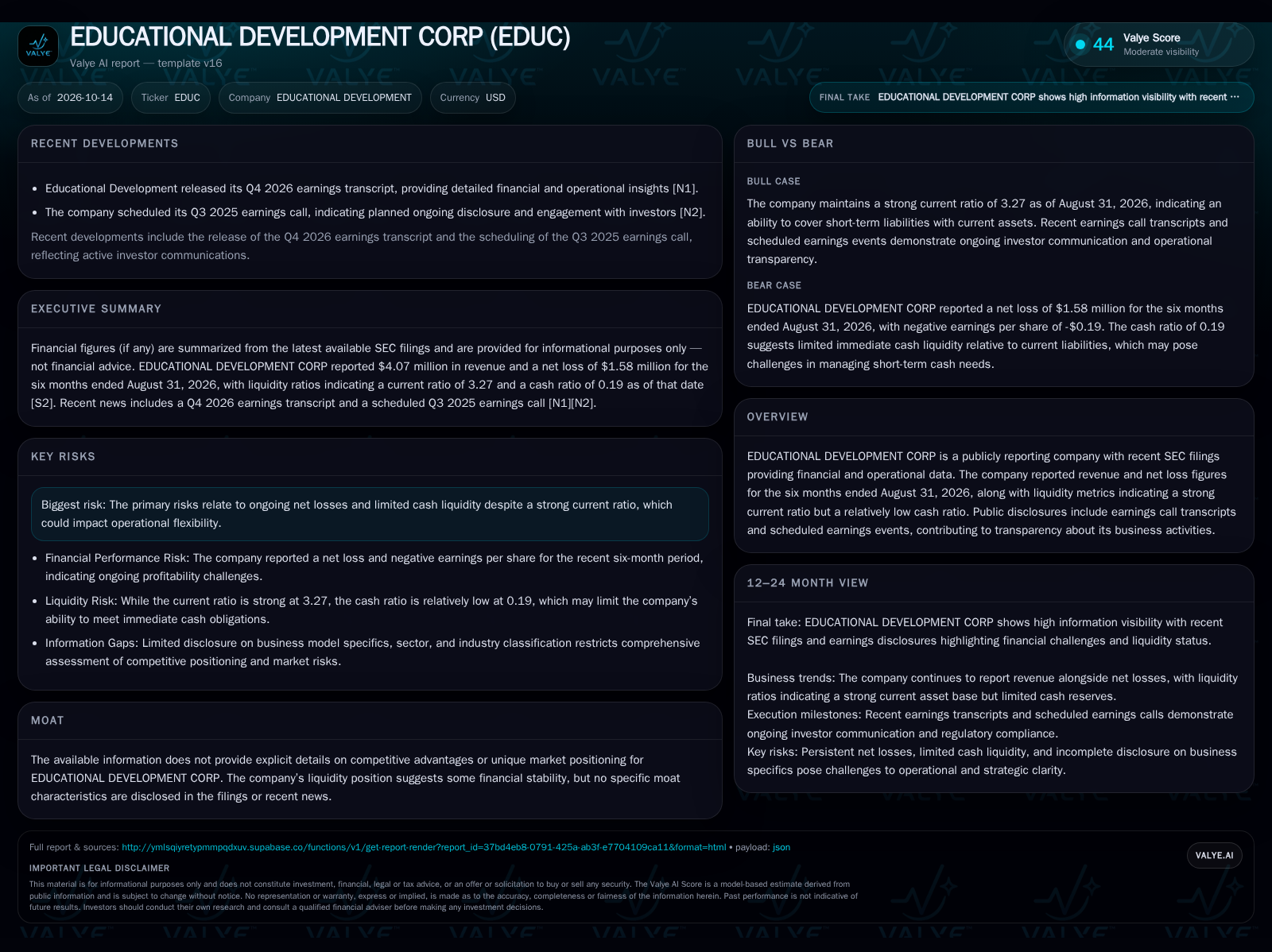
Educational Development Corp (EDUC) faces a confluence of structural and operational challenges. For the six months ended August 31, 2026, the company reported $4.07 million in revenue but continued to operate at a loss, with net income at -$1.58 million. Most notably, EDUC’s dependence on Usborne for a significant portion of its inventory introduces supplier risk, particularly as recent minimum purchase obligations have not been met. The company’s performance will depend on its ability to manage supplier relations, control costs, and extract more value from its dual-channel sales model. [S2]
Supplier Concentration and Margin Compression Shape the Immediate Outlook
Educational Development Corp reported $4.07 million in revenue and a net loss of $1.58 million for the six months ended August 31, 2026, with basic and diluted EPS of -$0.19. The company’s current ratio stands at 3.27, but its cash ratio is just 0.19, indicating that most current assets are tied up in inventory or receivables rather than immediately available cash. Gross margins remain under pressure, and the company continues to operate at a loss, with fixed costs and sales commissions consuming a significant portion of operating expenses. Critically, EDUC’s distribution agreement with Usborne—a major supplier—has not met minimum purchase volumes or timely payment obligations in recent years. While no termination notice has been received, the risk of contract loss remains material. Should the agreement end, EDUC would be allowed to sell through its remaining Usborne inventory over a 12-month period, but long-term revenue visibility would be impaired. [S2]
How EDUC Makes—and Loses—Money: Pricing, Volume, and Fixed Cost Drag
EDUC generates revenue through two primary divisions: PaperPie (multi-level marketing of children's books and educational products) and Publishing (wholesale sales to retailers). Both divisions are heavily dependent on product volume and the vitality of their respective distribution networks. The multi-level marketing (MLM) approach can drive high-volume sales in favorable cycles but is susceptible to volatility in distributor engagement and consumer demand. The Publishing division’s wholesale model offers access to broader retail channels but typically operates on thinner margins.
Gross margin for the six-month period was $2.43 million on $4.07 million in net revenue, but total operating expenses—including sales commissions and general/administrative costs—reached $3.99 million. High fixed expenses, especially sales commissions and G&A, limit operating leverage and make break-even challenging at current volumes. The company reported a cash ratio of 0.19 for the period. Variable costs track with sales, but the company’s fixed cost base creates significant downside risk if volumes continue to decline or if supplier disruptions occur.
Capital needs are moderate in a typical asset-light publishing and distribution model, but the Usborne agreement’s minimum purchase requirements and payment terms elevate working capital demands and liquidity risk. Any need to restock or expand inventory would further strain cash resources if not matched by improved sales velocity.
Distribution Dependency and the Absence of a Durable Moat
EDUC’s competitive position is defined by its exclusive U.S. MLM distribution rights for Usborne books, as well as ownership of Kane Miller, Learning Wrap-Ups, and SmartLab Toys. This provides a differentiated product portfolio, but the moat is shallow: if the Usborne relationship deteriorates or is terminated, EDUC would lose access to a key product line that drives much of its revenue. The company’s own imprints and educational toys offer some insulation, but are unlikely to offset the loss of the Usborne pipeline in the short to medium term.
Competition includes other children’s book publishers, educational toy makers, and alternative direct-to-consumer or digital-first educational content providers. The company’s MLM channel faces both traditional publishing competitors and the broader challenge of declining MLM engagement industry-wide. The wholesale channel is exposed to retail consolidation and the shift toward online marketplaces, where EDUC’s products may have weaker brand recognition compared to larger players.
Switching costs for distributors and customers are modest: alternative suppliers and publishers are available, and digital content is increasingly substitutable. EDUC’s lack of proprietary technology or unique distribution infrastructure limits its pricing power and leaves it vulnerable to both supplier and channel disruption.
A Path to Recovery: Cost Tightening and Supplier Continuity Drive Turnaround Potential
The most plausible upside scenario involves EDUC regaining operational discipline while maintaining its relationship with Usborne. Improvements in sales efficiency—through better distributor engagement, targeted marketing, and tighter inventory control—could lift gross margins and reduce working capital needs. If the company can renegotiate more favorable terms with Usborne or diversify its supplier base, it may mitigate the risk of abrupt contract loss and stabilize revenue streams.
Cost reduction in G&A and sales commissions, perhaps through digital transformation or leaner organizational design, would enhance operating leverage. Success in launching or growing proprietary product lines (Kane Miller, SmartLab, Learning Wrap-Ups) could reduce supplier concentration and increase margin contribution over time.
Confirmation of this scenario would come from sequential improvements in gross margin, a reduction in operating expenses as a percentage of sales, and evidence of successful renegotiation or extension of the Usborne agreement. Additional signals would include sustained or growing MLM distributor engagement and expansion of the wholesale customer base.
Sustained Losses and Eventual Inflection Hinge on Supplier Stability
Absent aggressive cost controls or new revenue drivers, EDUC is likely to continue operating at a loss over the next several quarters. The company’s current asset base and inventory may allow it to meet short-term obligations, but persistent net losses will gradually erode potential financial flexibility. The ongoing risk of Usborne contract termination is significant: if unresolved, it could lead to a phased wind-down of a major revenue stream, with only a 12-month inventory sell-through period as a buffer.
In this scenario, the company muddles through with modest revenue declines, incremental cost management, and no material improvement in underlying profitability. Cash constraints may force tighter inventory management or selective investment in new products, but without a structural change in supplier relations or operating model, EDUC’s medium-term outlook remains challenged.
This trajectory would be confirmed by continued negative EPS, stable but low cash balances, and no material change in cost structure or supplier diversification. A lack of new product launches or distributor growth would further signal stagnation.
Contract Termination or Distributor Attrition Could Trigger a Sharp Downturn
The key downside risk is the termination of the Usborne distribution agreement, which could occur if minimum purchase or payment terms continue to be missed. Without Usborne titles, EDUC would be forced to rely solely on its proprietary product lines, which may not sustain current sales volume. The 12-month sell-through provision would only delay—not prevent—a steep revenue decline.
Distributor attrition in the MLM channel, whether from lower engagement or competitive poaching, would further erode sales momentum. High fixed costs and reported cash balance would amplify losses, potentially leading to liquidity distress, asset sales, or a forced restructuring. The company could also face inventory write-downs or working capital squeezes if sales velocity drops abruptly.
Warning signs for this scenario include a formal non-compliance notice from Usborne, a sharp decline in reported revenues, or evidence of distributor network contraction. Escalating operating losses and a further drop in the cash ratio would confirm deteriorating financial health.
Milestones That Will Define EDUC’s Next Phase
Renewal, renegotiation, or termination developments regarding the Usborne distribution agreement—any change here would materially alter the revenue base and risk profile.
Gross margin trends by division, which would indicate whether cost control, pricing, and product mix efforts are yielding improvement.
Sequential trends in operating expenses and sales commissions as a percentage of revenue—if disclosed, these would clarify progress on cost discipline.
MLM distributor headcount and engagement metrics, if disclosed, to assess the health and growth potential of the PaperPie channel.
Wholesale customer concentration and retention rates, which would speak to the resilience of the Publishing division’s revenue stream.
Inventory turnover rates and days sales outstanding, as indicators of working capital efficiency and demand health.
Any new product launches, supplier agreements, or channel partnerships that could diversify revenue and reduce dependency on Usborne.
Disclaimer: This is research-only, informational analysis and not investment advice. It may include AI-generated interpretation and general industry context. Always verify important details using primary sources.

Comments