
Comtech’s Strategic Reset: Divestiture, Margin Expansion, and the Public Safety Bet
Comtech Telecommunications faces a pivotal transformation as it divests its satellite business, shifts focus to next-generation public safety technologies, and seeks to stabilize operating results after significant losses. The path forward hinges on execution, regulatory closure, and proving the economics of its evolving business model.
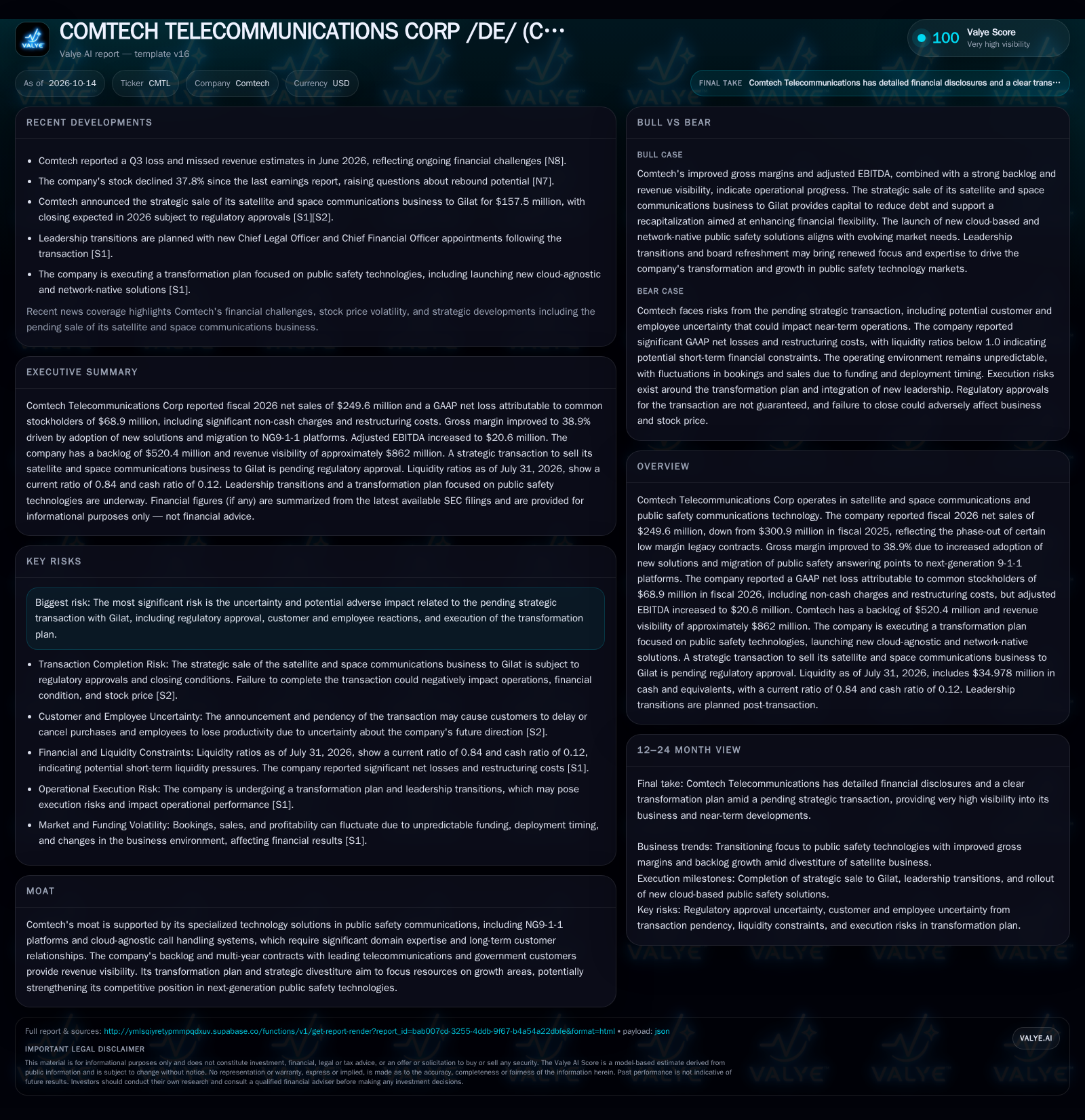
Comtech is divesting its satellite and space communications business to Gilat for $157.5 million, redirecting its strategy toward cloud-native public safety solutions. Fiscal 2026 saw a sharp revenue decline but notable gross margin improvement. The company reported a significant net loss but boosted adjusted EBITDA, and maintains a substantial backlog. The transformation’s success will depend on transaction closure, leadership transitions, and the performance of new public safety offerings. Liquidity remains tight, making operational execution and cash generation critical watchpoints. [S1] [S2]
Comtech Telecommunications is undergoing a high-stakes strategic overhaul, marked by the divestiture of its satellite and space communications business and a pronounced pivot toward cloud-based public safety technologies. While the company has managed to expand gross margins and secure a robust backlog, it continues to post significant net losses and faces acute liquidity pressures. The pending sale to Gilat, leadership transitions, and the market acceptance of Comtech’s new public safety platforms will determine whether this transformation delivers sustainable value or exposes deeper structural vulnerabilities.
Recent Financials and Strategic Actions Shape the Near-Term Outlook
Comtech reported fiscal 2026 net sales of $249.6 million, a steep decline from $300.9 million in fiscal 2025, as the company intentionally phased out low-margin and capital-intensive legacy contracts. Despite the revenue drop, gross margin improved from 31.6% to 38.9%, driven by the adoption of new technology solutions and the migration of public safety answering points (PSAPs) to next-generation 9-1-1 platforms. The company posted a GAAP net loss of $68.9 million, reflecting substantial non-cash charges and restructuring costs, but adjusted EBITDA rose to $20.6 million from $16.4 million the prior year. Comtech has agreed to sell its satellite and space communications business to Gilat for $157.5 million, with closing subject to regulatory approval, and is executing a transformation plan focused on public safety technologies. The company reported cash and liquidity metrics for the period; these figures do not by themselves establish operating runway, investment capacity, financial flexibility, or financing capacity. [S1] [S2]
Margin Expansion, Revenue Mix, and the Challenge of Public Safety Economics
Comtech’s business model is in flux as it shifts from hardware-heavy, capital-intensive satellite contracts to software-driven, service-oriented public safety offerings. The recent phase-out of low-margin legacy business has reduced top-line revenue but improved gross margins, suggesting a deliberate move toward higher-value, potentially recurring revenue streams. The economics of next-generation 9-1-1 and public safety platforms are typically characterized by multi-year contracts, integration complexity, and high switching costs, but also require significant upfront investment in platform development and customer acquisition.
The company’s improved gross margin—now 38.9%—suggests that the new product mix is structurally more profitable, provided that volume and adoption can be scaled. However, the fixed cost base, restructuring costs, and ongoing transformation expenses have kept Comtech in a net loss position. Adjusted EBITDA growth indicates some operating leverage, but sustained profitability will likely require both higher sales volume of new solutions and further cost discipline. The capital freed by the satellite business sale could be used to pay down debt or reinvest in public safety R&D, but will also be needed to shore up working capital and support the transformation. If the company succeeds in converting its backlog and revenue visibility into profitable growth, it could achieve a more resilient, margin-rich business model.
Specialization in Public Safety: Moat or Mirage?
Comtech’s future competitive position hinges on its ability to deliver differentiated, cloud-agnostic public safety solutions in a market dominated by established telecom equipment vendors, specialized software integrators, and large IT service providers. Its installed base and multi-year relationships with leading U.S. telecommunications and government customers provide a degree of revenue visibility and customer stickiness, especially in next-generation 9-1-1 deployments, where integration and regulatory requirements create moderate switching frictions.
However, the public safety communications market has seen increasing competition from cloud hyperscalers, SaaS-native vendors, and agile startups, all aiming to disrupt legacy PSAP infrastructure. The question is whether Comtech’s new cloud-agnostic platforms (Allerium Mira and Allerium Coral) can deliver enough technical and operational differentiation—such as interoperability, reliability, and compliance—to command premium pricing or secure multi-year contract renewals. The company’s historical expertise, domain-specific integrations, and regulatory familiarity may provide a moat, but only if it can keep pace with rapid technological change and evolving procurement models.
A Successful Pivot: When Margin Expansion Meets Sustainable Growth
If Comtech successfully closes the sale of its satellite business and deploys the proceeds to stabilize its balance sheet, the company could emerge as a focused leader in public safety communications. The upside scenario hinges on the rapid adoption of its new cloud-agnostic and network-native solutions, enabling it to convert backlog into high-margin, recurring service revenue. Operating leverage from the new business mix could drive adjusted EBITDA growth and, over time, a return to GAAP profitability.
Evidence confirming this scenario would include: regulatory approval and timely closing of the Gilat transaction; sequential growth in bookings and backlog for public safety solutions; improved operating cash flow from core operations (excluding restructuring costs); successful onboarding of new leadership with relevant domain expertise; and customer wins or contract extensions with leading U.S. telecom and government entities. Early revenue traction and favorable customer references for the Allerium platform would further validate the transformation.
Transformation Struggles: Execution Risk and Slow Adoption
The most plausible scenario is a protracted period of execution risk, with Comtech working to stabilize operations post-divestiture amid ongoing leadership transitions. The company’s backlog and revenue visibility provide some cushion, but realization depends on timely project execution, customer retention, and the ability to win new business in a competitive market. Gross margins may remain elevated relative to historical levels, but restructuring charges and transformation expenses could continue to weigh on net income.
This scenario would be confirmed by steady but unspectacular growth in public safety bookings, modest improvement in adjusted EBITDA, and a gradual reduction in net losses as the transformation plan matures. Delays in closing the Gilat transaction, slower-than-expected adoption of new platforms, or loss of key personnel could extend the recovery timeline. The absence of new material contract wins or customer endorsements would signal challenges in breaking out from the competitive pack.
Transaction Failure or Market Rejection: Liquidity and Competitive Pressures Intensify
The adverse scenario is one in which the Gilat transaction fails to close—due to regulatory or other hurdles—leaving Comtech with a subscale, capital-hungry satellite business and continued financial strain. In this case, liquidity pressures could intensify, forcing the company to seek dilutive financing or further asset sales. Alternatively, if the public safety transformation falters—because of weak customer adoption, technical shortcomings, or aggressive competition—Comtech could see bookings and backlog erode, with revenue visibility deteriorating.
Evidence for this scenario would include a failed or delayed transaction, public disclosures of material contract losses or cancellations, negative cash flow trends, and further deterioration in liquidity ratios. Additional restructuring charges, missed operating targets, or high leadership turnover would compound the risk. The stock’s recent 37.8% decline since the last earnings report [N7] suggests that investors are already pricing in some risk of downside outcomes.
Milestones That Will Validate or Challenge Comtech’s Public Safety Ambitions
Closure and timing of the Gilat satellite business sale, including regulatory approvals and final transaction terms.
Growth in bookings and backlog for next-generation public safety solutions, particularly Allerium Mira and Coral.
Operating cash flow from core operations, excluding restructuring and transition costs, as a sign of business model health.
Adjusted EBITDA margin progression post-divestiture, as a proxy for operating leverage in the new portfolio.
Customer wins, contract extensions, or high-profile deployments in U.S. public safety and telecom markets.
Retention and successful onboarding of new leadership, especially in legal and financial roles post-transaction.
If disclosed, customer churn or renewal rates for public safety platforms would help test the stickiness of the new offerings.
Disclaimer: This is research-only, informational analysis and not investment advice. It may include AI-generated interpretation and general industry context. Always verify important details using primary sources.

Comments