
Stimcell Energetics: Bioelectric Therapy Platform Stalled by Acute Financial and Regulatory Constraints
Stimcell Energetics’ proprietary eBalance® microcurrent technology offers a differentiated approach for managing diabetes-related complications, but severe liquidity shortfalls and suspended regulatory certifications have halted development and market access. The company’s ability to realize its scientific promise now hinges on securing funding, restoring compliance, and demonstrating scalable commercial execution.
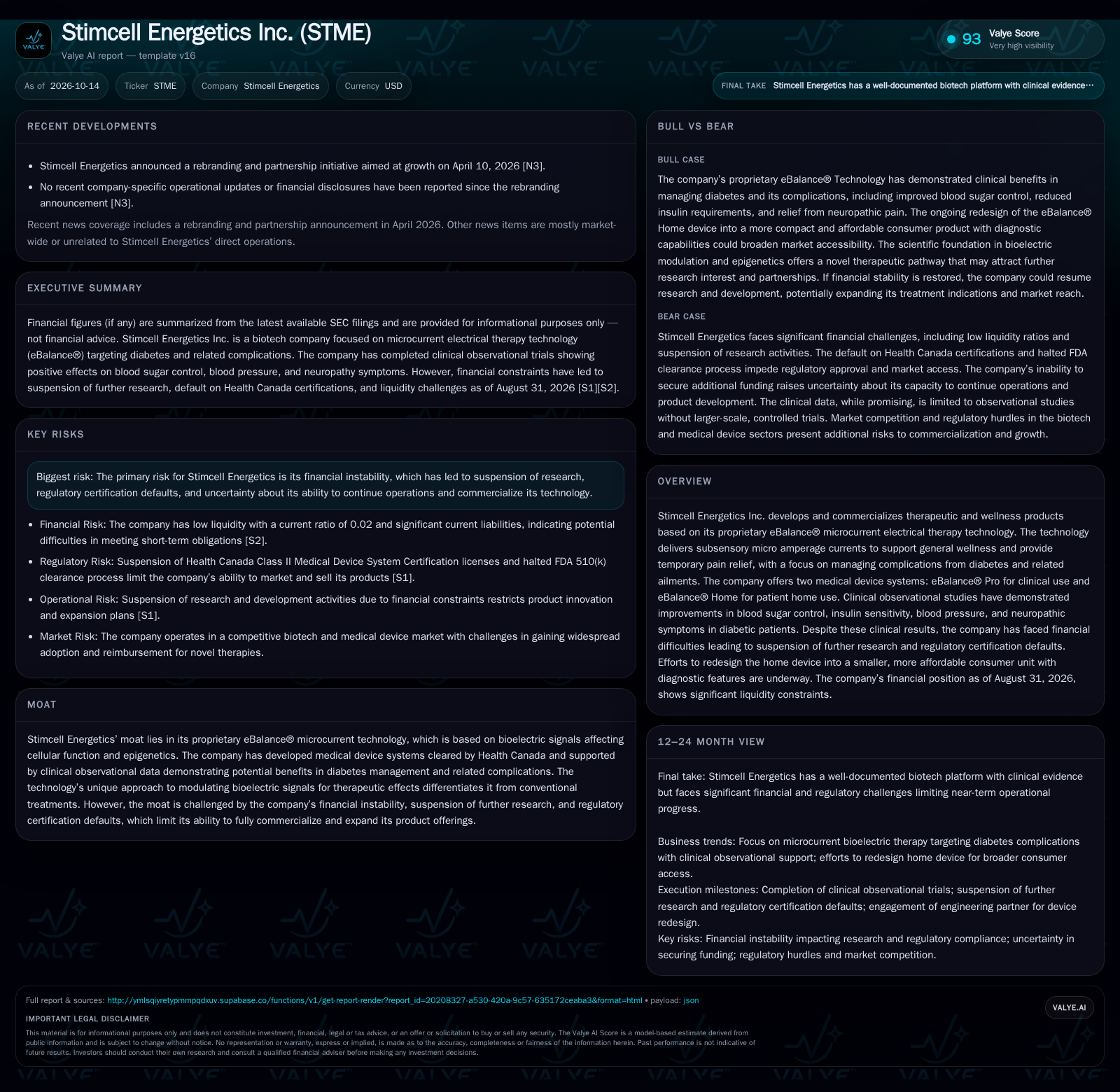
Stimcell Energetics’ eBalance® platform demonstrated encouraging clinical outcomes in diabetes management, but the company’s path forward is blocked by a critical lack of liquidity, suspended Health Canada device certifications, and frozen R&D activities. Its future depends on recapitalization and renewed regulatory progress, with market adoption and competitive positioning still untested at scale. [S1] [S2]
Stimcell Energetics Inc. stands at a strategic and financial impasse. While its proprietary eBalance® microcurrent therapy platform has produced promising observational results for diabetes-related complications, the company’s operational engine has all but stalled. With device certifications suspended, R&D halted, and a cash position dwarfed by near-term liabilities, the theoretical promise of bioelectric modulation remains unproven at scale. The next phase for Stimcell will be determined not by scientific progress, but by its success or failure in recapitalizing, regaining regulatory standing, and proving that its technology can move beyond pilot-stage results to commercial viability.
Liquidity Crisis and Certification Default Set Immediate Boundaries
As of August 31, 2026, Stimcell Energetics reported cash and equivalents of only $30,736 against current liabilities of $1,860,355, resulting in a current ratio and cash ratio of just 0.02. This acute liquidity constraint has forced the company to suspend all further research and product development, including halting the FDA 510(k) clearance process. Compounding these challenges, Health Canada suspended the Class II Medical Device licenses for both the eBalance® Pro and eBalance® Home systems in June 2023, directly restricting Stimcell’s ability to legally market or sell its core products in Canada. These facts sharply limit the company’s operational flexibility and ability to generate revenue in the near term. [S1] [S2]
The company’s most recent public developments include a rebranding and a partnership announcement in April 2026, but there is no evidence of resumed operational activity or regulatory progress since then.
Product Economics and the Challenge of Scaling a Device-Driven Platform
Stimcell’s business model is built around proprietary hardware and potential software extensions for therapeutic and wellness indications. The eBalance® Pro and Home systems are medical devices intended for clinical and home use, respectively. In principle, device-based platforms in healthtech can generate revenue through direct sales, leasing, or recurring service/software fees if a robust ecosystem is established. However, the economics are heavily dependent on regulatory clearance, insurance reimbursement, and clinical adoption—none of which are currently assured for Stimcell.
Gross margins in device-based therapeutics tend to be favorable post-approval, but significant upfront capital is required for R&D, regulatory compliance, and clinical validation. Stimcell’s inability to fund further trials or pursue FDA clearance has frozen the path to market, precluding both revenue growth and margin leverage. The planned redesign of the eBalance® Home device into a lower-cost, diagnostic-capable consumer unit could improve accessibility and unit economics if achieved, but this initiative is on hold due to lack of funds. Without new capital, the company cannot realize the operating leverage that comes from scaling device production and distribution.
Differentiated Science, Unproven Moat in a Crowded Therapeutics Landscape
Stimcell’s core differentiator is its proprietary eBalance® microcurrent technology, which seeks to modulate bioelectric signals to improve cellular function and address metabolic and neuropathic complications. This approach is distinct from conventional pharmacological or device-based treatments for diabetes and related conditions. The company has completed a small clinical observational trial showing reductions in blood glucose, plasma insulin, and HbA1c, as well as improvements in neuropathic symptoms—suggesting potential clinical relevance. [S1]
However, the moat remains theoretical. The lack of ongoing research, large-scale controlled trials, and regulatory approvals means the technology’s advantages are unproven in the broader market. The biotech and medical device sectors are intensely competitive, with numerous established and emerging players pursuing both device-based and digital solutions for diabetes management, pain, and metabolic health. Without the capital to advance clinical validation or regulatory standing, Stimcell cannot build the reference base or physician adoption required to establish a defensible position.
Recapitalization Enables R&D Restart and Regulatory Re-Entry
The most favorable scenario for Stimcell involves securing sufficient funding to address immediate liabilities, restore ongoing operations, and restart key R&D and regulatory processes. With new capital, the company could reinstate its Health Canada device certifications and resume the FDA 510(k) clearance pathway, giving it a chance to re-enter regulated markets. If Stimcell also completes the redesign of the eBalance® Home device for affordability and diagnostic integration, it could open new consumer health channels outside traditional clinical settings.
Confirmation of this scenario would require concrete evidence of a capital raise, renewed regulatory filings, and progress updates on product development. Early partnership announcements with established device distributors, healthcare networks, or diabetes management programs would further validate the company’s ability to move from bench to bedside. Ultimately, larger-scale, controlled clinical trials demonstrating statistically significant benefits over standard of care would be necessary to drive adoption and payer acceptance.
Stagnation Persists Pending Capital Infusion or Strategic Transaction
The most plausible trajectory in the absence of immediate funding is continued operational stasis. Stimcell remains unable to conduct further research, advance regulatory filings, or manufacture and market its devices. The rebranding effort and the engagement of an engineering partner for device redesign signal an intent to pivot, but without financial resources, these plans are frozen.
The company may seek a strategic transaction—such as licensing its technology, selling assets, or merging with a better-capitalized entity—but such outcomes are uncertain and typically occur at distressed valuations. This scenario would be confirmed by ongoing silence on new operational milestones, absence of regulatory or clinical updates, and possible disclosures regarding the exploration of strategic alternatives.
Acute Liquidity Shortfall Forces Liquidation or Intellectual Property Sale
If Stimcell fails to secure new capital or a strategic partner, the acute liquidity crisis could force the company into insolvency, asset liquidation, or a distressed sale of its intellectual property. In such a scenario, creditors may seize assets, and the value of the company’s proprietary technology could be realized only through a sale to a larger player—likely at a substantial discount to potential long-term value.
This outcome would be confirmed by bankruptcy filings, notices of default, or announcements regarding asset sales or winding down of operations. Absence of any meaningful operational or financial update over subsequent quarters would further suggest an impending or ongoing liquidation process.
Milestones That Would Test Stimcell Energetics’ Recovery or Disposition Thesis
Disclosure of a capital raise, bridge financing, or new investment partner—this is the primary gating factor to any operational progress.
Public updates on reinstatement of Health Canada device certifications or new FDA 510(k) submissions, which would indicate renewed regulatory momentum.
Announcements of resumed R&D activity or new clinical trials, particularly controlled studies with larger patient cohorts.
Progress on the eBalance® Home device redesign, including prototypes, manufacturing partnerships, or consumer launch timelines, if disclosed.
Evidence of initial sales, distribution agreements, or partnerships with healthcare providers or diabetes management programs.
Any indication of strategic transactions, such as licensing deals, mergers, or asset sales, that could alter the company’s trajectory or ownership.
Updates on the status of current liabilities, creditor actions, or restructuring efforts, which would clarify near-term solvency risk.
Clinical validation data or peer-reviewed publications supporting the efficacy of eBalance® technology in broader populations, if disclosed.
Disclaimer: This is research-only, informational analysis and not investment advice. It may include AI-generated interpretation and general industry context. Always verify important details using primary sources.

Comments