
Marsh & McLennan: Scaling Advisory and Broking Through Acquisition, Efficiency, and Resilience Initiatives
With robust global operations, steady underlying growth, and continued acquisition activity, Marsh & McLennan is pushing for operational efficiency via its Thrive restructuring program. The company’s ability to manage integration risk, legal settlements, and macroeconomic headwinds will determine whether it can sustain margin improvement and capitalize on its scale-driven business model.
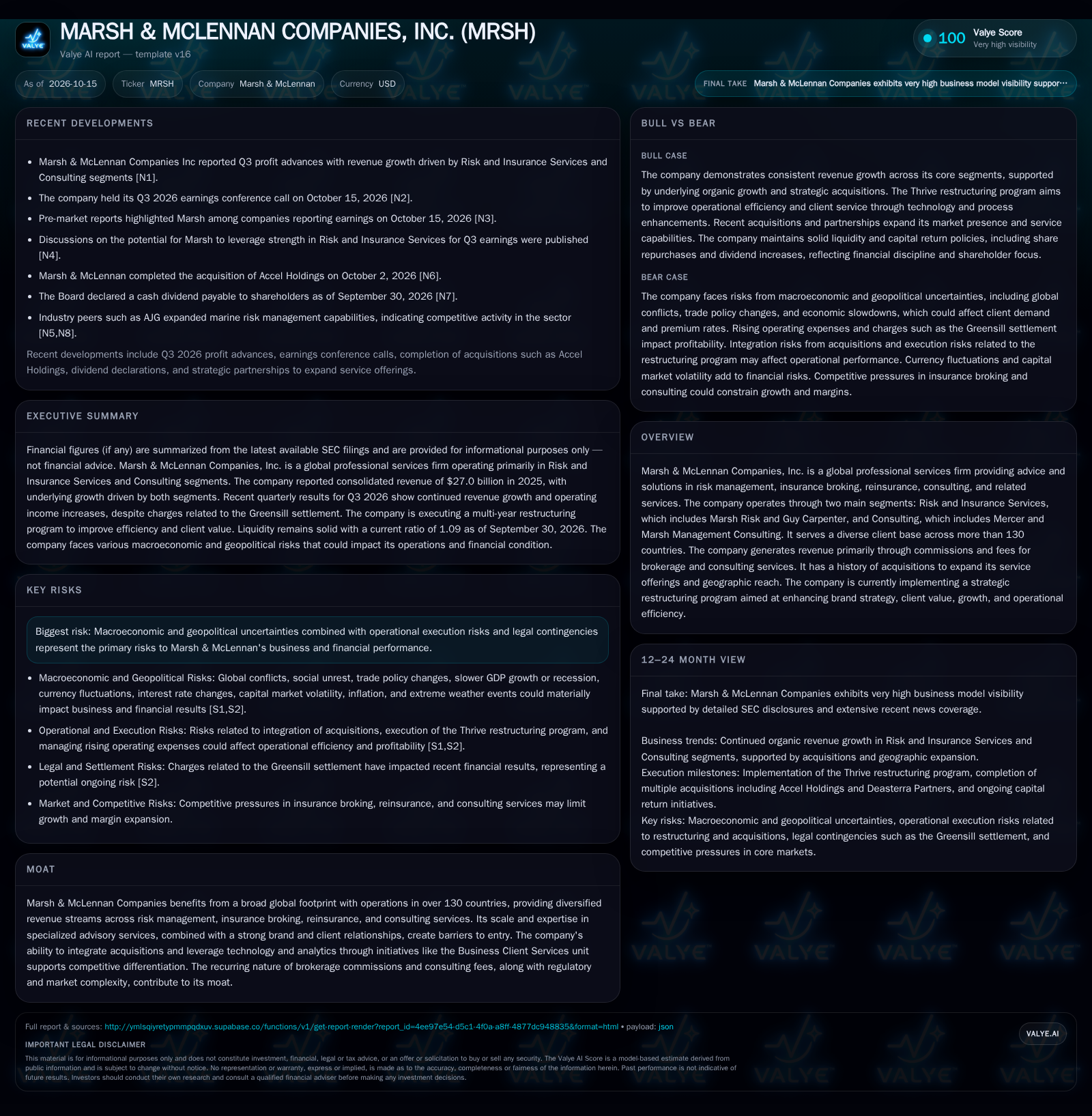
Marsh & McLennan Companies, Inc. (MRSH) continues to expand through acquisitions and underlying growth in both its Risk & Insurance Services and Consulting segments. The Thrive restructuring aims to generate recurring cost savings. However, profitability is pressured by legal settlements and integration costs. How well MRSH leverages its scale, manages risk, and adapts to macro and competitive pressures will shape its future economics and margin trajectory. [S1] [S2]
Marsh & McLennan stands at an inflection point: the company reports robust top-line growth and continues its acquisition-driven expansion, yet faces near-term profitability headwinds from legal settlements and integration costs. Its Thrive restructuring program aims to boost efficiency and unlock scale benefits, but the path to margin expansion depends on resolving operational frictions while navigating persistent macroeconomic and competitive challenges. The next phase will test whether Marsh’s diversified business model and global reach can deliver sustainable earnings growth.
Recent Acquisitions, Restructuring, and Legal Costs Shape the Present Landscape
Marsh & McLennan reported consolidated revenue of $27.0 billion in 2025, representing a 10% increase over the prior year, with underlying growth of 4% after adjusting for acquisitions and currency effects [S1]. The company has been highly acquisitive, completing 20 deals in 2025 for $857 million and 8 more in 2026 totaling $550 million, including the substantial McGriff acquisition for $7.75 billion [S1] [S2].
A major strategic initiative, the Thrive restructuring program, was launched in 2025 with a three-year horizon and targets $400 million in annualized savings at a cost of $500 million [S1]. This program focuses on brand strategy, client value, growth acceleration, and efficiency improvements.
Profitability is currently pressured by legal settlements, notably the Greensill settlement, which resulted in charges of $569 million for the nine months ended September 30, 2026 [S2]. The cited source reports dividend-related activity; that disclosure alone does not establish dividend-policy continuity, management confidence, or a material constraint on capital flexibility. [S2]
Liquidity as of September 30, 2026, included $1.842 billion in cash and equivalents, with a current ratio of 1.09 and a cash ratio of 0.1 [S2].
How Marsh & McLennan’s Scale and Model Drive Cash Flows—And Where Leverage Emerges
Marsh & McLennan’s business model is fundamentally driven by commissions and fees for professional services in risk management, insurance broking, reinsurance, and consulting. The majority of revenue is recurring, tied to annual policy cycles and long-standing advisory contracts. This model offers high revenue visibility and operational leverage, particularly as fixed personnel and technology investments can be spread over a growing client base.
Acquisitions are a core part of the growth strategy, providing immediate revenue and client base expansion, but they also introduce integration costs and potential dilution if synergies are not realized quickly. The Thrive restructuring is designed to extract margin improvement from this expanded base, with the target of $400 million in annualized savings representing a meaningful lever for future operating leverage if execution is successful.
Variable costs include compensation, technology investments, and integration expenses. Legal settlements, like the Greensill charges, represent episodic but material non-operating costs that can temporarily depress margins.
Capital intensity is moderate: the business is not asset-heavy, but ongoing investment in technology and talent is necessary to sustain advisory quality and defend against digital disruption. The company’s ability to generate cash for both shareholder returns and reinvestment depends on maintaining stable fee rates, controlling compensation growth, and achieving efficiency gains from both organic and acquired operations.
Scale, Specialization, and Technology: Marsh’s Defenses Against Disruption
Marsh & McLennan’s competitive position is anchored in its global scale, brand reputation, and breadth of expertise across insurance broking, reinsurance, and consulting. This enables cross-selling, global account management, and the ability to serve complex multinational clients—a barrier for smaller or regional competitors.
The company faces competition from other global advisory and broking firms, specialized boutiques, and, increasingly, technology-driven and direct-to-client platforms. The threat of digital disintermediation is real, as new entrants seek to automate risk placement and advisory services, potentially compressing margins in commoditized segments.
Acquisitions, such as McGriff and Deasterra Partners, are designed to reinforce Marsh’s market share in attractive geographies and specialties, but successful integration is crucial to realizing expected synergies. The company’s moat is partially sustained by regulatory complexity, long-standing client relationships, and the recurring nature of its fee-based contracts, but these advantages could erode if technology platforms reduce switching frictions or if regulatory changes enable new forms of competition.
The Thrive program’s emphasis on technology and client value is a direct response to these threats, aiming to modernize client engagement and internal processes while defending margins.
Margin Expansion Through Synergy Capture and Digital Enablement
The bull case for Marsh & McLennan is that the company successfully integrates recent acquisitions, extracting targeted cost synergies and leveraging cross-selling opportunities to grow wallet share among both legacy and new clients. The Thrive restructuring delivers or exceeds its $400 million annualized savings target, allowing operating margins to expand even as topline growth normalizes.
If Marsh can deploy technology to enhance client service and automate routine broking and advisory functions, it could both lower variable costs and increase client retention, reinforcing its competitive moat. Successful navigation of legal and settlement risks, with no further large-scale charges, would remove a significant drag on reported profitability.
Confirmation would come from sequential margin improvement, above-peer earnings growth, and evidence that integration costs and legal charges are not recurring. Sustainable increases in consulting segment profitability and cross-segment client wins would further support this scenario.
Sustained Growth Amid Cost Pressures and Steady Integration
The most likely path is continued steady revenue growth—primarily from underlying demand in risk, insurance, and consulting services, supplemented by bolt-on acquisitions. Operating margins may remain under pressure in the near term due to ongoing integration costs and the tail of legal settlements, but should gradually recover as Thrive savings are realized.
The consulting segment’s strong underlying growth (8% in Q3 2026) suggests resilience in advisory demand, while the larger risk and insurance segment provides cash flow stability. Competitive pricing pressures and rising compensation costs could cap margin expansion until efficiency gains are fully realized.
Evidence for this scenario would be modest but steady margin recovery, continued inorganic growth, and stable or slightly improving return on invested capital. If disclosed, retention rates and client cross-sell metrics would help affirm that the client base remains sticky and that integration risks are being managed.
Execution Slips, Integration Falters, and External Shocks Compound
The bear case centers on a combination of internal and external shocks: if integration of major acquisitions proves more complex or expensive than anticipated, synergies may be delayed or lost, eroding margins and consuming management bandwidth. If Thrive fails to deliver its targeted savings, or if further legal or regulatory charges emerge, profitability could be structurally impaired.
Externally, a severe macroeconomic downturn, sharp declines in insurance premium rates, or accelerated digital disintermediation could drive down both volume and pricing power, particularly in commoditized broking markets. Loss of key clients or talent could further destabilize the revenue base.
Downside confirmation would come from persistent margin compression, missed synergy targets, increased legal or restructuring charges, and possible credit downgrades. A useful falsification test would be any disclosure of client attrition, delayed acquisition integration, or significant technology-driven competitive losses.
Milestones and Metrics That Will Determine Marsh & McLennan’s Next Chapter
Progress against the Thrive restructuring program’s $400 million annualized savings target, including specific efficiency and headcount reduction milestones, if disclosed, will be crucial to margin improvement.
Integration expense trends and synergy realization from major acquisitions, especially McGriff and Accel Holdings, will indicate whether scale is translating to sustainable earnings growth.
Legal and settlement-related charges—recurrence, magnitude, and management commentary—will show if legacy risks are abating or persisting.
Underlying organic revenue growth rates in both Risk & Insurance Services and Consulting, excluding M&A and currency, will reveal the true health of core operations.
Operating margin trends by segment, with particular attention to consulting margin recovery and risk broking margin stability, if disclosed, will help gauge execution.
Client retention rates, cross-sell metrics, and new business wins (if disclosed) would help test the stickiness of Marsh’s client relationships and the effectiveness of its integrated offerings.
Any disclosure of technology-driven disruption or new digital competitors gaining share in core markets would be an early warning sign for moat erosion.
Disclaimer: This is research-only, informational analysis and not investment advice. It may include AI-generated interpretation and general industry context. Always verify important details using primary sources.

Comments