
Dankon Corp: Extreme Liquidity Stress and the Strategic Unknowns of an Opaque Public Entity
Dankon Corp’s severe liquidity deficit, persistent operating losses, and lack of business model disclosure place its near-term viability in question and leave investors with few concrete levers to assess future outcomes.
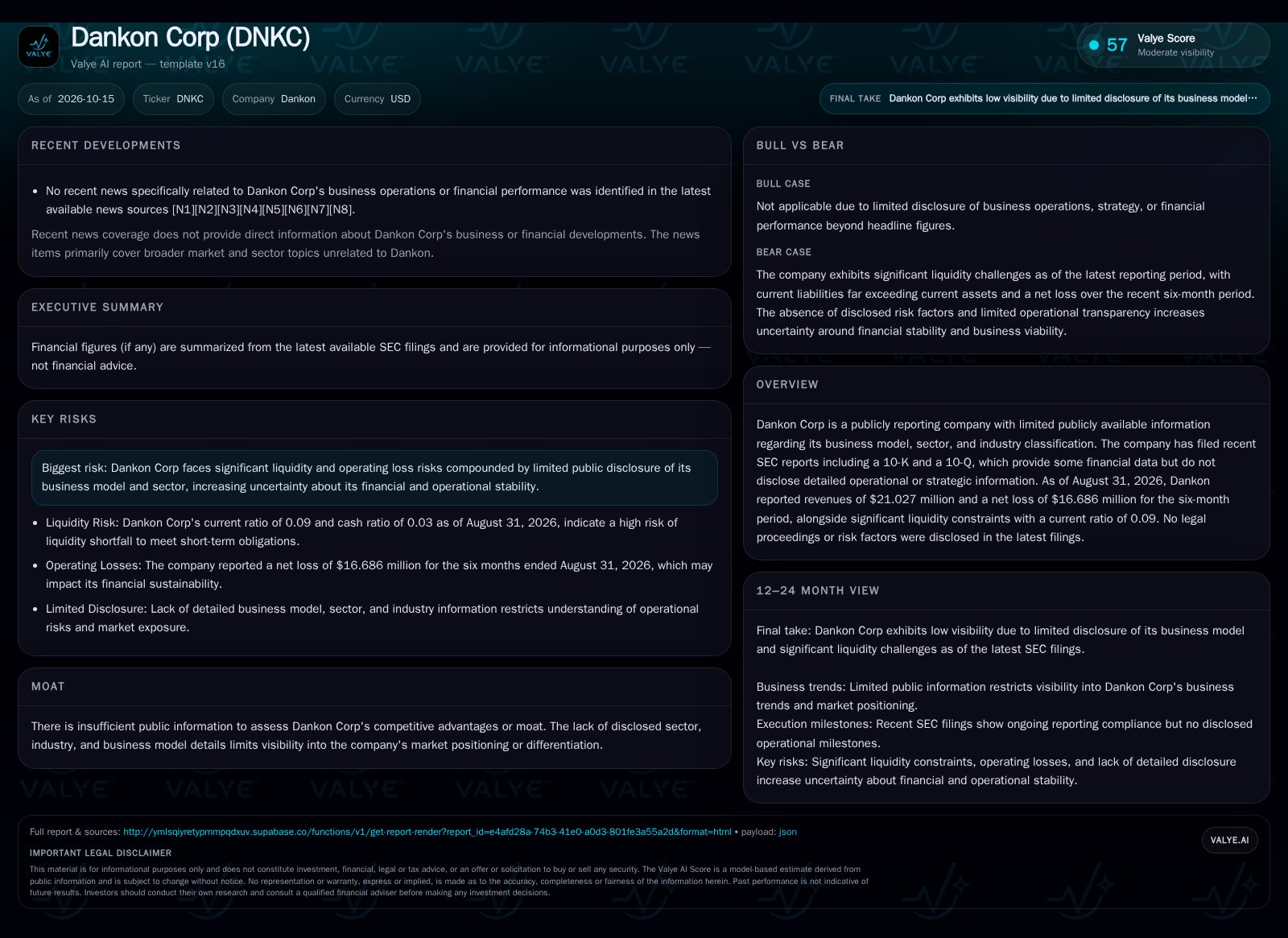
Dankon Corp’s latest filings reveal $21.0M in six-month revenue but a net loss of $16.7M and current liabilities exceeding current assets by over $100M. No legal actions or stated risk factors are disclosed, but the financials alone suggest that Dankon’s ability to continue as a going concern may hinge on undisclosed funding, restructuring, or fundamental business changes. [S2]
Dankon Corp presents an unusually high-risk profile for a public company, with financial filings showing a striking mismatch between liquid resources and short-term obligations. Despite generating $21 million in revenue over six months, Dankon’s current liabilities outstrip current assets by more than tenfold, and the company is running significant losses. With no disclosed risk factors, sector, or operating details, Dankon’s future appears to depend on factors outside the public’s view—such as emergency financing, asset sales, or undisclosed restructuring. The company’s lack of transparency compounds the challenge of assessing its true business prospects or underlying value.
Liquidity Crisis and Opaque Operations Define Dankon’s Present Reality
Dankon Corp’s most material current facts revolve around its dire liquidity position and extraordinary lack of disclosure. As of August 31, 2026, Dankon reported $3.621 million in cash and $10.213 million in current assets against $112.183 million in current liabilities, yielding a current ratio of 0.09 and a cash ratio of just 0.03 [S2]. For the six months ended on the same date, the company posted $21.027 million in revenue alongside a net loss of $16.686 million [S2]. Notably, there is no available information about Dankon’s business model, sector, or strategy, and no risk factors or pending legal proceedings were disclosed in the latest SEC filings [S1] [S2].
These facts matter because they indicate that Dankon is facing an imminent funding gap, with obligations vastly exceeding available resources, and no visible operational or strategic disclosures that could help investors assess the path forward. The combination of severe liquidity stress and near-total opacity makes Dankon an outlier among public companies, raising existential questions about its ongoing viability and the mechanisms that might resolve its financial predicament.
Uncertain Revenue Quality and Structural Losses: What Might Underlie Dankon’s Financials
While Dankon reported $21.027 million in revenue over six months, the absence of business model disclosure leaves open critical questions about how this revenue is generated—whether through product sales, services, licensing, or other means [S2]. The reported net loss of $16.686 million for the same period suggests that gross margins could be thin, operating expenses high, or both. Without segment or cost breakdowns, it is not possible to distinguish between fixed and variable cost structure or to assess where operating leverage could exist.
The company’s current asset and liability structure—current liabilities exceeding current assets by more than $100 million—implies either aggressive short-term financing, supplier payables, or other obligations coming due soon. If Dankon’s business model is asset-light and recurring (e.g., software or services), such a liability mismatch would be atypical, suggesting instead either a capital-intensive operation or a reliance on short-term borrowing. If capital needs are recurring and external funding is unavailable, a liquidity event or restructuring could be imminent. Conversely, if the company has off-balance-sheet assets or unreported credit arrangements, these are not visible in the filings.
In sum, Dankon’s business economics are fundamentally ambiguous, but the reported numbers point to an enterprise that is currently unsustainable under its existing cost, revenue, and capital structure.
Competitive Context: A Black Box with No Disclosed Sector or Peers
Dankon’s competitive positioning is impossible to assess directly, as the company has not disclosed its industry, sector, or main lines of business. This absence precludes any meaningful analysis of market share, differentiation, or rivalry. If Dankon operates in a highly competitive sector—such as manufacturing, technology, or services—its severe liquidity stress could make it vulnerable to substitution, customer attrition, or predatory competition. Alternatively, if it holds a niche or contractual lock-in, this is not apparent from public filings.
Potential substitutes and peer group dynamics are therefore unknown, but the lack of moat or strategic disclosure suggests that Dankon may lack defensible advantages. The company’s acute liquidity issues could further erode bargaining power with customers or suppliers, regardless of industry. If Dankon possesses proprietary technology, regulatory barriers, or contractual revenue streams, these would constitute material mitigants, but there is no evidence for such mechanisms in current filings.
How Dankon Could Survive: Emergency Funding, Asset Monetization, or Hidden Value
A positive outcome for Dankon would likely require immediate access to new liquidity—via external financing, asset sales, or a strategic transaction. If the company is able to secure a significant capital infusion or restructure its short-term obligations, it could stabilize operations and buy time to address underlying losses. Alternatively, Dankon may possess valuable assets, intellectual property, or contractual positions not disclosed in its filings, which could be monetized in a distressed sale or used to attract a strategic partner.
Confirmation of this scenario would require SEC filings or press releases disclosing new debt or equity financing, asset divestitures, or a merger/acquisition event. Evidence of major cost reductions, improved margins, or a sharp reduction in current liabilities would also suggest a viable turnaround. Falsification would occur if no such developments are announced and liquidity deteriorates further, leading to default or bankruptcy proceedings.
Default Risk Looms Without Visible Intervention or Strategic Change
The most plausible scenario given current disclosures is that Dankon faces acute default risk in the absence of new funding or a drastic operational change.
In this scenario, the company could enter a period of operational contraction, creditor negotiations, or formal restructuring. Confirmation would come from subsequent filings disclosing going-concern warnings, missed payments, or creditor actions. Falsification would require visible improvement in liquidity or the announcement of a material transaction that alleviates short-term financial pressures.
Insolvency and Value Destruction if Funding or Strategy Do Not Materialize
If Dankon is unable to secure new funding or restructure its liabilities, the most likely outcome is insolvency—potentially leading to bankruptcy, asset liquidation, or a wind-down of operations. In this adverse scenario, equity holders could be wiped out, creditors may recover only a fraction of claims, and any intangible or operating value would be lost.
Confirmation of this scenario would include bankruptcy filings, delisting notices, or asset sales at distressed valuations. Signs such as mounting unpaid obligations, auditor going-concern qualifications, or abrupt management departures would further reinforce the downside thesis. Falsification would require evidence of a successful refinancing, operational turnaround, or unexpected value unlock—none of which are currently visible.
What Would Test Dankon’s Survival Prospects in the Coming Quarters
Any announcement of new debt or equity financing would be critical in assessing Dankon’s ability to address its liquidity shortfall.
A sharp reduction in current liabilities—via renegotiation, settlement, or asset sales—would indicate progress toward financial stabilization.
Detailed disclosure of Dankon’s business model, major customers, or industry focus (if provided) would help evaluate the sustainability of its revenue base.
If disclosed, gross margin and operating expense breakdowns would clarify whether losses are structural or potentially addressable.
Auditor statements regarding going-concern risk in future filings would provide a clear signal of insolvency risk.
Any announcement of asset divestitures, strategic partnerships, or M&A activity could offer visibility into hidden value or rescue scenarios.
Evidence of creditor actions, delayed payments, or legal proceedings would signal imminent financial distress.
Material changes in management, board composition, or strategic direction (if disclosed) would be relevant for assessing turnaround potential.
Disclaimer: This is research-only, informational analysis and not investment advice. It may include AI-generated interpretation and general industry context. Always verify important details using primary sources.

Comments