
Greystone Logistics at an Inflection: Customer Loss, Liquidity Strain, and the Push for Diversification
The company’s ability to execute on customer diversification and adapt to regulatory, supply, and competitive pressures will determine whether it can stabilize operations and capture new market opportunities.
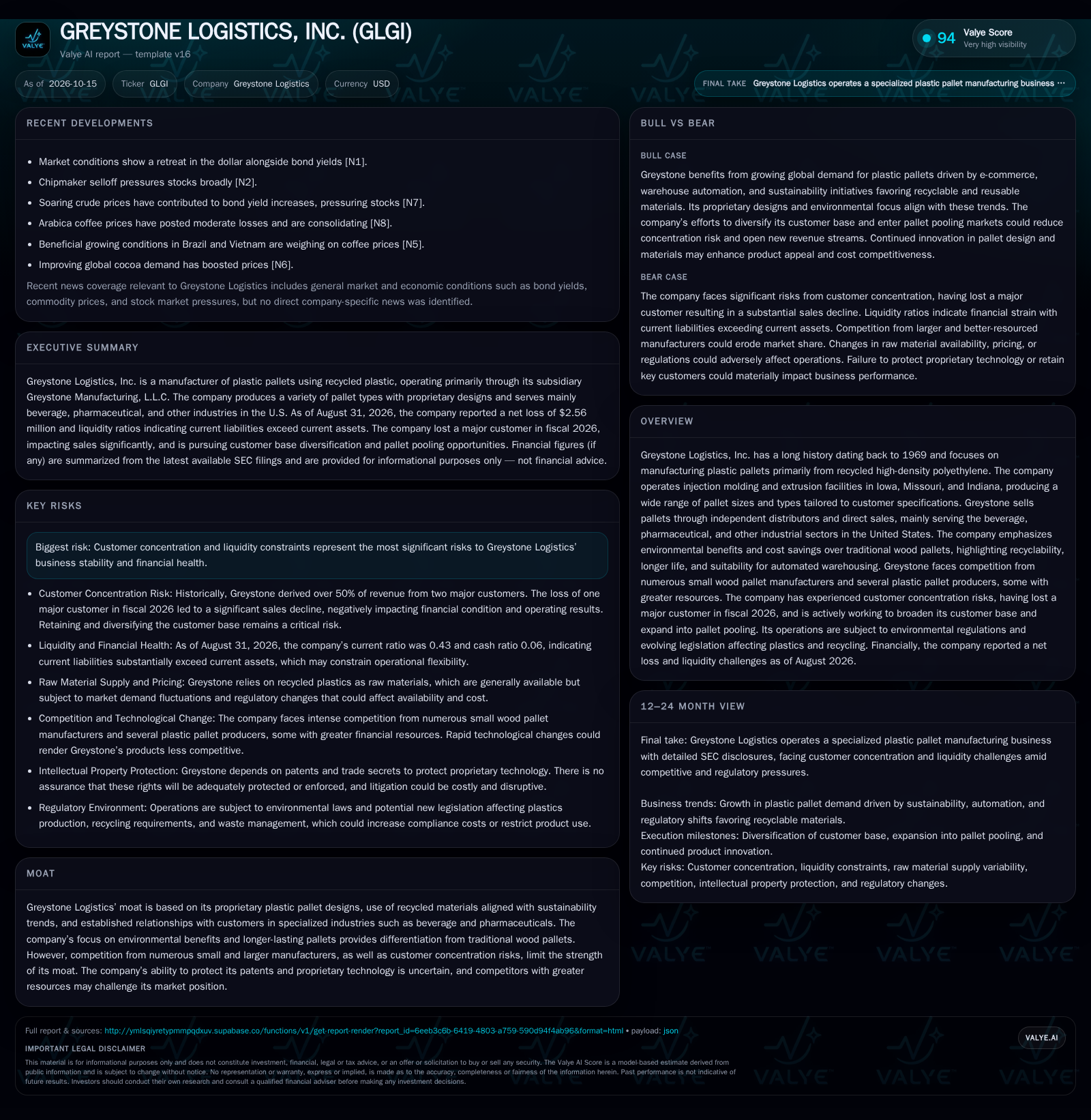
The company is now focused on expanding its customer base and exploring pallet pooling, but faces intense competition, raw material price risks, and regulatory uncertainty. Its future hinges on successfully reducing customer concentration, improving potential financial flexibility, and leveraging its recycled-materials positioning in a changing logistics landscape. [S1] [S2]
With a current ratio well below one and a net loss in the latest quarter, Greystone is under pressure to rapidly diversify its customer portfolio and stabilize its operations. The company’s future depends on its ability to execute on these strategic pivots while contending with commodity price swings, evolving environmental regulations, and intensifying competition in the pallet market.
Major Customer Loss, Liquidity Squeeze, and Strategic Reorientation
The defining near-term development for Greystone Logistics is the loss of a major customer in fiscal 2026—a customer that, along with another, historically accounted for over half of the company’s revenue. This event precipitated a significant drop in sales, directly impacting cash flow and overall financial health. As of August 31, 2026, Greystone reported current assets of $6.55 million against current liabilities of $15.31 million, resulting in a current ratio of 0.43 and a cash ratio of 0.06. These metrics signal acute liquidity constraints, with the company’s short-term obligations far outstripping its readily available resources. Facing this dual challenge of customer concentration and liquidity stress, Greystone is now prioritizing efforts to diversify its customer base and explore pallet pooling models to reduce reliance on a handful of large buyers. [S1] [S2]
How Greystone’s Plastic Pallet Model Can (and Might Not) Deliver Profits
Greystone’s business model centers on the manufacture and sale of plastic pallets, primarily from recycled high-density polyethylene (HDPE). The company operates 14 injection molding machines and multiple grinding and pelletizing lines, providing both vertical integration and some margin control over raw material inputs. Its economics are shaped by a mix of fixed capital-intensive plant costs and variable costs tied to resin, energy, labor, and distribution. The use of recycled plastic offers some insulation from virgin resin price volatility, but not immunity—recycled HDPE prices can be highly sensitive to demand and regulation.
Revenue drivers are a function of volume (number of pallets sold), product mix (rackable vs nestable vs specialty designs), and pricing, which is influenced by both input costs and competitive intensity. Historically, customer-specific designs and some patented features have allowed Greystone to command a premium and secure sole-supplier positions, but these advantages are now at risk given customer churn. Operating leverage is present: higher volumes over the fixed asset base can drive margin expansion, but volume declines—such as from the recent customer loss—exacerbate losses and cash strain. The company’s pursuit of pallet pooling and service contracts could introduce more recurring revenue and smoother cash flows, but the economics of these models remain unproven for Greystone and may require additional working capital or technology investment.
Navigating a Crowded Field: Differentiation and Its Limits
Greystone competes in a fragmented market against numerous small wood pallet manufacturers and a handful of larger, better-capitalized plastic pallet producers. Its core points of differentiation are proprietary pallet designs (some patented), the use of recycled materials, and established relationships in specialized verticals like beverage and pharmaceuticals. However, the moat is not deep. Larger plastic pallet competitors often have superior purchasing power, broader distribution, and more robust R&D pipelines, making it difficult for Greystone to sustain pricing power or defend market share if customers are lost.
Wood pallets, while less durable and less compatible with automation, remain price-competitive and deeply entrenched, especially in less-regulated or cost-sensitive market segments. Meanwhile, increased regulatory focus on plastics—both in terms of recycled content mandates and restrictions on single-use products—creates both potential tailwinds and risks. If Greystone can align its product and marketing with sustainability-driven customers and regulatory trends, it may carve out defensible niches. Otherwise, cost competition and limited IP protection could erode its advantage.
From Crisis to Opportunity: What a Successful Transition Could Look Like
The most favorable scenario for Greystone is one in which it rapidly diversifies its customer base and successfully enters the pallet pooling or logistics services market. This would reduce revenue concentration risk, stabilize volumes, and potentially provide recurring revenue streams. A successful pivot would likely require targeted investment in sales, marketing, and potentially technology (e.g., RFID-enabled pallets for asset tracking).
Evidence of this scenario playing out would include announcements of new multi-year contracts with marquee customers in sectors like e-commerce or pharmaceuticals, the launch or expansion of a pallet pooling service with visible customer uptake, and a return to positive operating income and cash flow. Additional signs would be improved working capital ratios (indicating better liquidity management), and perhaps strategic partnerships or technology integrations enhancing the value proposition of Greystone’s products.
Stabilization Through Incremental Gains and Operational Discipline
The most plausible trajectory for Greystone over the next 12-24 months is a period of stabilization rather than dramatic recovery or collapse. In this scenario, the company makes slow but steady progress in broadening its customer base, perhaps securing a handful of new accounts but not fully offsetting the lost revenue from its major customer.
Confirmation of this scenario would be the gradual improvement in sales volume (even if at lower margins), a modest uptick in customer count or sector diversification, and continued operation without significant additional debt or equity raises. Falsification would involve further customer losses, a worsening liquidity profile, or regulatory/commodity shocks that overwhelm incremental gains.
Liquidity Erosion and Competitive Displacement
The adverse scenario is one where Greystone fails to replace lost business quickly enough, leading to sustained negative cash flow and further balance sheet deterioration. Acute liquidity constraints—already evident with a current ratio of 0.43—could force the company to seek emergency financing on unfavorable terms, sell assets, or even restructure. Competitors, sensing weakness, could target Greystone’s remaining customers, further accelerating share loss.
This scenario would be confirmed by additional major customer defections, a further decline in current assets or worsening of the current/cash ratios, missed payments or covenant breaches (if disclosed), and the absence of new business wins. Regulatory changes that increase compliance costs or restrict plastic pallet use could compound the pressure, as could spikes in recycled resin prices or supply disruptions.
Milestones That Will Determine Greystone’s Ability to Reset Its Business Model
Evidence of new customer acquisitions, especially in sectors outside the legacy beverage/pharmaceutical base, would indicate progress in diversification.
Announcements or disclosures of entering into pallet pooling or logistics service agreements—with details on contract duration, customer commitment, and economics if disclosed—would help test the recurring revenue thesis.
Changes in the current ratio, cash ratio, or overall working capital profile in subsequent quarters would reveal whether liquidity is stabilizing or deteriorating.
Gross margin trends, if disclosed, would clarify whether cost pressures from input prices or competitive pricing are being managed.
Any significant capital expenditure announcements, especially for automation, new molds, or technology upgrades, could signal investment in future growth or, conversely, stretch liquidity.
Disclosures of additional customer losses or concentration shifts would highlight ongoing revenue vulnerability.
Updates on regulatory developments—such as new recycled content mandates or restrictions on plastic pallet use—would shape both risk and opportunity.
Patent litigation, new IP filings, or loss of proprietary technology protection, if disclosed, would impact the durability of Greystone’s product differentiation.
Disclaimer: This is research-only, informational analysis and not investment advice. It may include AI-generated interpretation and general industry context. Always verify important details using primary sources.

Comments