
Zicix Corp: Platform Pivot, Infrastructure Bets, and the Challenge of Surviving Liquidity Strain
Execution risk is amplified by operational interruptions, regulatory exposure, and the need to prove commercial viability in both digital advertising and infrastructure verticals.
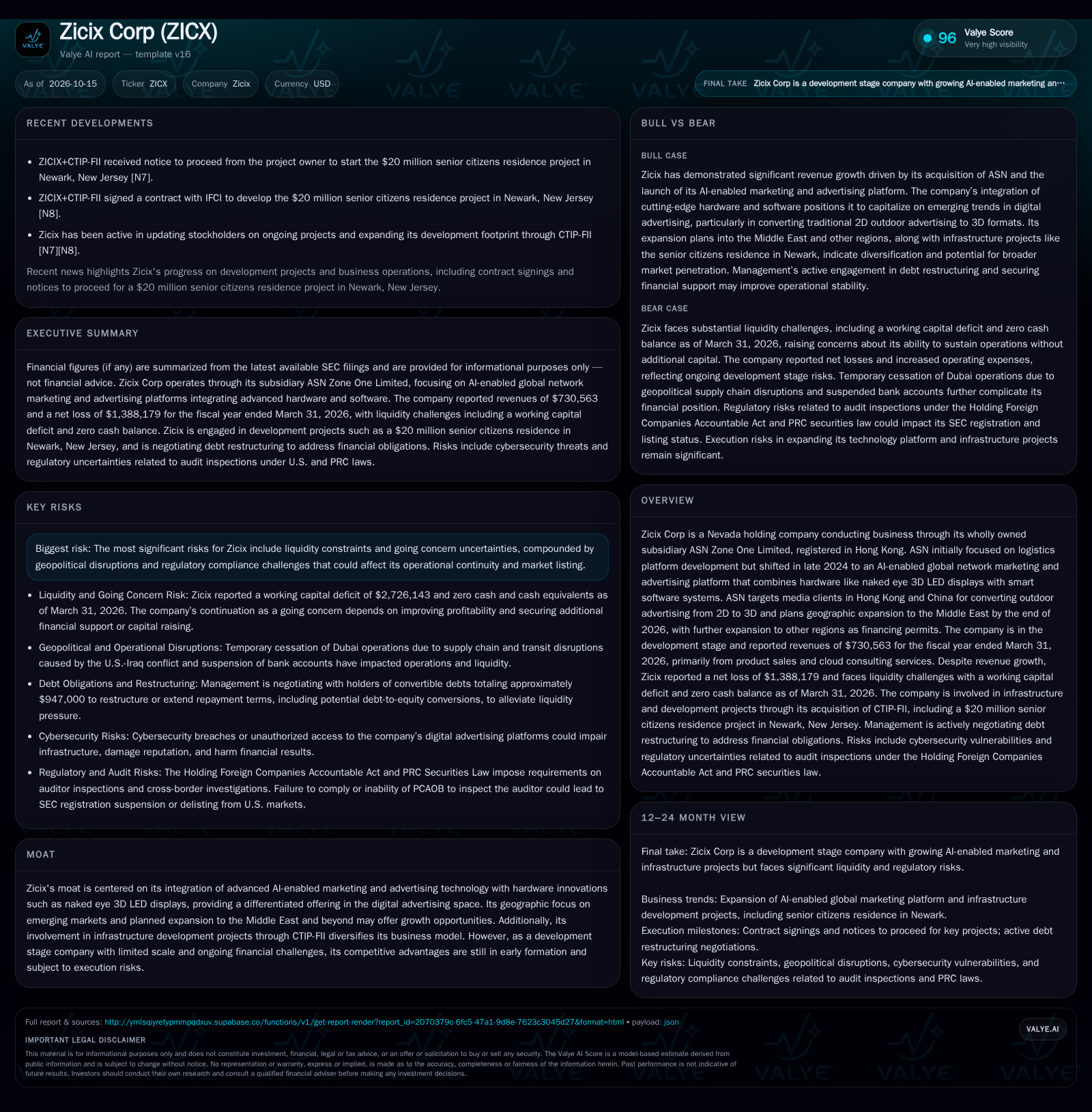
Execution risk is amplified by operational interruptions, regulatory exposure, and the need to prove commercial viability in both digital advertising and infrastructure verticals. [S1] [N7] [N8]
Zicix Corp has undergone a dramatic transformation over the past two years, evolving from a logistics platform developer into a hybrid play on AI-enabled marketing technology and infrastructure development. [S1] [N7] [N8]
Liquidity Crunch and Project Ambitions: The Present State of Play
Zicix reported $730,563 in revenue for the fiscal year ended March 31, 2026, marking a 943% increase from the prior year, primarily due to the ASN acquisition and its transition to an AI-enabled marketing and advertising platform. Despite this growth, the company ended the period with zero cash, current assets of $507,486, current liabilities of $3,233,629, and a working capital deficit of $2,726,143. Zicix also recorded a net loss of $1,388,179 for the year, though this was an improvement from the previous year’s loss. Operations in Dubai were temporarily halted due to supply chain disruptions tied to the U.S.-Iraq conflict, while suspended bank accounts further complicated liquidity. Management is actively negotiating to restructure $947,000 in convertible debt, including possible debt-to-equity conversion. Meanwhile, through its CTIP-FII subsidiary, Zicix has secured a notice to proceed and a contract for a $20 million senior citizens residence project in Newark, New Jersey, and is pursuing additional infrastructure projects. [S1] [N7] [N8]
How Zicix’s New Model Could Generate Cash—And Where It Breaks Down
Zicix’s economics now rest on two main engines: the digital marketing and advertising platform (anchored by AI and 3D hardware/software integration) and infrastructure development projects (via CTIP-FII). In digital advertising, the company’s model likely depends on a combination of hardware product sales (such as naked eye 3D LED displays and related components) and recurring or project-based fees for cloud consulting and smart software systems. The 2026 revenue mix—$300,536 from product sales and $430,027 from cloud consulting—suggests a hybrid of upfront and service-based income. Variable costs are significant, as cost of revenue ($480,461) consumed nearly two-thirds of total revenue, and high general and administrative spending ($1,326,751) reflects both business development and overseas expansion efforts. Capital intensity is high in both lines: the hardware/software business requires ongoing technology investment and client acquisition, while infrastructure projects demand upfront capital, long development cycles, and milestone-based cash inflows. Operating leverage could improve if Zicix successfully scales its consulting and platform business, but current fixed costs and the need for external funding dilute any near-term margin expansion. The absence of cash and a negative working capital position create acute funding risk, meaning future growth is contingent on securing new capital or converting debt to equity. [S1]
The Search for Moat: Differentiation, Counterforces, and Market Realities
Zicix’s competitive pitch hinges on integrating advanced AI and 3D display technology to help outdoor advertisers in markets like Hong Kong and China transition from static 2D to dynamic 3D formats. If the company’s technology can materially improve ad engagement or offer a compelling cost/ROI proposition, it could gain early traction with media outlets and property owners seeking to modernize their advertising inventory. However, barriers to entry in digital advertising technology are moderate—hardware innovation is often replicable, and local competitors or established global digital signage providers can quickly adapt. The company’s ability to build switching costs or defensible recurring revenue streams remains unproven; much depends on whether clients commit to multi-year service contracts or if sales remain transactional. In infrastructure, Zicix faces entrenched local and global developers with deeper pockets and longer track records, meaning its success may hinge on niche project wins, speed of execution, or unique financing structures. Regulatory and operational risks—especially in cross-border operations—further challenge any incipient moat.
What a Breakout Looks Like: Capital Raise, Execution, and Platform Adoption
The marketing platform gains traction with institutional clients in Hong Kong, China, and the Middle East, leading to repeat orders for 3D display hardware and recurring software/service contracts. Gross margins expand as consulting revenues grow and product cost efficiencies are realized. Simultaneously, the Newark senior citizen residence project advances on schedule, unlocking milestone-based payments and demonstrating the company’s ability to deliver on large-scale infrastructure contracts. These successes support further expansion into new regions and help attract additional project partners or institutional investors. Confirmation would come from disclosed contract wins, additional platform deployments, new financing rounds, improved gross and operating margins, and positive operating cash flow.
Piecemeal Progress: Survival Through Restructuring and Select Project Execution
The most plausible near-term path is one of incremental progress amid persistent financial strain. Zicix manages to restructure a portion of its convertible debt, reducing immediate cash outflows but still operating with minimal liquidity. Select digital advertising projects in Hong Kong and China move forward, but client adoption is gradual and subject to payment delays or short-term contracts. The Newark infrastructure project advances but faces timeline slippage or cost overruns, and additional projects are slow to materialize given capital constraints. Revenue growth continues, but at a slower pace, and margin improvement is muted by ongoing fixed cost pressures. Regulatory and audit risks remain unresolved, but do not trigger immediate delisting or business interruption. Evidence supporting this scenario would include modest increases in revenue, continued net losses, limited new project announcements, and periodic updates on debt negotiations and capital raising attempts.
When Liquidity Runs Out: Forced Retrenchment and Project Delays
If Zicix is unable to secure additional capital or convert enough debt to equity, its acute liquidity deficit could force it to halt ongoing projects, delay vendor payments, or even suspend operations in key markets. Supply chain or regulatory disruptions—such as further bank account freezes or geopolitical shocks—could exacerbate these pressures. Failure to execute on the Newark project or win new digital advertising contracts would erode stakeholder confidence and make further financing even more difficult to obtain. Regulatory action (such as auditor disqualification under the HFCAA or PRC securities law) could trigger delisting, cutting off access to U.S. capital markets. Confirmation of this scenario would come from further operational cessations, missed project milestones, default notices, auditor or exchange warnings, and a lack of new funding announcements.
What Will Determine Zicix’s Viability in the Next 12 Months?
Disclosure of new equity or debt financing, or material progress in debt-to-equity conversion negotiations, to address the working capital deficit and zero cash position.
Updates on the status and timeline of the Newark senior citizens residence project—especially evidence of milestone payments, construction progress, or cost overruns.
Announcements of new client wins, contracts, or deployments for the AI-enabled marketing and advertising platform, particularly in target expansion regions.
Gross and operating margin trends, especially any evidence of margin expansion as the revenue mix shifts toward consulting or software services (if disclosed).
Resolution of bank account suspensions or restoration of normal banking operations, especially in Dubai and other key markets.
Progress toward lifting operational suspensions or mitigating supply chain interruptions, particularly in geographies affected by geopolitical risk.
Regulatory updates or auditor inspection outcomes that could impact the company’s SEC registration or listing status.
Any change in management’s guidance regarding project execution timelines, capital needs, or business model focus.
Disclaimer: This is research-only, informational analysis and not investment advice. It may include AI-generated interpretation and general industry context. Always verify important details using primary sources.

Comments