
Plutonian Acquisition Corp. II: SPAC Execution Hinges on NT1 Merger and Asia-Pacific Focus
Plutonian Acquisition Corp. II has entered into a $500 million merger agreement with NT1 Pty Ltd, marking a critical transition from blank-check status to prospective operating company. The merger's outcome will define its future economics, competitive stance, and value creation, but execution risks and limited current disclosure remain central watchpoints.
Plutonian Acquisition Corp. II, a SPAC with no revenue or operating segments as of August 2026, has signed a definitive merger agreement to acquire NT1 Pty Ltd for $500 million in equity. The deal, if closed, will transition the company from a capital pool to an operating entity focused on the Asia-Pacific region (excluding Greater China). Execution risk is high, as the merger is subject to closing conditions, shareholder approval, and independent valuation. The company’s future now hinges on the successful integration and performance of NT1.
Plutonian Acquisition Corp. II stands at a pivotal juncture: after months as a capital pool with no operating business, the SPAC has announced a $500 million merger agreement with NT1 Pty Ltd, an Asia-Pacific-based company. This transaction—subject to closing conditions, shareholder approval, and independent valuation—would transform Plutonian from a blank-check entity into an operating company. The potential rewards are substantial, but so too are the uncertainties, as the company has yet to demonstrate operating capabilities, disclose NT1’s business profile, or provide financial projections. The next phase will test its ability to execute, integrate, and create value in a competitive regional landscape.
Merger Agreement with NT1 Pty Ltd Sets Strategic Direction
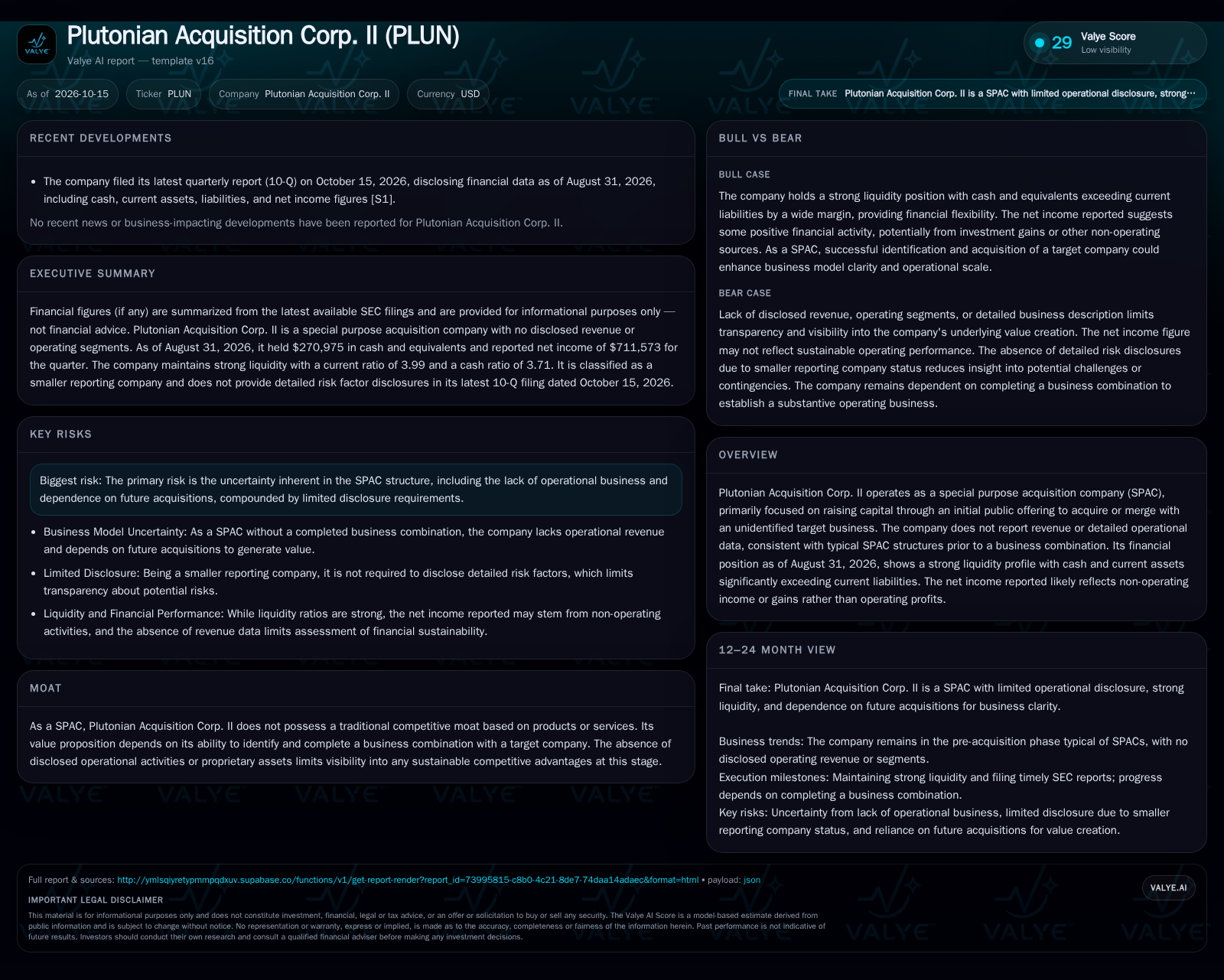
The most significant current development is Plutonian Acquisition Corp. II’s entry into a definitive merger agreement with NT1 Pty Ltd, announced on September 3, 2026. The deal is structured as a share exchange, with NT1’s shareholders receiving 50 million shares of a newly formed holding company (Purchaser), implying an aggregate consideration of $500 million at $10 per share. Closing is subject to customary conditions, including shareholder approval, regulatory clearance, and an independent valuation. As of August 31, 2026, Plutonian reported $270,975 in cash and current assets of $291,225, with current liabilities of $72,980, giving it reported liquidity position but limited capital relative to the size of the pending deal. The company remains in pre-operational status, with no revenue and net income likely reflecting non-operating gains. The outcome of the NT1 transaction will decisively shape future business prospects and operational scale [S1].
Economics of a Blank Check: From Capital Pool to Operating Company
As a SPAC, Plutonian Acquisition Corp. II’s pre-merger economics are straightforward: it raises capital through an IPO, invests proceeds conservatively (typically in short-term treasuries or equivalents), and incurs minimal operating expenses. Any reported net income up to this point is unlikely to be from core operations and more plausibly reflects investment gains or changes in fair value of the trust assets.
Post-merger, the economics transform entirely and will depend on NT1’s business model, which is not disclosed in current filings. If NT1 is a growth-stage operating company, Plutonian’s value proposition will hinge on NT1’s revenue growth, margins, and capital intensity. Key questions include whether NT1 operates in a high-growth, capital-light sector (e.g., software, digital services) or a more capital-intensive industry (e.g., manufacturing, logistics), as this will dictate funding needs, scalability, and the potential for operating leverage. The $500 million equity valuation suggests ambitions for significant scale, but without segment details, the margin structure and cash flow profile remain unknown. The adoption of an equity incentive plan for up to 10% of fully diluted shares post-merger indicates an intent to incentivize management and align interests, but could also introduce dilution if not matched by strong operational performance [S1].
Competitive Position Will Be Defined by NT1’s Sector and Execution
Plutonian’s competitive position is currently undefined, as it is a SPAC with no operations. The future competitive landscape will be determined by NT1’s industry, regional footprint, and differentiation. The Asia-Pacific focus (excluding Greater China) potentially situates the combined entity in fast-evolving markets with both high growth opportunities and intense competition—from local incumbents, regional conglomerates, and international entrants.
If NT1 operates in a sector with strong barriers to entry (such as proprietary technology, regulatory licenses, or network effects), the merged entity could enjoy defensible positioning. Conversely, if NT1 is in a commoditized or mature industry, sustaining margins and achieving growth may prove challenging. The lack of a pre-existing moat at the SPAC level means the company’s future advantage will depend entirely on NT1’s business quality and Plutonian’s ability to support and scale those assets post-merger [S1].
Transformational Value Creation If NT1 Delivers High-Growth and Integration Is Smooth
The favorable scenario is that the NT1 merger closes as planned and NT1 proves to be a high-growth, profitable operating company with a differentiated market position in the Asia-Pacific region. If NT1’s sector benefits from secular tailwinds—such as digital transformation, e-commerce, or renewable energy—the merged entity could rapidly scale revenue and margins, leveraging public capital access for further expansion.
Confirmation of this scenario would require disclosure of NT1’s business model, revenue growth, margin profile, and competitive differentiation. Evidence such as NT1’s customer concentration, contracted backlog, or proprietary technology would also support the bull case. Falsification would come from delayed closing, adverse findings in the independent valuation, or post-merger disclosures showing weak fundamentals or limited growth prospects.
Execution Risk and Integration Challenges Dominate the Transition Phase
The most plausible scenario is that the merger proceeds but faces typical SPAC execution risks: delays in closing, regulatory scrutiny, or shareholder pushback on valuation. Once closed, the company may encounter integration challenges, especially if NT1 is in a complex or regulated industry. Operating performance could be mixed as the combined entity works to establish reporting systems, align management incentives, and communicate its strategy to public investors.
This scenario would be confirmed by timely closing, gradual operational disclosures, and initial financial reports showing moderate growth. Falsification would come from prolonged deal closure, failed regulatory approval, or early post-merger financials revealing underperformance or unforeseen liabilities.
Deal Breaks Down or NT1 Underperforms, Leaving a Stalled Public Shell
The adverse scenario is that the NT1 transaction fails to close—due to regulatory, shareholder, or valuation issues—or closes and NT1’s business underperforms expectations. In this case, Plutonian could revert to SPAC status with a diminishing time window to find a new target, risking capital erosion from deal costs and negative market sentiment.
Confirmation of this risk would include missed closing deadlines, withdrawal of merger parties, or negative independent valuation outcomes. If the deal closes but NT1 fails to deliver operationally, early post-merger financial reports would likely show weak revenue, poor margins, or cash burn, undermining investor confidence and limiting access to future capital.
Milestones That Will Define Plutonian’s Trajectory Post-NT1 Merger
Shareholder approval and final regulatory clearance for the NT1 merger; delays or rejections would be a material negative.
Disclosure of NT1’s business model, operating history, and financial projections—these will be essential for evaluating future economics and competitive positioning.
Completion of the independent valuation and technical report, as required under the merger agreement; adverse findings could impact deal terms or closing probability.
Initial post-merger financial statements from the combined entity, providing visibility into revenue, margins, and cash flow for the first time.
Adoption and terms of the new equity incentive plan; the degree of dilution and alignment with shareholder interests will be important to monitor.
Any changes in regional regulatory environments or macroeconomic conditions impacting Asia-Pacific markets, as these could affect NT1’s business outlook.
If disclosed, NT1’s customer concentration, contract backlog, or renewal rates—these would help assess revenue stability and growth visibility.
Disclaimer: This is research-only, informational analysis and not investment advice. It may include AI-generated interpretation and general industry context. Always verify important details using primary sources.

Comments