
NextTrip’s Content-to-Commerce Strategy: Early Integration Efforts, Capital Limits, and the Quest for Market Validation
NextTrip, Inc. is building an integrated travel and media platform that fuses immersive content with direct booking technology and AI personalization. While recent acquisitions and product launches expand its reach, persistent operating losses, a working capital deficit, and urgent capital needs create a high-stakes test of whether its model can achieve the scale and integration required for viability.
Future success hinges on scaling supplier relationships, customer adoption, and demonstrating that media-driven booking conversion can materially improve unit economics.
NextTrip, Inc. aspires to bridge the worlds of digital media and travel commerce by converting content engagement into direct bookings through proprietary technology and a stable of recently acquired platforms. The company’s approach—combining AI-powered personalization, immersive travel video, and seamless booking overlays—seeks to create a differentiated consumer journey and a more efficient funnel from inspiration to transaction.
Cash Flow Pressures Highlight Need for Rapid Commercial Success
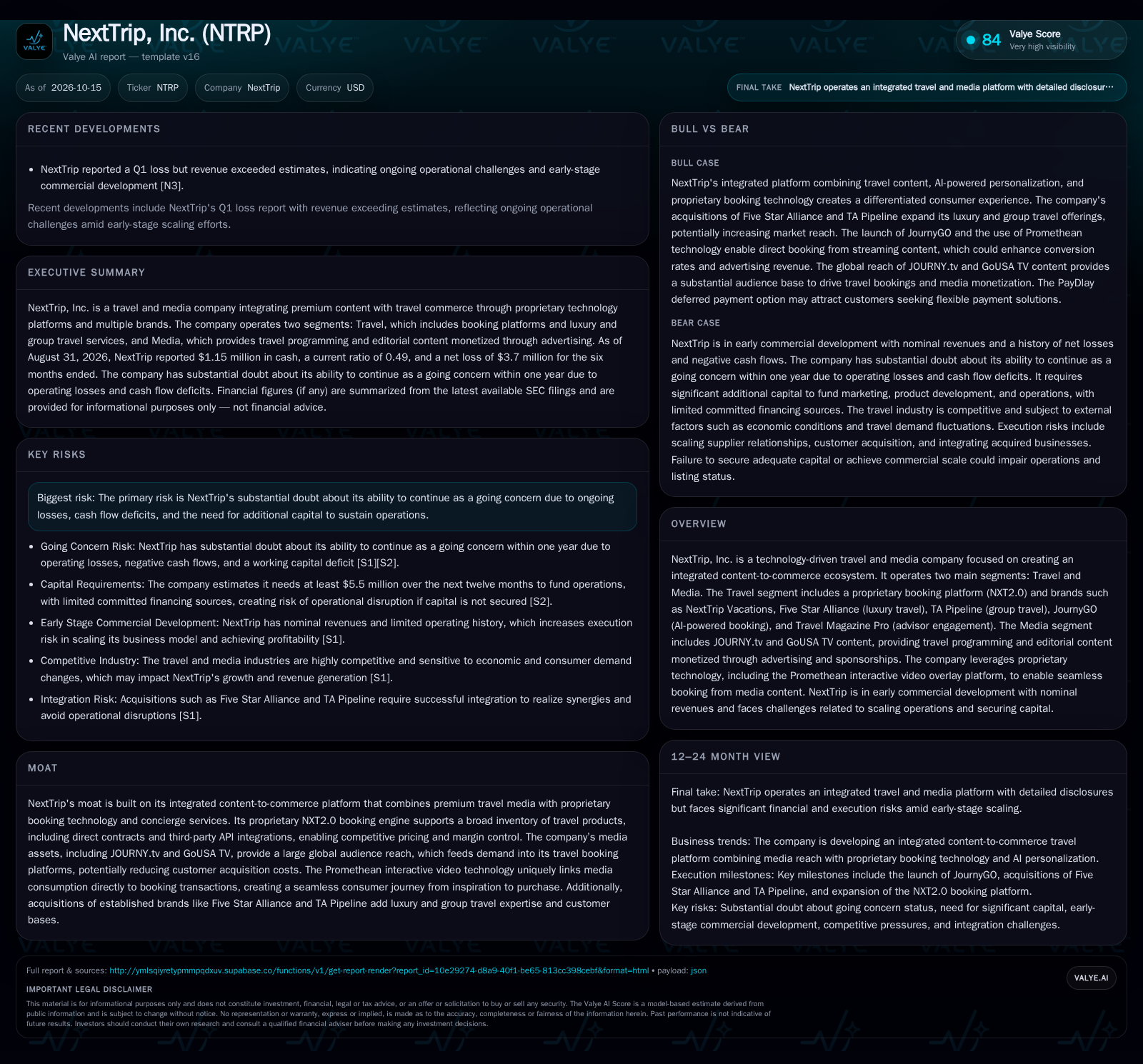
As of August 31, 2026, NextTrip reported $1,145,136 in cash and cash equivalents against current liabilities of $6,208,742, resulting in a current ratio of just 0.49 and a cash ratio of 0.18 [S2]. Management has publicly stated there is substantial doubt about the company’s ability to continue as a going concern within one year, given ongoing operating losses and cash flow deficits [S1] [S2]. For the six months ended August 31, 2026, NextTrip posted a net loss of $3,723,683 and basic EPS of -$0.25 [S2]. The company estimates it requires at least $5.5 million in new capital over the next twelve months to fund operations, with no substantial committed sources of financing [S2]. These facts make the company’s near-term survival and ability to execute on its integrated strategy critically dependent on external funding and rapid operational traction.
Transforming Travel Economics Through Content-Driven Commerce
NextTrip’s business model is predicated on leveraging media-driven engagement to lower customer acquisition costs and increase conversion rates for travel bookings. The Travel segment earns revenue from commissions, markups, and service fees on hotel, vacation, and cruise bookings, while the Media segment is monetized through advertising, sponsorships, and branded content [S1]. The core platform, NXT2.0, aggregates inventory from over four million properties and aims to offer competitive pricing through a mix of direct contracts and third-party integrations. Recent additions like Five Star Alliance (luxury) and TA Pipeline (group/MICE) expand the addressable market and potentially enhance margin opportunities through differentiated offerings [S1].
The company’s proprietary Promethean video overlay seeks to transform content consumption into actionable booking intent, theoretically compressing the traditional funnel and reducing reliance on high-cost digital marketing channels. If successful, this could drive higher booking conversion from media viewers and create a flywheel between the Media and Travel segments. However, the scale of fixed costs for technology development, content acquisition, and marketing is high relative to the company’s current revenue base, and the business remains in early-stage commercial development [S1] [S2]. Operating leverage would require a rapid ramp in booking volume and media monetization, while persistent negative cash flow suggests that variable costs (including supplier payments and customer support) currently outweigh gross profit generation.
NextTrip’s Competitive Edge in a Crowded Travel-Tech Sector
NextTrip’s competitive premise is its integrated content-to-commerce ecosystem—an attempt to stand out from traditional OTAs, travel publishers, and streaming platforms by merging inspiration, planning, and transaction in a single user journey. The acquisition of Five Star Alliance brings a luxury focus and a high-touch customer base, while TA Pipeline opens access to the group and MICE segment, both of which are less commoditized and may offer higher margins if scale is achieved [S1].
However, the travel and media spaces are highly competitive, with established online travel agencies (OTAs), meta-search platforms, luxury travel specialists, and large media conglomerates each defending entrenched customer relationships and supplier networks. Large OTAs benefit from network effects, deep supplier integration, and heavy marketing budgets, while streaming and digital content providers compete for consumer attention and advertising dollars. NextTrip’s Promethean overlay and AI personalization represent speculative sources of competitive advantage, but their effectiveness in materially shifting customer behavior or supplier preference remains unproven at scale. The requirement to rapidly integrate acquired brands and deliver a seamless experience across content and commerce adds further execution risk.
Content-Led Conversion as a Path to Cost-Effective, Engaged Bookings
The most favorable scenario for NextTrip is that its integrated platform succeeds in converting a meaningful portion of its large media audience—reportedly 250 million global viewers across JOURNY. tv and GoUSA TV—into high-value travel bookings [S1]. If Promethean’s interactive overlays and JournyGO’s AI-powered personalization drive above-industry booking conversion rates, NextTrip could achieve a structurally lower customer acquisition cost and higher lifetime value per user than traditional OTAs or travel publishers. The PayDlay deferred payment feature might further expand the addressable market by attracting budget-conscious travelers.
Confirmation would require clear evidence of accelerating booking volumes attributed to media-driven engagement, improving gross margins, and a narrowing gap between operating cash outflows and inflows. Strategic supplier partnerships, repeat customer metrics, and positive feedback from luxury and group travel clients would further validate the model. If NextTrip can close on new capital, achieve scale, and demonstrate positive unit economics, the platform could become an acquisition target or a niche leader in the premium travel-tech segment.
Scaling Challenges Amid High Burn and Integration Uncertainties
The most plausible scenario is that NextTrip continues to struggle with the challenges of early-stage execution—balancing product development, integration of recent acquisitions, and cash management. While the company may attract some incremental bookings and media revenues, the pace of scale-up is likely to lag initial ambitions given the complexity of merging content and commerce across multiple brands. The need to secure at least $5.5 million in additional capital over the next twelve months will be a persistent overhang, with dilution or unfavorable financing terms possible if external market conditions remain tight [S2].
This scenario would be confirmed by continued operating losses, limited evidence of viral customer adoption, and a reliance on bridge financing or cost-cutting to extend runway. Integration risks—especially across disparate technology stacks and customer-facing brands—could dilute focus and slow the realization of potential synergies, while the broader travel and media markets remain highly competitive and sensitive to macroeconomic pressures.
Funding Shortfalls and Execution Risks Point Toward Possible Restructuring
The most adverse outcome is that NextTrip is unable to secure the necessary capital to fund operations, forcing rapid retrenchment, distressed asset sales, or a search for a strategic acquirer under unfavorable terms. The combination of a working capital deficit, persistent net losses, and limited committed financing heightens the risk that the company will be unable to meet supplier and payroll obligations, potentially triggering default or delisting [S2].
This scenario would be confirmed by missed payroll or supplier payments, a going concern qualification in future filings, unsuccessful capital-raising attempts, or management signaling a strategic review or bankruptcy protection process. Integration failures, customer attrition, or negative supplier feedback could accelerate the timeline to restructuring. In such a case, asset value may be limited to the company’s proprietary technology and select brand equity, with minimal recovery for equity holders.
Critical Milestones Shaping NextTrip’s Content-to-Booking Progress
Evidence of successful capital raising—either through equity, debt, or strategic investment—that extends operating runway beyond the next twelve months.
Sustained increases in booking volume across NXT2.0, Five Star Alliance, and TA Pipeline platforms, particularly those attributed to media-driven engagement (if disclosed).
Gross margin trends in the Travel segment, as an indicator of whether integrated content-commerce is driving higher-value bookings or margin improvement (if disclosed).
User adoption and engagement metrics for JournyGO and the Promethean overlay feature, including conversion rates from media viewership to travel bookings (if disclosed).
Integration milestones for Five Star Alliance and TA Pipeline, such as unified customer experience, cross-selling rates, or operational cost savings (if disclosed).
Trends in repeat customer rates and lifetime value per user, especially in the luxury and group travel segments (if disclosed).
Media segment revenue growth and advertising/sponsorship pipeline, as a gauge of the company’s ability to monetize its content reach.
Any new strategic partnerships with major travel suppliers, media distributors, or technology providers that could accelerate adoption or reduce customer acquisition costs.
Disclaimer: This is research-only, informational analysis and not investment advice. It may include AI-generated interpretation and general industry context. Always verify important details using primary sources.

Comments