
FingerMotion’s Platform Transition: Can Diversification and North American Ambition Offset Legacy Headwinds?
FingerMotion, Inc. is accelerating its pivot from a China-centric telecommunications model to a diversified technology platform strategy, highlighted by a new Canadian AI/HPC infrastructure venture. With early-stage platform revenues, persistent losses, and complex regulatory exposure, the company’s future hinges on scaling higher-margin businesses and successfully executing its North American expansion.
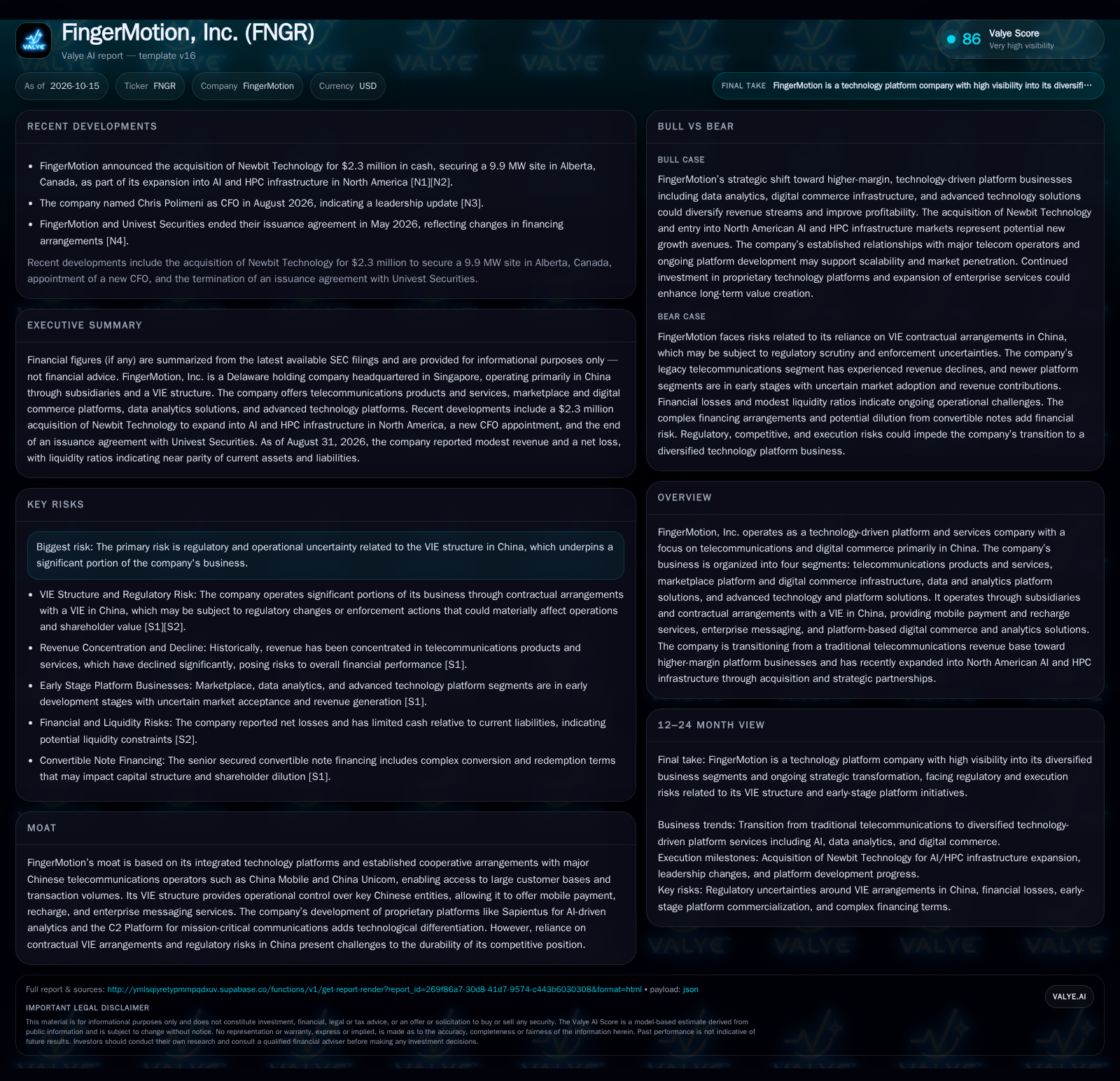
FingerMotion is actively shifting from a legacy telecom services model in China toward higher-margin digital platforms, analytics, and advanced technology solutions, now including North American AI/HPC infrastructure via a recent acquisition. Despite clear strategic intent, the company faces financial losses, early-stage revenue in new segments, and significant regulatory risks related to its VIE structure. The next phase depends on platform scaling, successful integration of its Alberta asset, and evidence that new lines of business can generate sustainable growth and margins. [S1] [S2] [N1] [N2]
FingerMotion, Inc. is at an inflection point, rapidly evolving from its roots as a China-focused telecommunications services provider into a multi-pronged technology platform company. The company’s recent acquisition of a 9.9 MW site in Alberta signals a bold move into North American AI and high-performance computing infrastructure, complementing its ongoing shift toward digital commerce, analytics, and advanced technology solutions. The next twelve to twenty-four months will test whether FingerMotion can scale its new businesses fast enough to offset legacy declines and structural headwinds.
Recent Moves Redefine Strategic Direction and Risk Profile
FingerMotion’s acquisition of Newbit Technology for $2.3 million in cash and the associated 9.9 MW Alberta site represent a tangible commitment to diversifying beyond its legacy China telecom revenue base. This move aims to establish a presence in the North American AI and high-performance computing (HPC) infrastructure market, a sector with fundamentally different economics and customer requirements than its traditional business. [N1] [N2]
As of August 31, 2026, the company reported quarterly revenue of $281,076 and a net loss of $4,932,239, underscoring the early-stage nature of its platform businesses and the ongoing drag from legacy operations. The cash ratio of 0.04 and current ratio of 1.04 indicate that liquidity is tight, with little margin for operational missteps. [S2]
FingerMotion continues to operate through a complex web of subsidiaries and contractual VIE arrangements in China, a structure that exposes the company to regulatory changes and enforcement uncertainties that could materially affect its ability to control and consolidate its key Chinese assets. [S1] [S2]
Platform Aspirations and the Challenge of Margin Expansion
FingerMotion’s business model is in transition. Historically, the company generated most of its revenue from low-margin telecommunications products and services—primarily mobile payments, recharge services, and enterprise messaging—through arrangements with major Chinese telecom operators. These activities are typically volume-driven, highly competitive, and exposed to pricing pressure, limiting the scope for meaningful margin expansion. [S1] [S2]
The strategic intent is to shift toward higher-margin platform businesses: digital commerce marketplaces (such as DaGe and JiuGe), AI-powered analytics (Sapientus), and advanced technology solutions (C2 Platform). Platform economics, if successfully scaled, can offer operating leverage, as incremental platform usage or data-driven services generally carry lower variable costs relative to fixed infrastructure. However, the company’s recent financial statements show that these segments remain nascent, with insufficient scale to offset legacy losses. [S2]
The acquisition of the Alberta site introduces a new economic model—providing powered land, cooling, security, and operations for AI/HPC customers who supply their own hardware. This colocation-like approach splits capital expenditure between provider and customer, but also exposes FingerMotion to utilization risk if it cannot secure long-term offtake contracts. The economics of this model depend on site fill rates, contract duration, and the ability to attract enterprise or mid-market clients willing to pay for reliability and performance. [S1] [N1] [N2]
Capital needs remain a constraint: with just over $2 million in cash and recent reliance on convertible note financing with complex terms, FingerMotion’s ability to fund further growth or absorb setbacks is limited absent external capital or a step-change in operating cash flow. [S2]
From Telecom Partnerships to Platform Differentiation—Competitive Landscape Shifts
In its legacy telecom business, FingerMotion’s main competitive advantage has been its established relationships with major Chinese operators like China Mobile and China Unicom, enabling access to large customer bases and transaction volumes. However, this segment is characterized by intense competition, commoditized offerings, and limited pricing power, making durable differentiation challenging. [S1] [S2]
The company’s platform ambitions—AI analytics, digital commerce, and advanced technology solutions—face a more fragmented and innovation-driven landscape. Competing successfully will depend on proprietary technology (e.g., Sapientus for AI analytics), the ability to integrate with enterprise workflows, and the stickiness of marketplace offerings. Barriers to entry are higher in analytics and enterprise platforms, but so is the need for sustained investment and customer acquisition. If FingerMotion can establish defensible intellectual property or data network effects, switching costs could increase over time, but this has yet to be demonstrated at scale.
The North American AI/HPC infrastructure market is structurally different. Here, competitors include established data center operators, cloud service providers, and specialized colocation vendors. The 9.9 MW Alberta site is sized for enterprise inference or partitioned workloads, not massive hyperscale training—which may limit customer scope but also allows focus on mid-market or specialized applications. Success will hinge on the ability to contract capacity quickly, differentiate on reliability or price, and manage operational risks unique to the Alberta environment. [N1] [N2]
If Platform Scaling and Alberta Integration Succeed, Margin Expansion Follows
A bullish scenario for FingerMotion would see rapid scaling of its proprietary platforms in China—especially in AI analytics and digital commerce—leading to a higher mix of recurring, higher-margin revenue. If the Sapientus platform achieves meaningful adoption in the insurance and telecom sectors, and the DaGe/JiuGe platforms gain traction with enterprise users, operating leverage could drive improved profitability even if legacy telecom revenue continues to decline.
On the North American front, swift permitting, successful site commissioning, and early customer wins for the Alberta AI/HPC infrastructure could validate the company’s expansion strategy. If FingerMotion is able to secure multi-year contracts with enterprise or AI customers at attractive utilization rates, the economics of the Alberta site could generate positive cash flow and serve as a template for further expansion.
Evidence confirming this scenario would include consecutive quarters of accelerating platform revenue growth, margin improvement, backlog or contracted capacity disclosures for the Alberta site, and a stabilization or narrowing of net losses. Early customer references, repeat business, or partnership announcements in both China and North America would further support the case.
Incremental Platform Growth Offsets Some Legacy Weakness, but Losses Persist
The most plausible scenario is that FingerMotion achieves moderate growth in its new platform segments, but progress is gradual and insufficient—at least in the near term—to fully offset continued softness in legacy telecom services. Revenue from digital commerce, analytics, and advanced technology solutions may rise, but not yet at a scale to deliver overall profitability.
The Alberta AI/HPC site may encounter typical ramp-up challenges: permitting delays, slow customer onboarding, or underutilization in the early quarters. If FingerMotion is able to contract some capacity but not fill the site, contribution margins may remain thin.
In this scenario, net losses continue but may narrow if cost discipline is maintained and new segments gain incremental traction. The company may require additional financing to fund ongoing operations and site build-out. Confirmation would come from steady, if unspectacular, growth in platform revenues, limited but visible progress in Alberta, and no material regulatory disruptions to the VIE structure.
Execution Stumbles, Regulatory Shocks, or Liquidity Crunch Derail Transition
Adverse outcomes could arise from multiple vectors. A sharp regulatory change or enforcement action affecting the VIE structure could result in loss of operational control or forced divestiture of key Chinese assets, severely impairing the company’s core business. [S1] [S2]
Platform initiatives may fail to scale, either due to weak market adoption, technological shortcomings, or competitive pressure from better-capitalized rivals. If the Alberta site faces permitting obstacles, construction delays, or cannot attract sufficient customers, sunk costs could weigh on the balance sheet without offsetting revenue. [N1] [N2]
Signs confirming this scenario would include a widening of net losses, negative operating cash flow, stalled or declining platform revenues, or public disclosure of regulatory or financing setbacks.
Milestones That Will Reveal the Durability of FingerMotion’s Platform Pivot
Quarterly revenue and gross margin trends for each of the four business segments, with a focus on the proportion of revenue from platform versus legacy telecom services (if disclosed).
Updates on contracted capacity, utilization rates, and customer types for the Alberta AI/HPC site—signed multi-year contracts would be a key indicator of economic viability.
Cash flow from operations and changes in the cash/current ratio, especially in light of ongoing losses and capital requirements.
Disclosure of customer wins, renewals, or reference deals for the Sapientus analytics platform and marketplace solutions.
Any material developments regarding the legal, regulatory, or enforcement status of the VIE structure in China.
Progress reports on site commissioning, permitting, and operational milestones for the Alberta infrastructure asset.
Management commentary or filings regarding additional financing needs, dilution risk, or changes to capital structure.
Churn, retention, or user growth metrics for the digital commerce and analytics platforms—if disclosed.
Disclaimer: This is research-only, informational analysis and not investment advice. It may include AI-generated interpretation and general industry context. Always verify important details using primary sources.

Comments