
Longevity Diversified Holdings: The High-Stakes Binary of a Blank Check Company with No Cash and No Target
With zero operations, no cash, and no acquisition target in sight, Longevity Diversified Holdings, Inc. presents investors with a pure speculative vehicle—its fate tied entirely to the uncertain prospect of completing a single business combination under severe capital constraints.
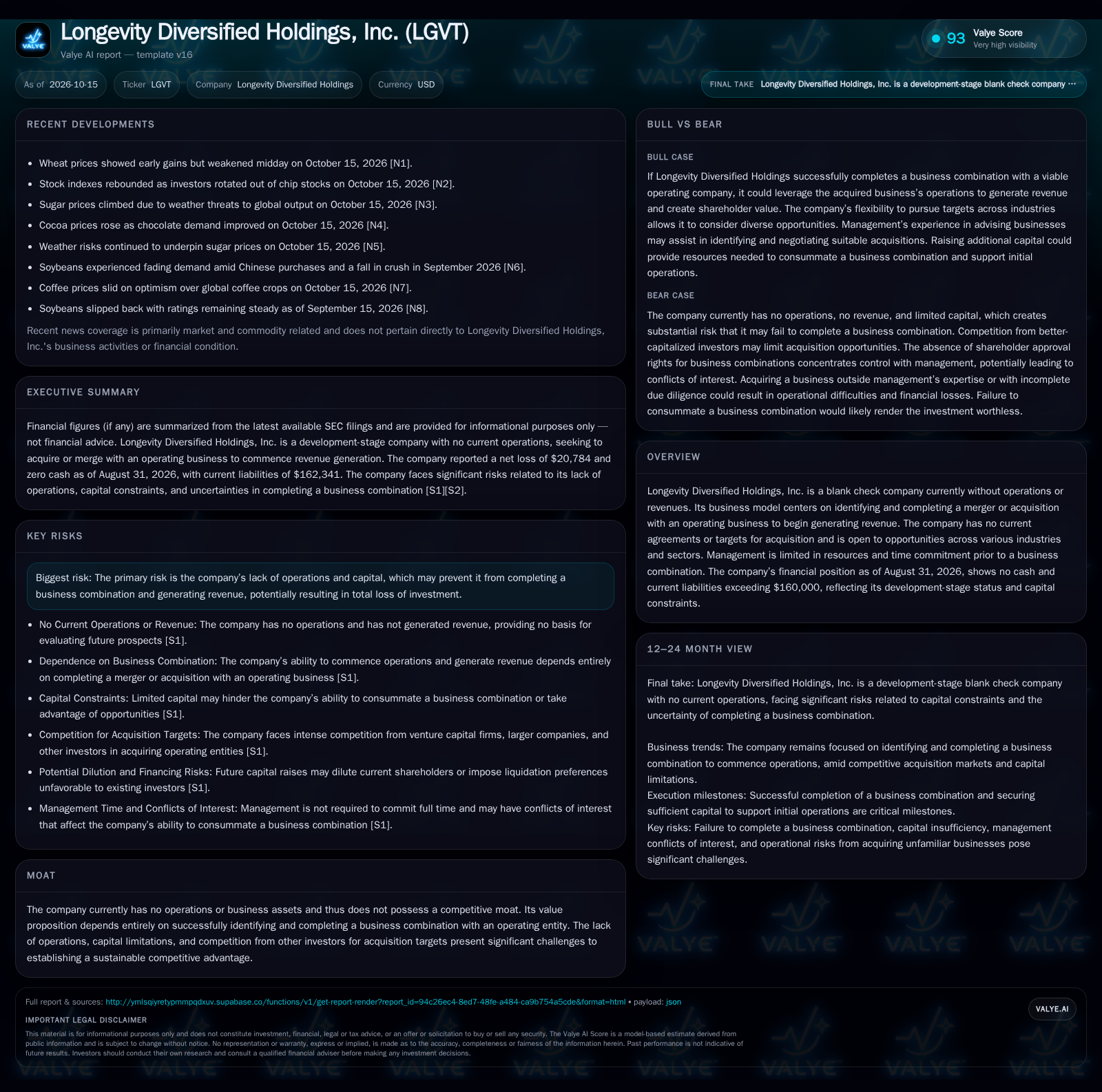
Longevity Diversified Holdings, Inc. is a shell company with no operations, revenue, or cash, and faces over $160,000 in current liabilities. Its entire business strategy is to find and acquire an operating business, but as of the latest filings there are no agreements or active discussions underway. The company’s future—and any potential for value creation—hinges on its ability to secure a suitable target and the capital needed to complete a deal, amid intense competition and concentrated managerial control [S1] [S2].
Longevity Diversified Holdings, Inc. is the archetype of a blank check company at its most speculative: as of its latest filings, it has no operations, no revenues, zero cash, and over $160,000 in current liabilities. With no acquisition target or even discussions underway, the company’s only stated plan is to find and consummate a merger or acquisition with an operating business—any industry, any sector. But with capital constraints, intense competition for targets, and concentrated managerial control, the odds and outcomes for investors remain highly uncertain [S1] [S2].
A Development-Stage Shell with No Cash, No Target, and Overhanging Liabilities
As of August 31, 2026, Longevity Diversified Holdings, Inc. reported zero cash and cash equivalents, with current liabilities totaling $162,341 and a net loss of $20,784 for the quarter [S2]. The company has no operations or revenue, and there are currently no agreements or even ongoing discussions regarding a business combination with any target [S1]. This combination of an empty operating shell, negative working capital, and absence of a deal pipeline places the company in an extremely precarious position. The only stated business plan is to identify and acquire an operating company, but with no cash on hand and mounting payables, the company’s ability to act on any opportunity is severely constrained.
How Value Could Be Created—and Destroyed—Through a Single Transaction
The economics of Longevity Diversified Holdings are typical of a blank check or SPAC-like entity at the pre-deal stage: there is no revenue, no operating cost base beyond minimal expenses, and no asset base to generate returns. All potential value is contingent on management’s ability to identify, negotiate, and fund a merger or acquisition with an operating business. If a deal is identified, the company would need to raise capital—almost certainly through dilutive equity or debt financing—to cover acquisition costs and provide working capital for the acquired business. The economics post-acquisition would then depend entirely on the quality, industry, and financial health of the acquired target. If the target is early-stage, distressed, or capital-intensive, the risk of ongoing losses and further dilution increases. Conversely, acquiring a profitable or fast-growing business could create rapid revenue and value accretion, but this is highly uncertain and dependent on deal execution, integration, and future capital markets access.
Facing a Crowded Field of Investors with No Moat and Minimal Resources
Longevity Diversified Holdings has no inherent competitive advantage at this stage. The market for private company acquisitions is intensely competitive, with venture capital funds, private equity, established corporations, and other blank check vehicles all seeking attractive targets. These better-capitalized competitors can typically offer larger, faster, and more certain transactions. With zero cash and a negative working capital position, Longevity Diversified Holdings is likely to be limited to targets that cannot attract more desirable suitors—typically businesses that are under-resourced, distressed, or in need of public market access. There is no sector specialization, brand, or sourcing edge currently disclosed, and the company’s ability to win a competitive process or negotiate favorable terms is highly questionable without fresh capital and a credible operating plan.
A Successful Acquisition of a High-Quality Target Could Rapidly Transform the Company
The most favorable scenario would involve management sourcing a high-potential operating business—ideally one with strong growth prospects, proven revenues, and a need for public market access. If Longevity Diversified Holdings can secure bridge financing or raise equity on reasonable terms, it may be able to consummate such an acquisition. This could quickly shift the company from a shell to an operating entity, enabling revenue generation and potential value creation for shareholders. Confirmation of this scenario would require a public announcement of a definitive agreement with a credible target, disclosure of committed financing, and evidence of target business quality (such as audited financials, growth metrics, or a clear competitive advantage). Falsification would be indicated by continued lack of deal activity, inability to raise capital, or selection of a low-quality or highly speculative target.
The Most Likely Outcome: Prolonged Search, Dilution, or Eventual Liquidation
Given the company’s lack of cash and no current deal pipeline, the most plausible scenario is a protracted search for a suitable acquisition, during which time the company will need to raise additional capital simply to cover basic expenses. This could mean repeated small equity financings at unfavorable terms, leading to significant dilution for existing shareholders. If a target is eventually found, it is likely to be an early-stage or financially unstable business, as more attractive targets are out of reach. The post-acquisition entity may struggle to achieve profitability or even generate meaningful revenue, and the risk of further dilution or operational failure remains high. Confirmation of this scenario would come from announcements of small capital raises, ongoing operating losses, and eventual acquisition of a non-core or distressed business. Falsification would require evidence of rapid, high-quality deal execution or an unexpected infusion of capital from a strategic investor.
Deal Failure, Inability to Raise Capital, and the Prospect of Total Loss
In the most adverse scenario, Longevity Diversified Holdings fails to secure a viable acquisition candidate and cannot raise the necessary capital to continue operations. With zero cash and mounting liabilities, the company could face creditor actions or be forced to dissolve, resulting in a total loss for shareholders. Even if a deal is attempted, poor due diligence or selection of an unsuitable target (for example, one without a viable business model, or operating in a sector unfamiliar to management) could accelerate losses and trigger further dilution or insolvency. Confirmation of this downside path would include continued SEC filings with zero or negative cash, increasing payables, lack of deal announcements, and eventual going concern warnings or liquidation filings.
Milestones and External Triggers That Will Define LGVT’s Viability
Announcement of any letter of intent, memorandum of understanding, or definitive agreement with a target business would be the first concrete sign of progress.
Disclosures of capital raises—whether equity, debt, or convertible instruments—and the terms attached to such financings (including dilution or liquidation preferences) will be critical to assessing future shareholder value.
If disclosed, the quality and financial health of any prospective target business (revenues, margins, growth rates, customer concentration) would help determine the viability of the post-acquisition entity.
Evidence of credible third-party advisors, board expansion, or operational hires may indicate increased deal readiness and seriousness of intent.
Changes in current liability levels or the addition of secured creditors could signal rising financial strain or potential default risk.
Any attempt to establish sector focus, sourcing differentiation, or a competitive edge in deal-making would help assess whether the company can compete for quality targets.
Shareholder communications regarding approval rights, governance changes, or changes in control would clarify the alignment and risks for minority investors.
A useful metric would be the length of time remaining before regulatory or exchange rules require action to maintain listing or trigger liquidation procedures.
Disclaimer: This is research-only, informational analysis and not investment advice. It may include AI-generated interpretation and general industry context. Always verify important details using primary sources.

Comments