
PreAxia Health Care Payment Systems: Ambition in Health-Fintech Integration Confronts Acute Liquidity Pressures
PreAxia Health Care Payment Systems is a pre-revenue fintech focused on integrating health spending account processing with an AI-powered personal finance super-app targeted at Generation Z.
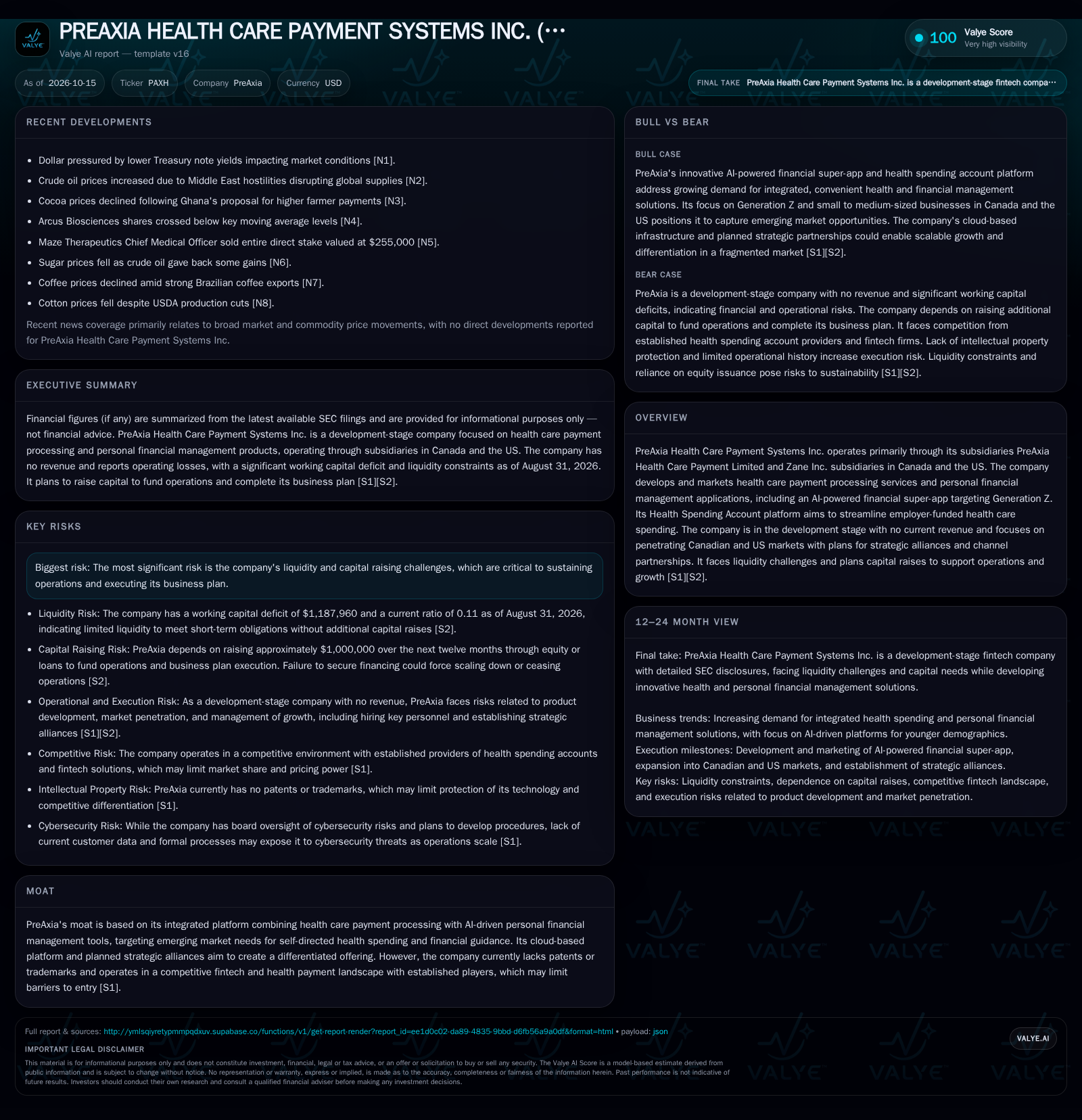
PreAxia Health Care Payment Systems is a pre-revenue fintech focused on integrating health spending account processing with an AI-powered personal finance super-app targeted at Generation Z. Continued operation and product launch are dependent on raising at least $1 million in new capital, and the company lacks patents or meaningful commercial traction. Its ability to establish a differentiated position in a crowded health and fintech market remains unproven. [S2]
PreAxia Health Care Payment Systems is positioning itself as an innovator at the crossroads of healthcare payment processing and AI-powered personal finance, targeting an emerging market need for seamless, digital-first financial and health benefits solutions. Yet, as of late 2026, the company’s ambitions are checked by immediate financial realities: no revenue, a material working capital deficit, and urgent capital needs. Its ability to survive and execute on its integrated product vision will depend on timely funding, effective go-to-market execution, and the capacity to carve out a defensible niche against well-resourced incumbents.
Immediate Capital Needs and Development-Stage Status Define PreAxia’s Present
PreAxia Health Care Payment Systems remains a development-stage company with no reported revenue for the quarter ended August 31, 2026. It posted a net loss of $206,876 during this period, and its cash and cash equivalents stood at $141,579, dwarfed by current liabilities of $1,329,539. The company reported cash and liquidity metrics for the period; these figures do not by themselves establish operating runway, investment capacity, financial flexibility, or financing capacity. The company’s R&D expenses dropped to zero in the latest quarter, indicating either a pause or completion of certain development activities, though some development costs have been capitalized. PreAxia acknowledges its need to raise approximately $1 million over the next twelve months, primarily through equity or loans, to fund operations and product launches. There are currently no patents or trademarks protecting its technology. [S2]
How PreAxia’s Platform Could Monetize Integrated Health and Financial Services
PreAxia’s business model aspires to generate revenue by charging employers and individuals for health spending account (HSA) administration, while layering on monetization from personal financial management tools. If launched, its AI-powered super-app could derive income from a mix of SaaS fees, transaction-based revenue (e.g., interchange on smart debit cards), interest spread on high-yield accounts, and potentially commissions or referral fees from partner financial products. The HSA platform targets small and medium employers, who may pay per-employee monthly fees for digital claims management and compliance reporting.
The economics of such a platform depend on scaling user volume to cover high fixed costs of platform development, regulatory compliance, and customer acquisition. Margins could improve with automation and AI-driven customer support, but initial customer acquisition costs are likely to be high due to entrenched incumbent providers and the need to build trust in financial/health data handling. Capital requirements are front-loaded: significant funding is needed for technology buildout, regulatory licensing, and marketing before recurring revenues can materialize. Operating leverage could be substantial if user adoption scales, but breakeven requires reaching a critical mass of employer clients or consumer users—something not yet achieved or demonstrated.
PreAxia’s Differentiation Ambitions Meet an Established Fintech and Health Payments Landscape
PreAxia aims to distinguish itself by integrating employer-sponsored health payment processing with an AI-enabled personal finance platform, targeting Generation Z and SMBs. However, the competitive environment is crowded: established HSA administrators, benefits platforms, neobanks, and fintech super-apps (including those from major financial institutions and upstart fintechs) already offer overlapping services. These incumbents enjoy scale, brand recognition, regulatory infrastructure, and existing customer relationships, making entry difficult.
PreAxia’s lack of intellectual property protection (no patents or trademarks) further weakens its defensibility, as any technical innovations could be rapidly copied. The company’s cloud-based, agile infrastructure and focus on regulatory compliance could help it adapt quickly, but absent a truly unique product or network effect, customer switching costs may remain low. Strategic alliances, if secured, could provide distribution leverage, but this is not yet demonstrated. Ultimately, PreAxia’s window for differentiation will depend on speed to market, user experience, and the ability to create a compelling, integrated value proposition before incumbents respond or user inertia sets in.
What a Breakout Could Look Like: Successful Capital Raise Fuels Product Launch and Early Traction
In the most optimistic scenario, PreAxia raises its targeted $1 million swiftly and deploys these funds to complete development, launch its super-app and HSA platform, and begin customer acquisition. Early traction could come from landing several reference SMB accounts in Canada, validating product-market fit, and leveraging positive case studies to attract channel partners or financial advisor distribution. If the AI-powered budgeting and credit-building features resonate with Generation Z, viral adoption or strong word-of-mouth could drive rapid user growth.
Confirmation of this scenario would include announcements of funding closed, live product launches, signed customer or channel agreements, and initial revenue generation. Metrics to watch would be user registrations, active accounts, employer signups, and early retention rates. Evidence of strategic partnerships with established financial institutions or benefits platforms would further validate the model. Falsification would occur if capital raising is delayed, product launch timelines slip, or customer acquisition costs prove prohibitive relative to early revenue.
Execution and Funding Delays Keep PreAxia in a Prolonged Development Holding Pattern
The most plausible path, given current realities, is one in which PreAxia encounters continued funding delays or raises less than its targeted amount, slowing product development and market entry. Without meaningful capital, the company may be forced to scale back or sequence its product roadmap, focusing on a minimal viable product for a narrow user segment. Customer acquisition would be slow, with initial traction limited to pilot programs or small-scale employer trials. Competitive pressure from incumbent fintech and health payment providers could make it difficult to secure early reference accounts.
Evidence confirming this scenario would include further operating losses without revenue, repeated capital raises on dilutive terms, and limited product or market updates. Watch for extended periods with no new customer announcements, slow growth in user or employer signups (if disclosed), or continued working capital shortfalls. Falsification would require evidence of a significant capital infusion, accelerated product rollout, and credible customer wins.
Acute Liquidity Risk Forces Strategic Retrenchment or Wind-Down
Should PreAxia fail to secure the required capital in the near term, the company could face an inability to fund ongoing operations, forcing it to delay or halt product launches, reduce staff, or pursue a sale of assets. With a working capital deficit exceeding $1 million and no revenue, the margin for error is thin. In this scenario, development may stall, and PreAxia’s ability to retain talent or meet regulatory obligations could be compromised, increasing the risk of insolvency or an abrupt wind-down.
Confirmation would come from missed payroll or payment obligations, public disclosure of going concern doubts, or announcements of layoffs and operational cutbacks. If disclosed, a sharp drop in R&D activity, staff departures, or the absence of new funding rounds would also be red flags. Conversely, a last-minute bridge financing or asset sale could temporarily avert this outcome, but would likely come at the cost of significant dilution or loss of strategic optionality.
Milestones and Metrics That Will Determine Whether PreAxia Can Transition from Concept to Commercialization
Closure and terms of the targeted $1 million capital raise—was it achieved, and on what terms?
Timing and scope of initial product launches, including the AI-powered super-app and HSA management platform.
First announcements of paying employer clients, user signups, or active account metrics (if disclosed).
Partnership agreements with financial institutions, benefits brokers, or channel partners.
Any evidence of recurring or transaction-based revenue, or early revenue run-rate (if disclosed).
Updates on R&D activity, platform development milestones, and staffing levels.
Regulatory approvals, licenses obtained, or compliance milestones in Canada and the US.
Changes in working capital, current ratio, and cash runway as new funds are raised or burned.
Disclaimer: This is research-only, informational analysis and not investment advice. It may include AI-generated interpretation and general industry context. Always verify important details using primary sources.

Comments