
Webstar Technology Group: Specialty Real Estate Pivot and the Tension Between Ambition and Financial Constraints
A recent strategic overhaul has transformed Webstar Technology Group from a software licensing entity into a specialty real estate developer with a focus on green, multi-tenant, and entertainment/resort properties. The company's future now hinges on its ability to execute the Forge Atlanta project and manage mounting financial obligations, amid a backdrop of related-party deals and evolving governance.
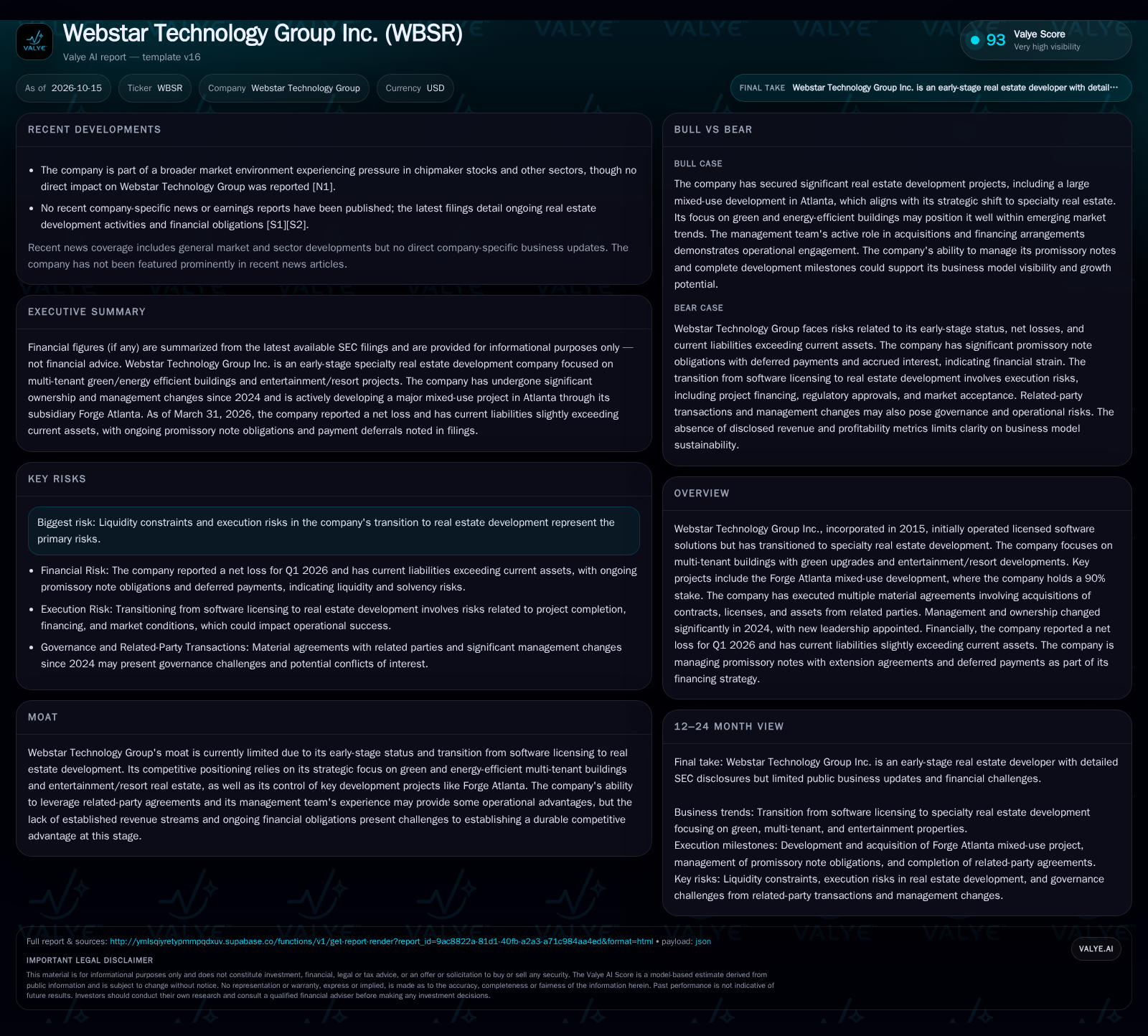
Webstar Technology Group has shifted from software to real estate development, acquiring assets and launching the Forge Atlanta mixed-use project. The company faces significant financial strain, with current liabilities exceeding current assets and ongoing promissory note obligations. [S1] [S2]
Webstar Technology Group’s pivot from software to real estate development represents both an ambitious transformation and a high-wire act. The company now controls key assets in the green, multi-tenant, and entertainment/resort real estate niches, with the Forge Atlanta project as a potential flagship. Whether Webstar can convert its real estate ambitions into sustainable value depends on project execution, managing liquidity, and navigating governance complexities from recent related-party transactions and leadership turnover. [S1] [S2]
Recent Strategic Overhaul and Financial Tightrope
Webstar Technology Group has undergone a dramatic transformation since 2024, shifting its core business from proprietary software licensing to specialty real estate development. This pivot is anchored by the acquisition of Bear Village, Inc. and the launch of the Forge Atlanta mixed-use project, where Webstar holds a 90% controlling stake. Material definitive agreements for asset and contract acquisitions from related parties have reinforced this new strategic direction. At the same time, the company’s financial disclosures as of March 31, 2026, reveal a net loss of $1.31 million for the quarter, current assets of $38.1 million against current liabilities of $40.5 million, and a cash ratio of zero. These facts collectively position Webstar at the intersection of strategic ambition and financial strain, with near-term outcomes likely to be dictated by its ability to execute and finance its cornerstone development projects. [S1] [S2]
The shift from software licensing to specialty real estate development not only redefines Webstar’s operational focus but also fundamentally alters its risk profile and capital requirements. Unlike software, where incremental development costs and scalability are often manageable, real estate development demands significant upfront capital commitments with long gestation periods before revenue realization. This temporal mismatch between cash outflows and inflows amplifies liquidity risk, especially when coupled with the company’s existing debt obligations. Moreover, the reliance on related-party transactions introduces additional complexity in governance and financial transparency, potentially constraining access to third-party financing and investor confidence. Effective risk management and clear communication with stakeholders will be essential to navigate these intertwined strategic and financial challenges.
How Value Could Be Created in Specialty Real Estate
The economics of specialty real estate development are driven by the ability to acquire, entitle, develop, and ultimately monetize properties—typically through sales, leases, or mixed-use operating income. Webstar’s focus on green, energy-efficient, and entertainment/resort properties positions it toward higher-value, potentially premium segments. If the Forge Atlanta project reaches completion and achieves strong lease-up or sale, the company could realize significant capital gains and recurring income streams. However, real estate development is capital-intensive, with high fixed costs (land acquisition, construction, permits) and variable costs (marketing, tenant improvements). Profitability is highly sensitive to project execution, cost overruns, financing terms, and ultimate market demand. Webstar’s reliance on promissory notes with deferred payments and accrued interest suggests a funding model dependent on external debt and favorable renegotiation, which may compress margins if interest costs escalate or refinancing becomes difficult. The transition from software—an asset-light, recurring-revenue model—to real estate—a capital-heavy, milestone-driven business—means that operating leverage could be substantial if projects succeed, but downside risk is amplified by fixed obligations and potential cash shortfalls during delays or downturns.
In specialty real estate, the timing and sequencing of capital deployment are critical levers for value creation. If Webstar can phase development to align with market absorption rates and secure non-recourse or project-level financing, it may mitigate balance sheet risk and enhance return on invested capital. However, the capital-intensive nature of green and entertainment-focused properties often entails higher development costs and longer approval cycles, which can strain cash flow and increase exposure to market cyclicality. Additionally, the company’s ability to leverage tax incentives, grants, or green financing instruments could materially influence project economics. Should these external funding sources be limited or delayed, Webstar’s margin compression risk would increase, underscoring the importance of diversified capital strategies and contingency planning.
Competitive Dynamics: Is Differentiation Enough?
Webstar’s competitive positioning now rests on its ability to deliver differentiated, green, and entertainment-focused developments in competitive urban markets. The Forge Atlanta project, located in a prime district, may offer locational advantages and appeal to sustainability-conscious tenants or buyers. However, the company is entering a market crowded with established real estate developers, REITs, and private equity-backed platforms with deeper balance sheets and more extensive track records. While green upgrades and energy efficiency are increasingly valued, they are not unique differentiators and can be replicated by better-capitalized rivals. Related-party agreements could offer operational synergies or proprietary deal flow, but they also risk governance challenges and may raise investor concerns about transparency and arm’s-length economics. The absence of established revenue streams and limited public disclosure of project pre-leasing, sales, or anchor tenant commitments leave Webstar’s ability to secure meaningful market share and pricing power unproven.
Differentiation in specialty real estate increasingly hinges not only on product features but also on operational capabilities such as tenant engagement, property management, and community integration. Webstar’s success may depend on its capacity to build these competencies or partner effectively with established operators to enhance asset performance and tenant retention. Furthermore, the replicability of green building standards by competitors reduces the potential for sustained pricing premiums, making execution excellence and location advantages paramount. The company’s governance structure and transparency in related-party dealings will also influence its reputation and ability to attract institutional capital, which often demands rigorous environmental, social, and governance (ESG) compliance. Thus, competitive positioning is as much about operational execution and governance discipline as it is about project design.
A Path to Value Creation: Completing Forge Atlanta and Monetizing Assets
If Webstar successfully closes on the Forge Atlanta acquisition, secures necessary permits, and executes the development on time and within budget, the company could unlock substantial value. Achieving pre-leasing targets or attracting anchor tenants to the mixed-use project would validate demand and could support favorable financing or joint-venture terms for future phases. Monetization via sales or long-term leases could move the business from a cash-consuming development phase to a cash-generating operating phase. The company’s focus on energy efficiency could also attract institutional investors or green financing options, potentially lowering capital costs. Evidence that would support this scenario includes announcements of lease commitments, successful refinancing or conversion of promissory notes into longer-term, lower-cost debt, and progress milestones such as construction starts, regulatory approvals, or positive pre-sales. Conversely, the absence of such disclosures, or further payment deferrals and financing extensions, would challenge the plausibility of this upside case.
Navigating Development and Liquidity Hurdles: A Balancing Act
The most plausible near-term scenario is one in which Webstar continues to make incremental progress on its core projects, while managing liquidity constraints through ongoing promissory note extensions and periodic capital infusions. The company may achieve partial development milestones—such as obtaining entitlements, initiating site work, or securing early-stage tenants—without reaching full stabilization or exit. Operating losses may persist, and the balance sheet could remain stretched, with current liabilities exceeding assets until a major monetization event occurs. Confirmation of this scenario would come from continued disclosures of payment extensions, modest project updates, and the absence of transformative revenue or leasing news. Falsification would require either a breakthrough in project monetization or, conversely, a material default or asset sale under distress.
Liquidity Crunch and Execution Shortfalls: Risks of the Capital-Intensive Model
If deferred payments and accrued interest compound faster than the company can generate cash from asset sales or leasing, Webstar may face covenant breaches, forced asset sales, or even insolvency proceedings. Governance challenges from related-party contracts and management turnover could exacerbate operational risks and reduce stakeholder confidence, potentially limiting access to new capital. Evidence supporting this downside case would include missed payment deadlines, disclosure of default notices, forced asset dispositions, or the resignation of key officers. The absence of meaningful project or financing progress over several quarters would also tilt the risk profile toward this scenario.
Concrete Milestones That Will Shape Webstar’s Real Estate Pivot
Updates on the status and closing of the Forge Atlanta property acquisition, including any changes to the purchase price, payment schedule, or equity structure.
Disclosure of pre-leasing activity, anchor tenant commitments, or signed sales contracts for units in Bear Village or Forge Atlanta—if disclosed.
Details on regulatory approvals, construction permits, or ground-breaking milestones for major development projects.
Announcements of refinancing, conversion of promissory notes to longer-term debt, or new equity capital raises that materially alter the liquidity profile.
Quarterly or interim reports on changes in current assets, liabilities, and net operating cash flow.
Evidence of cost overruns, project delays, or disputes with contractors, lenders, or related parties.
Management commentary or board actions regarding governance practices, related-party transaction oversight, or changes to executive leadership.
Any material default events, asset sales under distress, or restructuring agreements with creditors or partners.
Disclaimer: This is research-only, informational analysis and not investment advice. It may include AI-generated interpretation and general industry context. Always verify important details using primary sources.

Comments