
Biomerica’s Diagnostic Ambitions: Strategic Financing, Product Expansion, and the Profitability Challenge
Biomerica advances its portfolio of rapid diagnostic assays and tests, pursues international authorizations, and secures strategic financing, but persistent net losses and execution risks continue to shape its path toward sustainable growth.
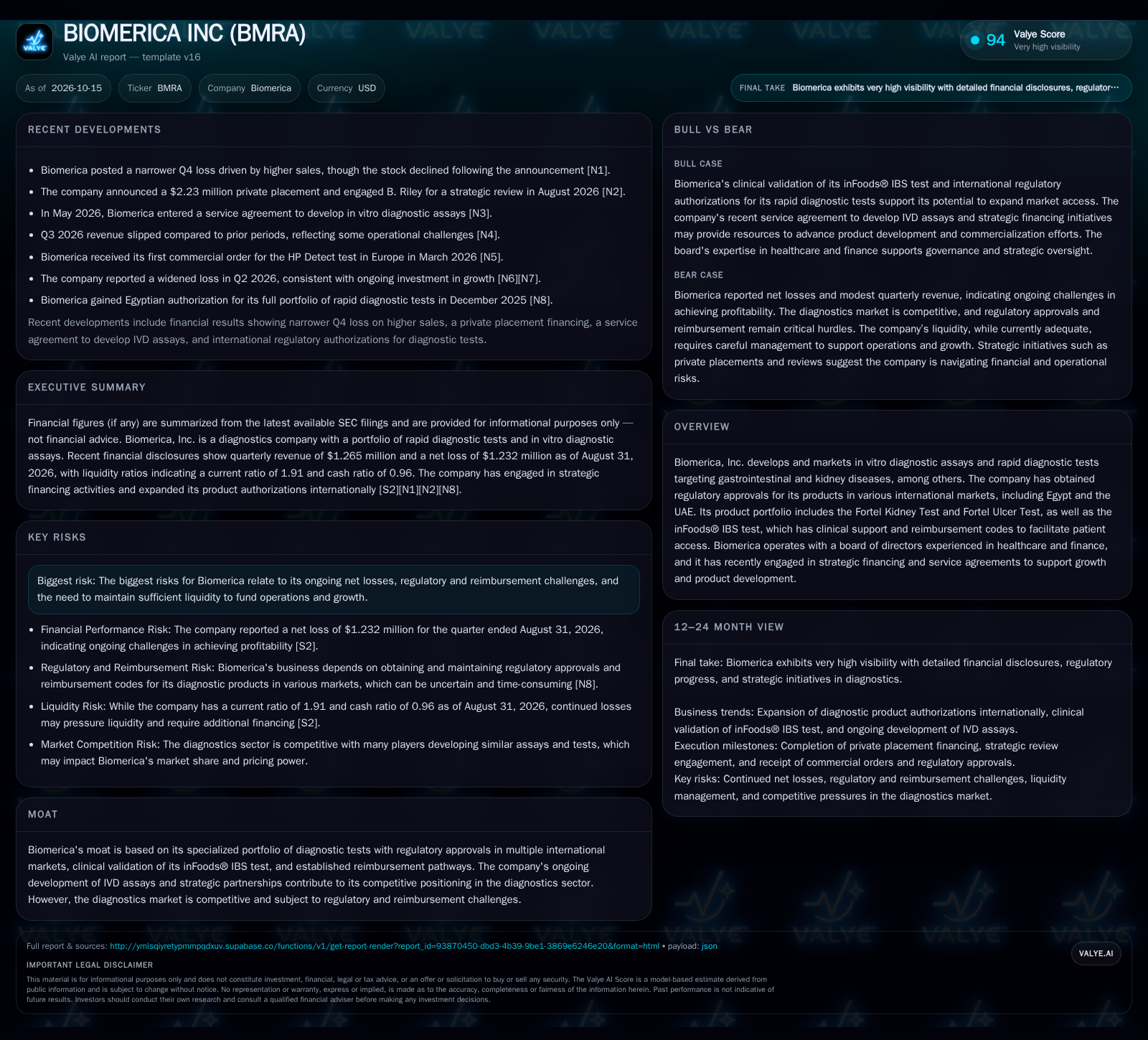
Biomerica reported a quarterly net loss of $1.232 million on $1.265 million in revenue as of August 31, 2026, despite higher sales and new service agreements in diagnostics. The company completed a $2.23 million private placement and initiated a strategic review, suggesting a focus on funding and operational pivots. International authorizations and commercial orders for new tests highlight growth potential, but ongoing losses and competitive pressures underline the need for execution and capital discipline. [S2] [N1] [N2] [N5] [N8]
Biomerica, Inc. is at a pivotal juncture as it seeks to convert its growing portfolio of rapid diagnostic assays and international product authorizations into commercial traction and financial stability. Recent moves—including a $2.23 million capital raise, a strategic review led by B. Riley, and new service agreements—underscore a dual focus on funding and operational realignment. Yet, persistent net losses and a volatile revenue trajectory reflect the company’s uphill battle in a competitive diagnostics landscape, where execution, capital allocation, and product adoption will determine whether Biomerica can transition from development-stage promise to sustainable growth.
Recent Inflection Points: Financing, Strategic Review, and Product Expansion
As of August 31, 2026, Biomerica reported $1.265 million in revenue and a net loss of $1.232 million for the quarter, with $2.73 million in cash and cash equivalents on hand [S2]. In August 2026, the company announced a $2.23 million private placement and engaged B. Riley for a strategic review, signaling a proactive approach to both funding and evaluating strategic options [N2]. Biomerica has also expanded its commercial reach, receiving its first European commercial order for the HP Detect test in March 2026 and gaining full Egyptian regulatory authorization for its rapid diagnostics portfolio in December 2025 [N5] [N8]. These developments highlight a period of operational and financial transition as the company pushes to commercialize its pipeline and shore up its balance sheet.
How Biomerica’s Revenue Model Could Scale—And Where the Economics Get Difficult
Biomerica’s business model hinges on the development and commercialization of rapid diagnostic assays for gastrointestinal and kidney diseases, among other indications. Revenue is generated through the sale of test kits and, potentially, through service agreements to develop in vitro diagnostic (IVD) assays [N3]. The underlying economics of diagnostics often favor high gross margins once products achieve scale, as manufacturing and distribution costs are typically lower relative to price points for specialized tests. However, Biomerica’s current revenue base remains modest, and fixed costs associated with R&D, regulatory compliance, and market entry weigh heavily on profitability. The recent net loss of $1.232 million on just $1.265 million in revenue for the quarter demonstrates that the company has yet to achieve the operating leverage necessary for break-even or positive cash flow [S2].
Capital requirements in this sector can be lumpy, with up-front product development and regulatory costs followed by a long commercialization ramp. Biomerica’s recent $2.23 million private placement suggests the need to bridge near-term funding gaps as it pursues broader market penetration and new assay development. The strategic review with B. Riley may open pathways for partnerships, licensing, or even asset sales, each with distinct economic implications. Ultimately, the path to sustainable economics will depend on driving sufficient test volume, securing reimbursement, and effectively managing the cost structure as the company expands internationally.
Diagnostics Market Dynamics: Biomerica’s Place Amid Intense Competition and Substitution Risk
The in vitro diagnostics (IVD) landscape is characterized by a proliferation of established players and emerging innovators, each vying for clinical adoption and payer reimbursement. Biomerica’s product focus—rapid tests for gastrointestinal and kidney conditions—targets large addressable markets but faces entrenched competition from global diagnostics firms, as well as ongoing risk of product substitution by newer, more accurate, or more convenient modalities.
Potential advantages for Biomerica include speed to market with novel assays, regulatory clearances in non-U.S. jurisdictions, and the ability to address unmet diagnostic needs with differentiated products like the inFoods® IBS test. However, these advantages are counterbalanced by the need for robust clinical validation, successful navigation of complex reimbursement landscapes, and the challenge of building commercial infrastructure from a relatively small base. The company’s partnerships, such as the recent IVD service agreement, could offer access to broader distribution or technical capabilities but may also dilute economics or increase dependence on external parties if not structured favorably [N3].
Unlocking Value: International Orders and Assay Partnerships Drive Scale
A favorable trajectory for Biomerica would involve rapid expansion of commercial orders in newly authorized international markets, particularly in Europe and Egypt, where regulatory barriers have already been cleared [N5] [N8]. If the company can convert these authorizations into sustained sales growth—leveraging its Fortel and HP Detect tests—operating leverage could improve materially as fixed costs are spread across higher volumes.
The service agreement to develop new IVD assays, if it results in milestone payments, royalties, or co-marketing opportunities, could provide non-dilutive funding and broaden the revenue base [N3]. Key evidence supporting this upside would include: sequential revenue acceleration from international markets, expanded distribution partnerships, and increasing gross margins as scale is achieved. A reduction in quarterly net losses or a move toward break-even would further validate the commercial model.
Incremental Progress, Ongoing Cash Burn, and Strategic Uncertainty
The most plausible near-term outlook is one of gradual operational progress punctuated by continued net losses and periodic capital raises. Biomerica may see episodic revenue growth from new product launches or regional authorizations, but execution risks—such as slow adoption, reimbursement hurdles, or supply chain constraints—likely temper the pace of improvement.
Strategic review outcomes could range from minor partnerships to more significant structural changes, but given the company’s modest scale and persistent losses, any transaction is likely to reflect ongoing uncertainty about long-term standalone viability. Confirmation of this scenario would include modest revenue growth, continued negative EPS, and recurring disclosures of additional financing or cost containment measures.
Stalling Adoption and Capital Constraints Threaten Commercialization
In an adverse scenario, Biomerica’s international authorizations and new product launches fail to translate into meaningful sales, either due to lack of market uptake, reimbursement denials, or competitive displacement. Fixed costs associated with regulatory compliance and product support persist, leading to sustained or widening net losses.
If the company is unable to secure additional capital on favorable terms—or if the strategic review concludes without actionable alternatives—liquidity pressures could force reductions in R&D, delays in commercialization, or even asset divestitures at unfavorable valuations. Evidence of this downside would include declining or flat revenue, increasing quarterly losses, and warnings or disclosures regarding going concern or funding uncertainty.
Milestones That Will Shape Biomerica’s Transition from Pipeline to Profitability
Quarterly revenue growth, particularly from newly authorized international markets, would help demonstrate product traction and commercial scalability.
Gross margin trends, if disclosed, would be critical to assess whether scale and mix improvements are translating into better underlying economics.
Updates on the strategic review process—including any partnership, licensing, or asset sale outcomes—will clarify the company’s direction and capital needs.
New service or distribution agreements, especially those that provide non-dilutive funding or access to larger customer bases, would help test the sustainability of the business model.
Net cash burn rate and the timing/terms of future financing transactions will be essential to monitor balance sheet risk and runway.
Product adoption metrics, such as test kit reorder rates or customer retention (if disclosed), would provide direct evidence of recurring demand.
Regulatory milestones in new geographies or for new assays could open additional markets and impact long-term growth potential.
Any disclosures related to reimbursement status or payer coverage for the company’s core diagnostics would help validate product-market fit and pricing power.
Disclaimer: This is research-only, informational analysis and not investment advice. It may include AI-generated interpretation and general industry context. Always verify important details using primary sources.

Comments