
ClimateRock’s SPAC Clock: Can Related-Party Funding and Deadline Extensions Rescue a Challenged Energy Transition Vehicle?
ClimateRock, a SPAC targeting the energy transition sector, faces acute financial stress with a $7.9 million working capital deficit and negligible cash outside its trust as of year-end 2025.
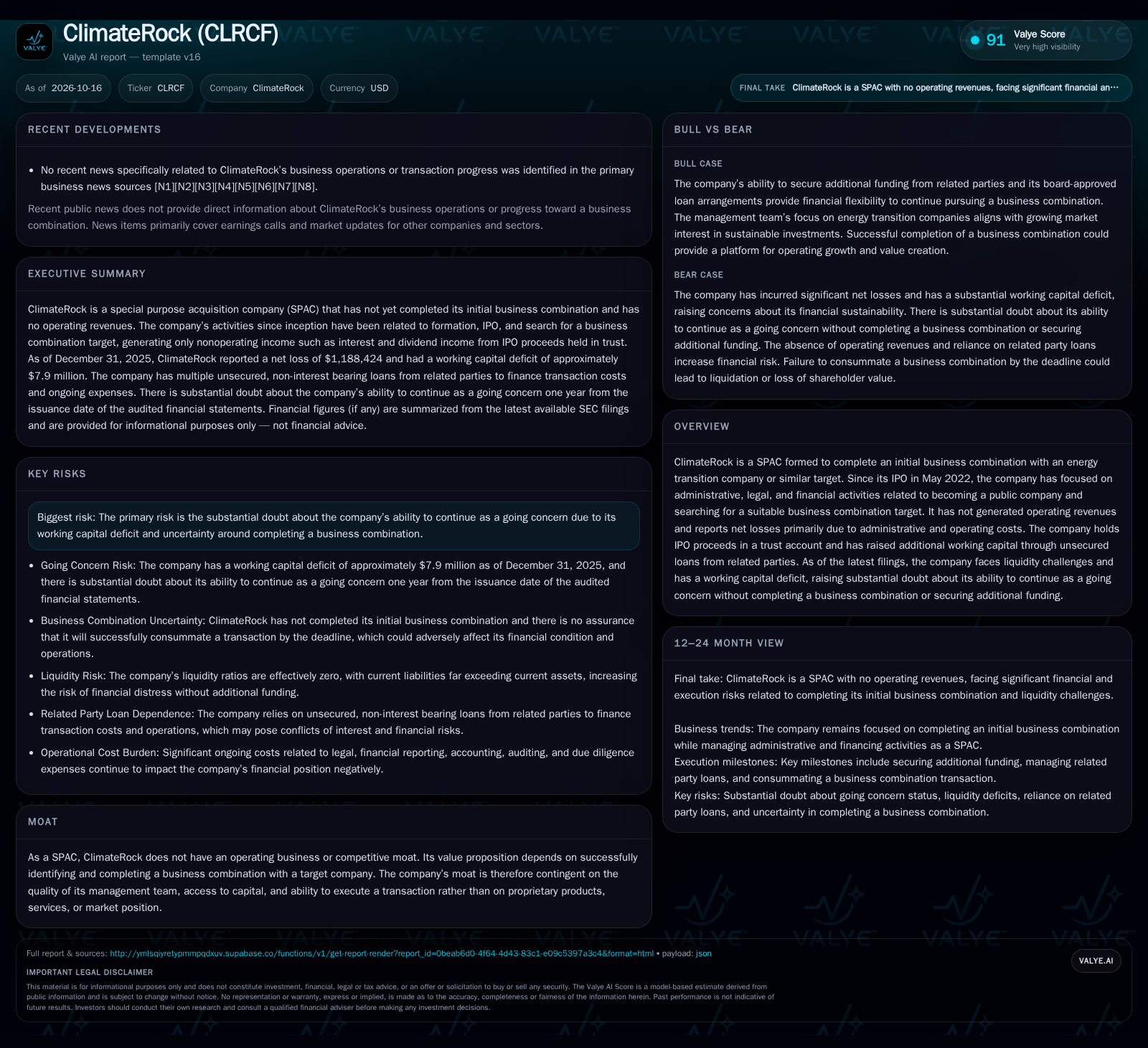
ClimateRock, a SPAC targeting the energy transition sector, faces acute financial stress with a $7.9 million working capital deficit and negligible cash outside its trust as of year-end 2025. With no operating revenues and ongoing reliance on related-party loans, its survival depends on closing a business combination before the May 2026 extension expires or securing new capital. The board’s willingness to approve loans and deadline extensions provides some flexibility, but execution risk and going concern doubts are now central to the thesis. [S1]
ClimateRock illustrates the acute late-stage risks facing special purpose acquisition companies (SPACs) that have yet to secure an operating target. With its extended deadline now set for May 2026 and a working capital deficit of nearly $8 million, the company’s only lifeline comes from related-party loans and the possibility of a last-minute deal.
Deadline Extension Buys Time, But Financial Pressures Mount
As of December 31, 2025, ClimateRock reported only $5,670 in cash outside its trust account and a working capital deficit of approximately $7.9 million, reflecting the cumulative impact of administrative, legal, and deal pursuit costs since its 2022 IPO. The company has not generated any operating revenues, relying instead on non-operating income from trust account investments and a series of unsecured, non-interest-bearing loans from related parties to fund its operations. The board recently extended the deadline for completing a business combination to May 2026, providing a short runway but not resolving underlying liquidity and execution risks. There is now substantial doubt about ClimateRock’s ability to continue as a going concern if it cannot close a deal or secure new funding within the extension period. [S1]
The reliance on related-party loans, while providing short-term relief, introduces a layer of complexity that could affect stakeholder confidence and governance transparency. Such financing arrangements typically lack the protections and formalities of market-based debt, potentially leading to conflicts of interest or prioritization dilemmas in the event of liquidation or restructuring. Furthermore, the limited cash outside the trust account restricts the company’s operational agility, making it vulnerable to unexpected expenses or regulatory requirements. This constrained liquidity environment heightens the urgency for a timely business combination or alternative capital infusion to stabilize the company’s financial footing.
SPAC Economics: Fixed Costs, Negative Carry, and the Binary Deal Outcome
As a SPAC, ClimateRock’s business model is structurally binary: either a successful business combination is closed, unlocking trust account assets and facilitating an operating future, or the company is forced to liquidate, returning remaining trust funds to public shareholders and likely resulting in a wipeout for sponsors and warrant holders. In the meantime, the company faces persistent fixed costs—legal, accounting, regulatory, and due diligence expenses—that do not scale down with inactivity. These costs, combined with the lack of operating revenue, create a negative carry scenario, where each month erodes the capital available for a future merger or acquisition.
The reliance on related-party loans for working capital introduces both financial and governance complexity, as these loans are typically non-interest bearing and unsecured, but their repayment may be contingent on a successful transaction. If a deal does materialize, the economics will pivot entirely to the target’s financial profile, with ClimateRock’s current capital structure, warrant overhang, and deal expenses shaping the post-merger company’s viability and dilution profile. Without a deal, sunk costs and ongoing deficits will culminate in liquidation.
The structural binary outcome inherent in SPAC models creates a unique risk-reward dynamic that influences sponsor incentives and investor behavior. Sponsors often face a compressed timeline to identify viable targets, balancing the need to preserve capital against the pressure to consummate a deal that justifies their initial investment and warrants. Negative carry during the search phase can erode the net asset value available to public shareholders, raising questions about the optimal allocation of resources toward deal sourcing versus cost containment. Additionally, the presence of warrant overhang can dilute post-merger equity, complicating valuation assessments and potentially dampening investor enthusiasm for the combined entity.
SPAC Market Saturation and Target Scarcity: A Tougher Environment for Acquisition
ClimateRock’s competitive position is not defined by product or service differentiation but by its ability to identify and close a deal with an attractive target—typically in the energy transition or environmental sector. However, as the SPAC cycle matures, the pool of viable targets has shrunk, with many high-quality companies either already acquired, opting for traditional IPOs, or demanding more favorable terms. The broader environment is now characterized by increased regulatory scrutiny, greater investor skepticism, and a glut of SPACs chasing a limited universe of targets.
Competing SPACs may have larger trust accounts, more prominent sponsors, or sector-specific expertise, making it harder for ClimateRock to win competitive processes. Additionally, targets may demand additional capital infusions or more favorable post-merger economics, further straining already tight SPAC balance sheets. If a target is found, negotiating a deal that preserves value for public shareholders—while covering accumulated costs and satisfying related-party loan obligations—will be challenging.
In a saturated SPAC market, differentiation hinges less on financial capacity and more on strategic alignment and sector expertise. ClimateRock’s focus on the energy transition sector implies a need for deep industry knowledge and relationships to identify targets with credible growth prospects and sustainable business models. However, heightened regulatory scrutiny and evolving investor expectations around environmental, social, and governance (ESG) factors may narrow the pool of acceptable targets, requiring more rigorous due diligence and potentially prolonging deal timelines. Moreover, the competitive pressure to offer attractive terms can strain the SPAC’s economics, necessitating careful negotiation to balance sponsor returns, public shareholder protections, and target company incentives.
A Last-Minute Business Combination Unlocks Value
The best-case scenario for ClimateRock is the identification and successful closure of a business combination with a credible, growth-oriented energy transition company before the May 2026 deadline. In this scenario, trust account funds are released, related-party loans are repaid, and the surviving entity transitions from a shell to an operating business with a clear growth narrative.
Confirmation of this scenario would include the announcement of a definitive merger agreement, SEC filing of a merger proxy with detailed financials and pro forma ownership structure, and evidence that the post-merger entity has sufficient capital to execute its business plan. Additional validation would come from minimal redemptions by public shareholders, favorable investor reception, and clear disclosure of how related-party obligations and sponsor economics are handled.
Deadline Drift and Ongoing Costs Erode Remaining Options
The most plausible scenario is continued deadline extensions, ongoing administrative expenses, and mounting working capital deficits in the absence of a compelling acquisition target. In this path, related-party loans may be extended further, but with each month, the net value available for a potential deal diminishes, and the attractiveness of ClimateRock as a merger partner weakens.
This scenario would be confirmed by repeated extensions, incremental loans from sponsors or related parties, and persistent going concern warnings in SEC filings. A lack of substantive merger announcements or progress updates would reinforce the likelihood that the SPAC will eventually be forced to liquidate, with public shareholders receiving their pro-rata trust account balance and sponsors likely absorbing losses.
Forced Liquidation: No Deal, No Time, and Sponsor Losses
The adverse outcome is that ClimateRock is unable to secure a business combination or additional funding before the May 2026 deadline, triggering a mandatory liquidation. In this case, public shareholders would be entitled to their pro-rata share of the trust account, but accrued administrative costs, related-party loan claims, and sponsor investments in founder shares and warrants would be largely wiped out.
Evidence supporting this scenario would include an absence of merger negotiations, sponsor withdrawals, failure to secure further loans, and explicit board moves to initiate wind-up procedures. Shareholder communications announcing the return of trust assets and cancellation of sponsor equity would confirm that the SPAC lifecycle has ended without a successful transition to an operating business.
Milestones That Will Decide Whether ClimateRock Transitions or Liquidates
Announcement of a definitive business combination agreement, including target identity, valuation, and post-merger capital structure.
SEC filings of merger proxy statements with detailed financials and pro forma ownership, if disclosed.
Updates on the size and terms of related-party loans, including any new advances or repayment arrangements.
Frequency and terms of deadline extensions, including any board communications regarding wind-up or liquidation triggers.
Shareholder redemption levels at each extension or deal announcement, as high redemptions could limit deal viability.
Ongoing disclosure of administrative and due diligence costs, which directly impact residual trust value.
Evidence of target company willingness to merge with a SPAC structure in the current market environment.
Any changes in sponsor or board composition that could signal shifting commitment or altered deal strategy.
Disclaimer: This is research-only, informational analysis and not investment advice. It may include AI-generated interpretation and general industry context. Always verify important details using primary sources.

Comments