
BitVentures Ltd: Post-Restructuring Pivot to E-Commerce and Digital Assets Faces Execution and Transparency Tests
Recent exits from legacy wealth management, a nascent e-commerce rollout, and early-stage Bitcoin mining mark BitVentures’ transition into higher-growth arenas—but thin revenue, heavy reliance on non-operating income, and persistent internal control weaknesses keep the company’s business model and future scalability highly uncertain.
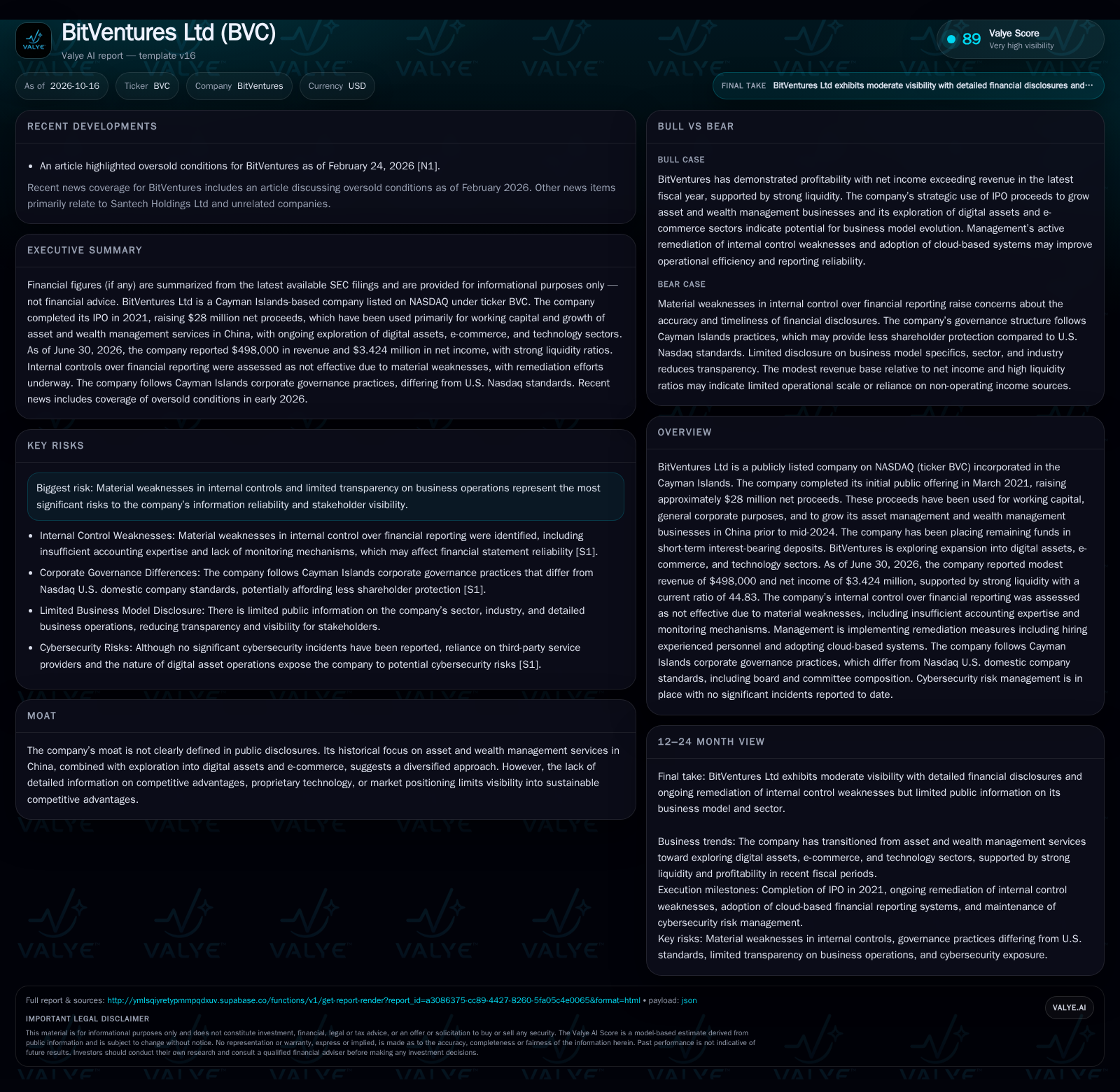
BitVentures Ltd (NASDAQ: BVC) has exited its legacy wealth management businesses and is now pursuing growth in e-commerce and digital asset mining, with reported liquidity position but low operational revenue and unresolved internal control issues. The company’s new segments are in their infancy, with e-commerce gross merchandise volume of $0.14 million and early-stage Bitcoin mining deployment. Despite reporting $3.4 million in net income, the company’s core business economics remain opaque, and the sustainability of its profitability is questionable without more substantial operating scale and internal controls remediation [S1].
BitVentures Ltd stands at a strategic inflection point after a wholesale exit from its former wealth management businesses, now seeking growth in e-commerce and digital assets. While its balance sheet is flush and a recent net income figure appears strong relative to revenue, the company’s operational scale remains limited. The new business lines—Amazon-based e-commerce and U.S.-hosted Bitcoin mining—are still in early rollout, with meaningful questions around scalability, competitive positioning, and the reliability of reported results due to lingering internal control weaknesses. For investors, the next phase hinges on BitVentures’ ability to translate liquidity and new ventures into sustainable, transparent operating income—and to build trust in its financial disclosures.
Major Business Realignment and Early-Stage Growth Initiatives Define 2026 Position
BitVentures completed a decisive exit from its legacy asset and wealth management businesses in Hong Kong and mainland China by August 2024, disposing of key subsidiaries and fully transitioning away from its prior operating model [S1]. This strategic reset left the company focused on two nascent segments: e-commerce and digital assets. The e-commerce business, officially rolled out in fiscal 2026, generated approximately $0.14 million in gross merchandise volume from over 1,800 orders on Amazon, and management intends to use this as a launchpad for broader product and revenue expansion [S1]. In the digital assets segment, BitVentures deployed 39 PH/s of Bitcoin mining hardware and 0.3 TH/s of Scrypt-based mining hardware at U.S. datacenters, marking a notable but early entry into crypto mining [S1].
Despite this pivot, BitVentures reported only $498,000 in revenue for fiscal 2026 but posted net income of $3.424 million—an unusually high ratio that raises questions about the sustainability and source of profitability [S1]. The company reported cash and liquidity metrics for the period; these figures do not by themselves establish operating runway, investment capacity, financial flexibility, or financing capacity. [S1] However, material weaknesses in internal control over financial reporting remain unresolved, particularly around accounting expertise and inventory monitoring, casting doubt on the reliability of the company’s disclosures [S1].
Revenue Model Uncertainty and Early-Stage Operating Leverage
BitVentures’ business model is now a hybrid of e-commerce reselling and digital asset mining, both of which have distinct economics but currently contribute minimally to topline results. The e-commerce segment operates on a resale model through Amazon, which typically involves low margins due to platform fees, intense competition, and the need for working capital to fund inventory. With just $0.14 million in GMV and 1,800 orders, the scale is currently too small to generate meaningful operating leverage or to cover fixed costs associated with logistics, marketing, and compliance. Without evidence of differentiated product sourcing or proprietary brands, the company likely faces price-based competition and limited pricing power.
The digital asset mining business, meanwhile, is capital-intensive and highly volatile, driven by cryptocurrency prices, mining difficulty, and energy costs. BitVentures’ deployment of 39 PH/s of Bitcoin mining hardware could, under favorable market conditions, generate significant gross profit, but this depends on Bitcoin prices, hash rate competition, and operational uptime. The company’s modest reported revenue and outsized net income suggest that non-operating income—potentially from interest on cash, investment gains, or one-off items—has been a major driver of profitability in fiscal 2026 [S1]. If operating segments do not scale, future profitability could be highly sensitive to external factors beyond management’s control.
Emergent Market Position in Crowded, Low-Moat Sectors
In e-commerce, BitVentures is entering a hyper-competitive landscape dominated by established aggregators, direct-to-consumer brands, and Amazon-native sellers. Without proprietary products, brand equity, or technology-driven differentiation, the company is likely to face low switching costs and thin margins. Barriers to entry are low, and customer acquisition on Amazon tends to be auction-driven, favoring incumbents with scale and established seller ratings.
The digital asset mining segment is similarly crowded, with large public and private miners operating at scale and benefiting from access to cheap energy, bulk hardware purchasing, and operational expertise. BitVentures’ initial deployment of 39 PH/s is modest compared to leading miners, and its ability to scale will depend on capital allocation, electricity sourcing, and effective risk management. Regulatory uncertainties and hardware price cycles add further complexity.
With no evidence of proprietary technology, unique data assets, or ecosystem effects, BitVentures’ competitive position appears undifferentiated at this stage. Its future moat, if any, would need to be built through either operational scale, niche product leadership, or technology/process innovation.
Potential for Operating Scale and Profitable Diversification
If BitVentures successfully leverages its liquidity to scale the e-commerce business—expanding product lines, improving sourcing, and building brand recognition—it could achieve higher GMV and incremental margin expansion. A successful transition from reselling to private-label or exclusive products would materially improve gross margins and customer retention. In digital asset mining, if Bitcoin prices rise and the company manages to secure low-cost hosting, it could generate outsized returns on its hardware investment.
Confirmation of this scenario would require evidence of rapid revenue growth from e-commerce (e.g., quarterly GMV and order volume expansion), clear gross margin improvement, and sustained mining output and profitability as disclosed in future filings. Additional signs would include new strategic partnerships, proprietary product launches, or evidence of recurring revenue streams from technology-enabled services.
A falsification would be continued stagnation in revenue and operating scale, or if liquidity is depleted without a corresponding increase in core segment profitability.
Early-Stage Growth with Persistent Transparency and Execution Risks
Revenue may rise modestly from the current low base, but fixed costs and competitive pressure could keep operating margins thin. Internal control weaknesses may persist for several quarters, limiting investor confidence in reported results and constraining access to additional capital on favorable terms.
Improvement in disclosure—such as segment-specific revenue, gross margin, and order data—would support a more constructive outlook. If management demonstrates progress in remediating internal controls and provides evidence of operating leverage, this scenario could evolve more favorably. Conversely, if revenue growth stalls and control weaknesses remain unresolved, BitVentures could remain a cash-rich but subscale operator with limited valuation upside.
Liquidity Erosion and Inability to Achieve Sustainable Scale
The adverse scenario would see BitVentures’ liquidity erode as investments in e-commerce and digital asset mining fail to generate sufficient operating cash flow. If the company is unable to differentiate in e-commerce or if Bitcoin prices decline, operating losses could accumulate. Persistent internal control deficiencies could result in misstatements, regulatory scrutiny, or loss of investor confidence.
If non-operating income sources dry up (e.g., lower interest rates, investment losses), the company’s reported profitability could reverse sharply. A further risk is that the company’s thin public disclosures and Cayman Islands corporate governance structure limit shareholder recourse in the event of adverse developments.
Evidence of this scenario would include declining cash balances without corresponding revenue growth, widening operating losses, negative audit findings, or regulatory interventions related to financial reporting.
Milestones and Disclosures That Will Clarify BitVentures’ New Model
Quarterly breakdown of segment revenue and gross profit for e-commerce and digital asset mining—if disclosed—would provide insight into the scalability of the new business lines.
Detailed GMV, order volume, and average order value metrics for the e-commerce segment would help assess traction and pricing power.
Disclosures on mining output (Bitcoin and Scrypt-based coins produced per quarter), realized margins, and operational uptime would clarify the economics of the digital asset segment.
Updates on remediation of material weaknesses in internal controls, including independent audit opinions on progress, are critical for trust in financial reporting.
Announcements of strategic partnerships, proprietary product launches, or technology-enabled service offerings would signal progress towards differentiation.
Changes in management composition, especially additions of technology or e-commerce expertise, could affect execution capability.
Any regulatory or legal actions, audit findings, or restatements related to financial reporting would be material watchpoints for downside risk.
Disclaimer: This is research-only, informational analysis and not investment advice. It may include AI-generated interpretation and general industry context. Always verify important details using primary sources.

Comments