
Accenture’s AI and Cybersecurity Expansion: Can Scale and Integration Sustain the Growth Engine?
Accenture’s 2026 results highlight a sharpened pivot toward AI-driven consulting and cybersecurity, underpinned by reported liquidity position and a string of strategic acquisitions. The challenge now is whether global scale and integration discipline can convert innovation ambition into sustained value amid intensifying competition and rapid client technology shifts.
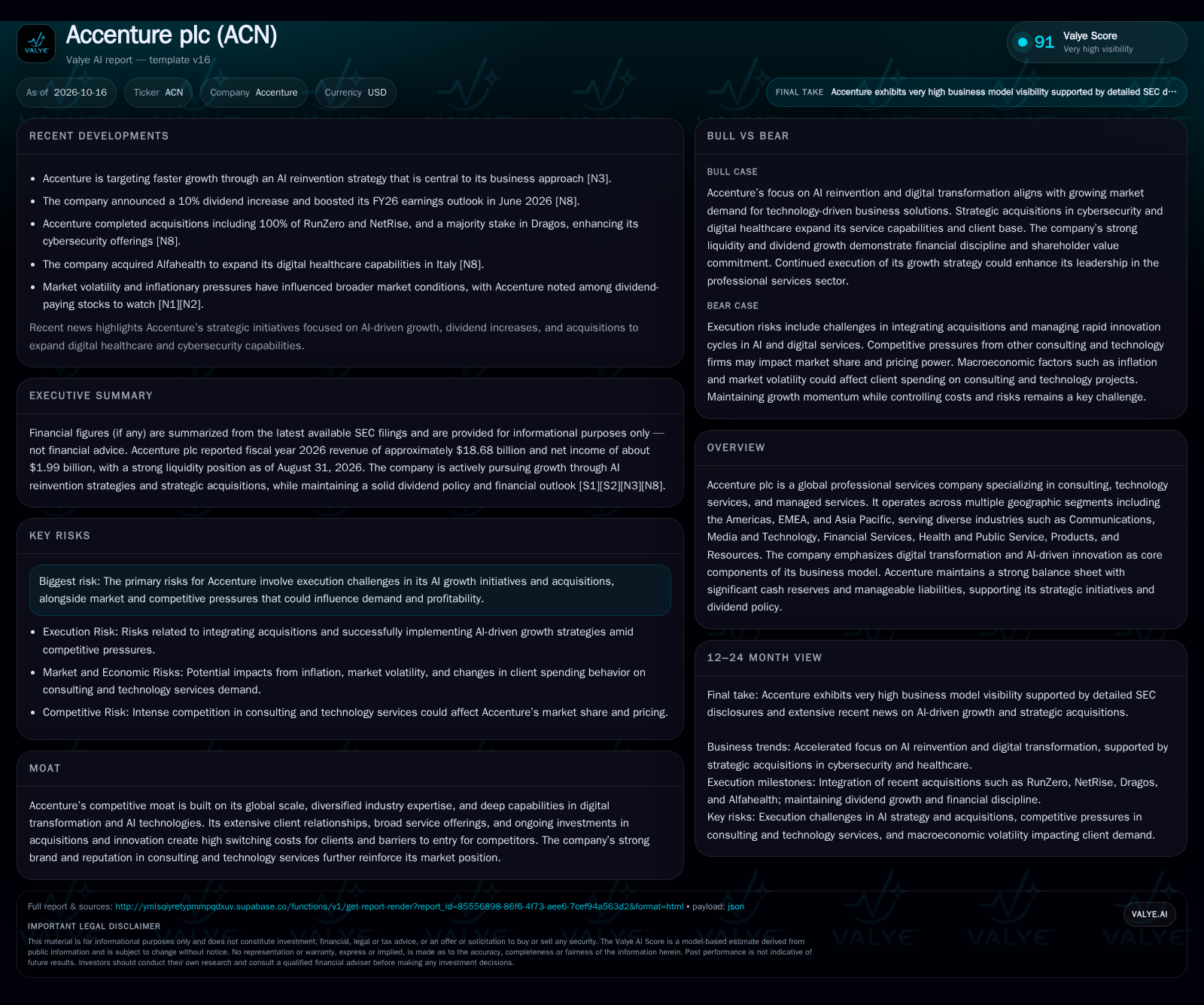
Accenture reported $18.68 billion in FY2026 revenue and $1.99 billion in net income, with a cash and short-term investments position exceeding $12.8 billion as of August 2026. The company has accelerated its focus on AI reinvention and digital healthcare, executing several acquisitions in cybersecurity and expanding its dividend by 10%. The core question is whether Accenture’s scale, integration capabilities, and diversified client base can offset execution and competitive risks as digital transformation cycles shorten and market pressures mount. [S1] [N3] [N8]
Accenture’s 2026 performance underscores a deliberate shift toward AI-powered consulting and managed services, reinforced by major investments in cybersecurity and digital health. With $18.68 billion in annual revenue and a reported balance sheet position, the company is actively deploying capital to capture next-generation technology opportunities. However, as digital transformation cycles accelerate and client demands evolve, Accenture’s ability to integrate acquisitions and maintain its competitive edge will be central to sustaining growth and protecting margins. The coming quarters will test whether its scale and diversification are enough to outpace rivals and absorb the risks of rapid innovation. [S1] [N3] [N8]
2026 Financials and Strategic Moves Set the Stage for Transformation
Accenture reported $18.68 billion in revenue and $1.99 billion in net income for fiscal 2026, with basic EPS of $3.31 and diluted EPS of $3.29. As of August 31, 2026, the company held $12.83 billion in cash and cash equivalents, and $6.3 million in short-term investments, supporting a current ratio of 1.43. Recent acquisitions—100% of RunZero and NetRise, plus a majority stake in Dragos—strengthen Accenture’s cybersecurity and digital transformation offerings. The cited source reports dividend-related activity; that disclosure alone does not establish dividend-policy continuity, management confidence, or a material constraint on capital flexibility. These moves underscore a proactive strategy to leverage liquidity for growth and reinforce market leadership in technology-driven services. [S1] [N8]
How Accenture’s Operating Model Converts Scale and Innovation into Profits
Accenture’s revenue engine is anchored in consulting, technology services, and managed services spanning diverse sectors and geographies. The company’s model blends high-value advisory work with recurring managed services, offering a mix of project-based and ongoing revenue streams. Digital transformation and AI-driven solutions are becoming a larger share of the mix, potentially commanding premium pricing but also requiring ongoing investment in talent and technology.
Operating leverage is driven by the ability to scale delivery teams and platforms across clients while maintaining a relatively stable SG&A base. However, the shift toward AI and cybersecurity may alter cost structures—upfront investments in integration and R&D can pressure near-term margins, while successful execution could yield higher long-term profitability through automation and differentiated offerings.
The capital intensity of the business remains moderate compared to asset-heavy industries, but continued M&A and technology investments could increase capital needs if organic growth slows or integration costs rise.
A critical factor influencing Accenture’s profitability is the scalability of its AI and cybersecurity offerings across diverse client segments. While these services can command premium pricing, their successful monetization depends on the company’s ability to standardize solutions without sacrificing customization for complex client environments. This balance requires sophisticated delivery frameworks and continuous investment in upskilling personnel, which can temporarily dampen margins but is essential to sustain competitive differentiation. Furthermore, the interplay between consulting-led advisory projects and managed services necessitates integrated go-to-market strategies that maximize cross-selling opportunities while managing client expectations around innovation adoption cycles.
Defending the Moat: Global Reach, Switching Frictions, and the AI Arms Race
Accenture’s competitive position is underpinned by global scale, deep client relationships, and sectoral expertise across technology, financial services, healthcare, and more. The breadth of its service offerings and its ability to deliver integrated solutions across consulting, technology, and managed services create meaningful switching costs for large enterprise clients.
However, the rapid pace of AI adoption and digital transformation is lowering some traditional barriers to entry, with specialized competitors, boutique consultancies, and hyperscale cloud providers increasingly targeting high-margin advisory and managed services. Accenture’s recent acquisitions in cybersecurity and digital health suggest a recognition that best-in-class capabilities are needed to defend and expand share.
The key question is whether Accenture’s integration discipline and client stickiness can offset the threat of technology substitution and price competition, especially as clients seek partners who can deliver both innovation and execution at scale. Sustaining pricing power will depend on continued investment in differentiated IP, proprietary platforms, and talent.
If Integration and AI Execution Accelerate, Margin Expansion and Share Gains Are Plausible
In a favorable scenario, Accenture successfully integrates recent acquisitions, rapidly scales AI-driven offerings, and demonstrates clear ROI for clients, leading to outsized share gains in digital transformation and cybersecurity. If the company can leverage its global delivery network to deploy new solutions efficiently, operating leverage could drive margin expansion.
Evidence for this scenario would include accelerated growth in digital and managed services revenue, improved segment margins despite ongoing investment, and continued client wins in AI and cybersecurity.
Conversely, this scenario could be falsified if integration costs materially depress margins, if digital/AI revenue growth lags peers, or if client retention deteriorates in key industry verticals.
Most Likely Outcome: Solid Growth with Integration Friction and Margin Trade-Offs
The most plausible outcome is that Accenture delivers steady revenue growth in line with global IT and consulting market expansion, while managing the complexities of integrating acquisitions and evolving its service mix. Digital transformation and AI will drive incremental growth, but pricing pressure and integration costs will likely temper margin expansion.
This scenario would be confirmed by continued mid-single-digit revenue growth, stable or modestly improving operating margins, and ongoing investment in talent and technology.
Falsifying evidence would include a material slowdown in digital or managed services growth, rising attrition among top clients, or margin compression beyond stated integration and investment plans.
What If Integration Falters or Competitive Dynamics Shift Rapidly?
In an adverse scenario, Accenture faces significant execution risk: integration of new acquisitions stalls, leading to cultural clashes, talent departures, or delayed product rollouts. Meanwhile, aggressive competition from digital-native consultancies or hyperscalers erodes pricing and market share, especially in high-growth verticals like AI and cybersecurity.
Evidence of this scenario would include cost overruns, restructuring charges, declining client satisfaction, and a slowdown in new contract wins. If cash flow comes under pressure, dividend growth could stall and the company might need to moderate acquisition activity.
This scenario could be falsified by clear evidence of successful integration, stable margins, and resilience in client demand even amid macro or competitive shocks.
Milestones That Will Clarify Accenture’s AI-Led Growth and Integration Thesis
Revenue growth rate in digital transformation, AI, and cybersecurity segments—if disclosed, outpacing sector averages would support the upside case.
Gross and operating margin trends in the wake of recent acquisitions—stability or improvement would suggest successful integration and pricing power.
Attrition and retention rates among top enterprise clients, especially in technology and financial services verticals—a useful metric would be.
Pace and scale of new flagship client wins in AI-driven and managed services offerings.
Integration milestones for RunZero, NetRise, Dragos, and Alfahealth—on-time delivery and cross-selling would indicate execution strength.
Competitive win/loss disclosures or market share changes in key regions or verticals, if reported.
Client satisfaction and net promoter scores, especially in newly acquired service lines—would help test the thesis if disclosed.
Disclaimer: This is research-only, informational analysis and not investment advice. It may include AI-generated interpretation and general industry context. Always verify important details using primary sources.

Comments