
CLPS Inc: Revenue Scale, Margin Pressure, and the Strategic Implications of Limited Disclosure
CLPS Inc generates substantial revenue but remains unprofitable, with reported liquidity position and scarce public detail on its business model or sector. The company’s compliance with Nasdaq listing rules and a new share repurchase program signal capital-market discipline, but persistent losses and limited transparency leave fundamental questions about its economics and long-term viability.
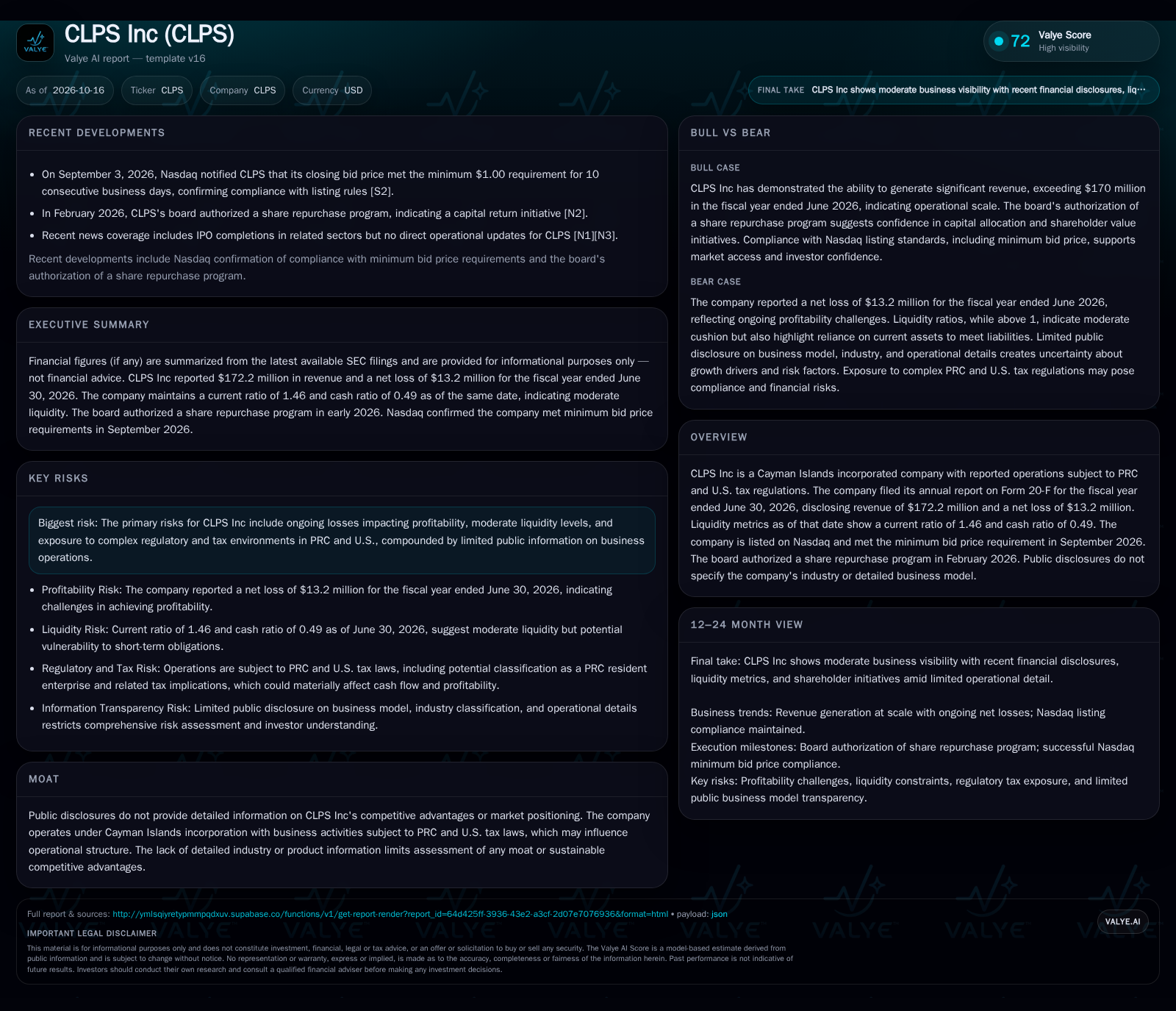
CLPS Inc reported $172.2 million in revenue and a net loss of $13.2 million for FY2026, with reported liquidity position and a recently approved share repurchase program. The company remains compliant with Nasdaq listing requirements. However, a lack of public detail on its business model, industry, or operational mechanics clouds assessment of underlying drivers, margin structure, and competitive positioning. The key question is whether CLPS can translate revenue scale into sustainable profitability amid regulatory complexity and information opacity. [S1] [S2] [N2]
CLPS Inc stands out for its significant revenue scale, with $172.2 million reported for fiscal 2026, yet the company remains unprofitable and operates with only reported liquidity position. Recent board approval of a share repurchase program and sustained Nasdaq listing compliance show financial market discipline, but the lack of public detail on the company’s industry, business model, or strategic initiatives makes it difficult to assess the root causes of its losses or the viability of its operations. Investors and analysts must navigate this opacity, focusing on liquidity trends, margin recovery, and any future disclosures that could clarify CLPS’s economic engine or competitive context.
Financial Scale vs. Profitability: What the Latest Results Reveal
CLPS Inc reported revenue of $172.2 million for the fiscal year ended June 30, 2026, but posted a net loss of $13.2 million and negative earnings per share of -$0.45. As of the same date, the company held $25.1 million in cash and cash equivalents, with a current ratio of 1.46 and a cash ratio of 0.49. In February 2026, the board authorized a share repurchase program, and in September 2026, Nasdaq confirmed that CLPS met the minimum bid price requirement for continued listing. These facts indicate that CLPS has achieved operational scale and maintains access to U.S. capital markets, but faces persistent margin or cost-structure challenges. The recent share repurchase program suggests some management focus on capital return or signaling, but the core issue remains the company’s inability to deliver bottom-line profitability. [S1] [S2] [N2]
Unpacking the Economics: Revenue, Costs, and the Elusive Path to Profit
The available facts establish that CLPS operates at a substantial revenue base but fails to achieve net profitability. In the absence of detailed disclosure on products, services, or sector, several economic mechanisms could be at play. If CLPS operates in a labor-intensive or low-margin industry—such as IT services, outsourcing, or business process management—gross margins may be thin, and fixed costs could weigh heavily on operating profit. Alternatively, if the company is in a capital-intensive sector, depreciation and financing costs could depress earnings. The moderate current and cash ratios suggest working capital is sufficient for ongoing operations but does not provide a significant buffer for aggressive investment or weathering shocks.
The share repurchase program, while typically a signal of capital discipline or excess cash, may also reflect management’s limited options for organic or inorganic growth. Without insight into the company's specific commercial mechanics—such as contract structure, pricing power, customer concentration, or recurring revenue—it is unclear whether CLPS’s revenue base is stable, growing, or at risk. The persistent net loss signals either a chronic cost overhang, competitive pricing pressure, or an inability to gain operating leverage at current scale.
Assessing Competitive Positioning Without a Map
CLPS’s public disclosures do not specify its industry, product lines, or customer base, making direct peer comparison impossible. If the company is in a commoditized or rapidly evolving sector, such as IT services or fintech, it may face intense pricing competition and limited differentiation. In such markets, scale and client stickiness are critical, but so too are cost control and innovation. The company’s Cayman Islands incorporation and PRC/U.S. tax exposure suggest cross-border operations, which could be a source of complexity or a strategic advantage depending on how global delivery and regulatory arbitrage are managed.
Without evidence of proprietary technology, a platform business, or long-term commercial relationships, one cannot infer moat characteristics such as high switching costs, network effects, or brand power. Instead, the lack of transparency itself is a competitive risk—potentially deterring customers, partners, or investors who demand clarity on service quality, security, or compliance. In sum, CLPS’s competitive position remains opaque, and the absence of detail is a disadvantage in most capital markets.
Margin Recovery and Strategic Clarity Could Drive Rerating
The most favorable scenario for CLPS would involve a combination of margin improvement and increased disclosure that reveals a defensible business model. If the company is able to reduce its cost structure—through automation, offshoring, renegotiating supplier terms, or exiting loss-making lines—net margins could recover even at flat or modestly growing revenue. A credible shift to higher-value or recurring revenue streams, such as software subscriptions or managed services, could also transform the margin profile and lower earnings volatility.
This scenario would be confirmed by sequential improvement in gross and operating margins, a return to positive earnings, and new disclosures detailing business lines, customer retention, and the nature of commercial relationships. Additional signals would include growth in cash from operations, increased share repurchase activity backed by free cash flow, and explicit management guidance on strategy and capital allocation.
Continued Scale with Margin Headwinds and Information Gaps
The most plausible path for CLPS, absent new information, is the maintenance of revenue scale with ongoing net losses and only reported liquidity position. The company may sustain its current operations, meet Nasdaq listing requirements, and continue capital return initiatives, but without a structural shift in economics or greater transparency, bottom-line improvement is unlikely. This outcome would be confirmed by stable or modestly growing revenue, persistent negative earnings, and limited updates on business model or competitive positioning.
If CLPS remains opaque about its sector and operational drivers, it will likely continue to trade at a discount to peers with clearer economics and proven profitability. The share repurchase program may provide temporary support for the share price, but will not address the underlying challenges in cost management or business model sustainability.
Escalating Losses and Eroding Trust in the Absence of Transparency
A more adverse scenario would see CLPS’s net losses widen, liquidity deteriorate, and investor confidence erode further due to lack of disclosure. If revenue declines—whether from customer attrition, price cuts, or market share loss—while fixed costs remain high, operating leverage would turn negative, rapidly depleting cash resources. Regulatory or tax complications related to PRC and U.S. exposure could trigger unexpected costs or operational restrictions.
This outcome would be confirmed by declining quarterly revenue, worsening net losses, shrinking cash balances, and any notice of non-compliance with Nasdaq or other regulatory bodies. A lack of progress on disclosure or strategy, or any delay or suspension in the share repurchase program, would further signal distress. In the worst case, financing constraints could force asset sales, restructuring, or delisting.
Benchmarks to Gauge CLPS’s Progress Toward Sustainable Value
Quarterly trends in gross and operating margin, if disclosed, to assess whether cost structure is improving or further deteriorating.
Quarterly cash flow from operations and changes in cash and cash equivalents, to monitor underlying business strength and reported liquidity position.
Any new, detailed disclosures on business model, industry, customer composition, or the nature of commercial relationships, which would clarify the company’s economic engine.
Updates to the share repurchase program: size, pace, and funding source, to determine whether capital return is sustainable or opportunistic.
Nasdaq listing status and compliance with other regulatory requirements, as a proxy for financial health and governance.
Material tax or regulatory disclosures related to PRC or U.S. operations, which could impact profitability or cash flow.
Announcements of new partnerships, product launches, or strategic pivots, which would indicate efforts to change the revenue or margin profile.
Evidence of segment or geographic performance, if disclosed, to test for revenue concentration or diversification.
Disclaimer: This is research-only, informational analysis and not investment advice. It may include AI-generated interpretation and general industry context. Always verify important details using primary sources.

Comments