
Travelers Companies: Navigating Catastrophe Risk, Regulatory Headwinds, and Emerging Insurance Frontiers
Travelers Companies produces strong net income in a volatile environment, but faces mounting challenges from unpredictable catastrophe losses, inflationary pressures on reserves, and the limits of risk modeling—especially as it expands into new lines like cyber insurance.
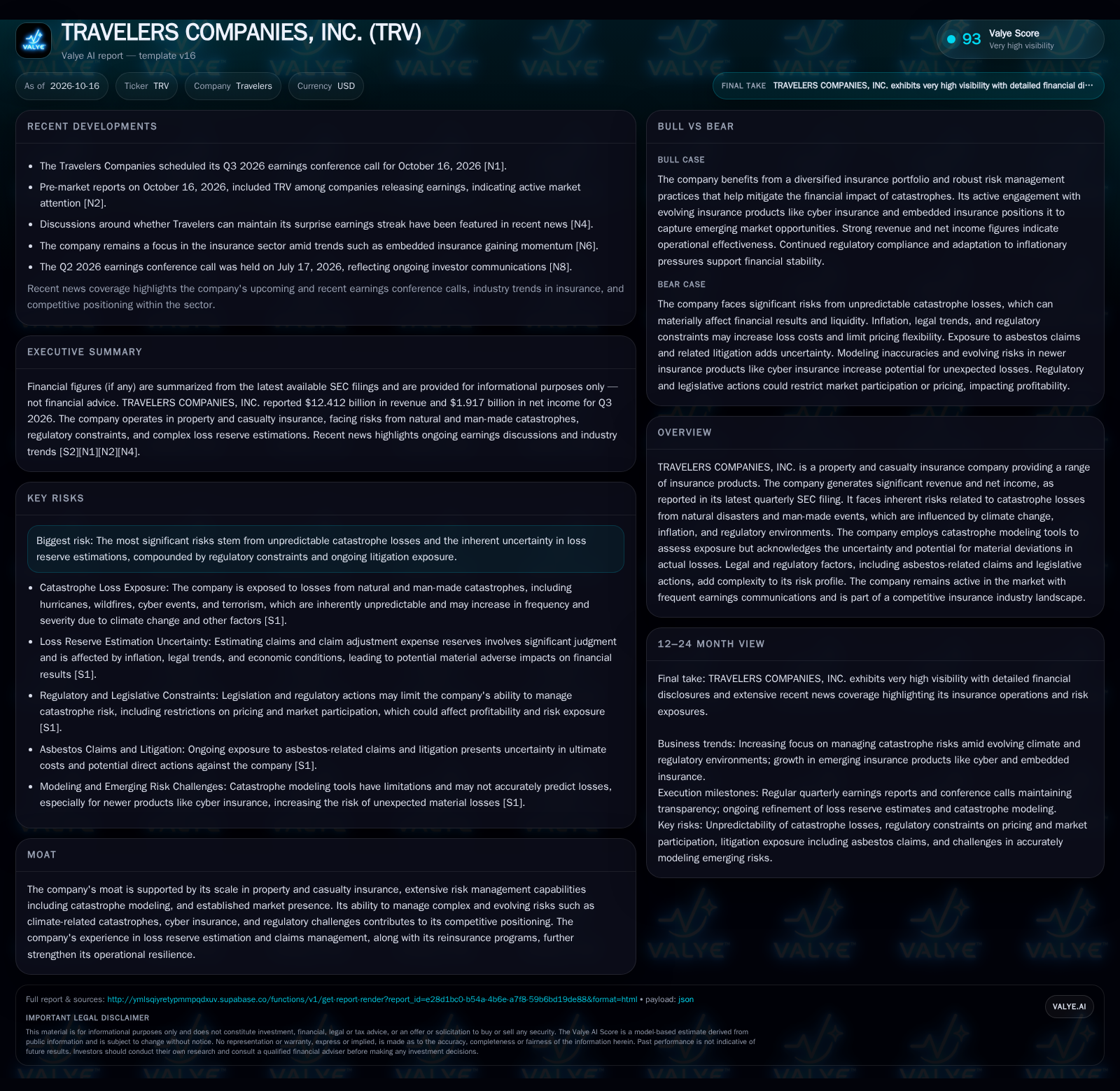
Travelers Companies reported $12.4 billion in Q3 2026 revenue and $1.9 billion in net income, underscoring its scale and operational efficiency. The company’s earnings quality is tested by rising catastrophe losses, regulatory restrictions on pricing, and the inherent uncertainty in loss reserve estimation. As Travelers pushes into emerging risk categories such as cyber insurance, its ability to adapt risk management and pricing models will shape future profitability and resilience. The core questions: Can Travelers’ scale and modeling sophistication offset the unpredictable nature of its risk exposures, and will regulatory environments allow necessary pricing flexibility to maintain margins? [S2] [S1]
Travelers Companies, a heavyweight in property and casualty insurance, continues to generate substantial earnings despite operating in one of the most risk-laden corners of financial services. With $12.4 billion in Q3 2026 revenue and nearly $2 billion in net income, Travelers’ scale and risk management sophistication are clear. Yet beneath these numbers lies a volatile reality: catastrophe losses are increasing and ever less predictable, regulatory constraints squeeze pricing flexibility, and new insurance lines like cyber introduce fresh uncertainty into the company’s risk models. Travelers’ future performance will hinge on how effectively it can price risk, adapt to climate and legal shifts, and maintain underwriting discipline amid industry change. [S2] [S1]
Where Travelers Stands: Recent Performance and Pressing Exposures
Travelers Companies reported $12.412 billion in revenue and $1.917 billion in net income for Q3 2026, highlighting continued operational strength at scale [S2]. These headline numbers are particularly notable given the company’s persistent exposure to large, unpredictable catastrophe losses—from hurricanes and wildfires to cyber incidents and terrorism—which can swing quarterly results dramatically [S1]. The company’s risk environment is further complicated by regulatory actions that may restrict its ability to price risk or withdraw from unprofitable markets, and by the ongoing challenge of estimating loss reserves accurately in the face of inflation and changing legal trends [S1]. Collectively, these factors keep Travelers’ earnings quality highly sensitive to both external shocks and internal modeling discipline.
Insurance Economics: Pricing, Risk Pools, and the Leverage of Scale
Travelers’ principal business model is built on collecting premiums in exchange for underwriting property and casualty risk, then investing float and managing claims over time. Profitability depends on the spread between earned premiums and claims/losses paid, adjusted for operating costs and investment returns. Fixed costs—such as technology, regulatory compliance, and claims infrastructure—create operating leverage, while variable costs scale with claims severity and frequency.
Pricing power is inherently cyclical: in benign periods, competition drives down premiums, while catastrophic loss years typically trigger industry-wide rate increases. Travelers’ ability to price risk accurately is contingent on the predictive power of its catastrophe models and actuarial assumptions. Reserve adequacy—how much is set aside for future claims—is a critical determinant of both reported profits and long-term solvency. Inflation, legal trends (such as jury awards), and new forms of risk (cyber, embedded insurance) increase the complexity of both pricing and reserving.
Capital requirements are significant, dictated by regulatory solvency standards and the need to withstand severe loss years. Reinsurance is used to manage tail risk, but rising reinsurance costs and tighter capacity can compress margins if primary insurers like Travelers cannot pass costs along to policyholders.
How Travelers Competes: Scale, Risk Analytics, and Industry Counterforces
Travelers’ competitive position is anchored in its scale, brand recognition, and established risk management infrastructure. Large insurers benefit from diversified risk pools, better access to capital, and the ability to invest in advanced analytics and catastrophe modeling. This helps Travelers absorb shocks that might cripple smaller rivals and, in theory, supports more accurate pricing and selection.
However, the property and casualty insurance industry remains highly competitive and cyclical, with pricing pressure from both traditional carriers (such as Progressive and Allstate) and new entrants leveraging data and embedded insurance models. Regulatory constraints—such as limits on premium increases or mandatory market participation—can erode competitive advantages, particularly in high-risk geographies or lines. Technology-driven disruption in distribution, claims automation, and risk selection could further pressure legacy players unless they adapt rapidly.
Substitution risk is low for core insurance products, but customers can switch carriers based on price, service, or perceived value. Retention is aided by multi-line discounts, claims service, and brand trust, but switching frictions are not insurmountable. The company’s foray into new segments like cyber insurance pits it against both specialist underwriters and tech-enabled MGAs, raising the bar for risk assessment and pricing sophistication.
What Could Go Right: Risk Selection, Market Hardening, and New Premium Growth
A favorable scenario would see Travelers leverage its risk analytics and modeling capabilities to outperform peers in selecting and pricing risk. If catastrophe losses remain within modeled ranges and the company sustains reserve discipline, underwriting margins could expand. A hardening market—characterized by industry-wide premium increases following major loss years—would enable Travelers to reprice risk more quickly than competitors, especially in specialty lines like cyber and embedded insurance.
Regulatory environments that support actuarially justified pricing, or that allow for withdrawal from unprofitable markets, would further boost results. Success in new product lines, with loss ratios at or below company averages, would demonstrate the scalability of Travelers’ risk management. Evidence supporting this scenario would include: sustained improvement in combined ratios, above-peer premium growth in new insurance categories, and stable or declining reserve development relative to earned premiums.
Likely Trajectory: Earnings Volatility Amid Gradual Portfolio Evolution
The most plausible medium-term outlook is one of ongoing earnings volatility driven by the unpredictability of catastrophe losses, inflationary pressure on claims, and continued regulatory friction. Travelers is likely to maintain or modestly grow its premium base, with occasional windfall quarters offset by periods of elevated losses. The company will continue refining its catastrophe models and risk selection but will be challenged to keep pace with emerging risks and shifting climate patterns.
Incremental growth in cyber and specialty lines will be offset by persistent uncertainty in modeling and claims development. Regulatory and legal headwinds will limit pricing flexibility in some geographies, forcing the company to continually rebalance its risk portfolio. Confirmation of this base case would be continued but uneven net income, moderate premium growth, and periodic reserve adjustments—without either a sustained breakout in profitability or a material capital impairment.
Where the Model Breaks: Catastrophe Clustering, Model Misses, and Regulatory Squeeze
The principal downside risk is a sequence of outsized catastrophe events—natural or man-made—that exceed modeled expectations and rapidly erode earnings and capital. If Travelers’ catastrophe models fail to capture the frequency or severity of losses, particularly in newer segments like cyber, loss ratios could spike and reserves may prove inadequate, leading to negative reserve development and potential capital strain.
Further downside is possible if regulatory actions prevent the company from raising rates or exiting high-loss markets, locking Travelers into unprofitable business. A spike in claims inflation or adverse legal judgments could further pressure reserves. Evidence confirming this scenario would include: multiple quarters of negative reserve development, regulatory intervention in rate filings, or a marked deterioration in solvency ratios and reinsurance costs.
What Will Determine Travelers’ Resilience and Upside Potential?
Quarterly combined ratio trends, especially in catastrophe-exposed lines, will reveal whether underwriting discipline is holding up in the face of climate volatility.
Net reserve development (favorable or adverse) relative to earned premiums—if disclosed—would clarify the accuracy of prior loss estimates and the risk of future reserve charges.
Premium growth in emerging segments such as cyber and embedded insurance; a useful metric would be segment-level loss ratios to gauge profitability of new lines.
Trends in reinsurance costs and retention levels, which may signal rising tail-risk pricing or constraints on risk transfer.
Regulatory developments affecting rate approvals or market participation, especially in catastrophe-prone states or for new products.
Frequency and severity of large loss events, and whether reported outcomes deviate materially from modeled expectations.
Litigation and legal expense trends, including new asbestos claims or major adverse judgments, as a potential drag on capital and earnings.
Disclaimer: This is research-only, informational analysis and not investment advice. It may include AI-generated interpretation and general industry context. Always verify important details using primary sources.

Comments