
Awaysis Capital: Early-Stage Resort Platform Seeks Scale Amid Liquidity and Execution Hurdles
The company’s ability to scale its property portfolio, convert leases to recurring income, and navigate funding constraints will determine its trajectory.
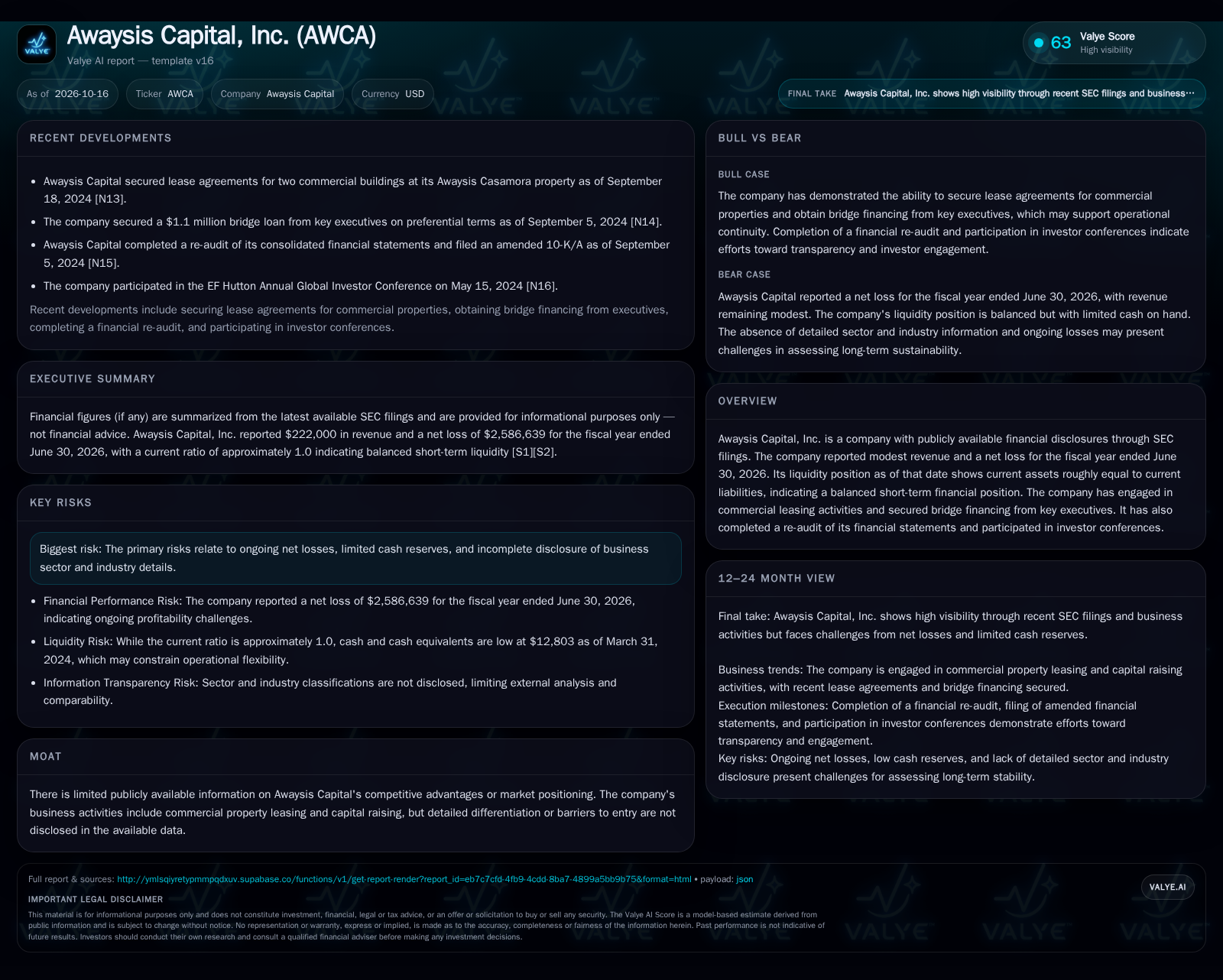
Awaysis Capital’s current operations center on commercial property leasing and short-term resort rentals, with revenue of $222,000 against a $2.6 million net loss for FY2026 and a current ratio near 1.0. Bridge financing and new lease agreements offer some operational runway, but the company must scale recurring property income and control costs to approach sustainability. Execution on property development, revenue mix, and capital access are critical watchpoints. [S1] [S2]
Awaysis Capital, Inc. is positioning itself as a developer and operator of residential-resort enclaves, combining property leasing, hotel operations, and short-term rentals across the U.S. and Belize. Despite securing new lease agreements and bridge financing, the company’s modest revenue and net losses underscore a business still in its formative stages. Its path forward will hinge on scaling recurring income streams, managing operating expenses, and navigating a thin liquidity margin—while contending with the complexities of multi-jurisdictional real estate and hospitality operations.
Where Awaysis Capital Stands: Revenue, Losses, and Operational Moves
As of the fiscal year ended June 30, 2026, Awaysis Capital reported $222,000 in revenue and a net loss of $2,586,639, with basic and diluted EPS of -$0.01, reflecting limited scale against a heavy cost structure [S1]. Current assets and liabilities are nearly matched ($11.08 million vs. The company reported cash and liquidity metrics for the period; these figures do not by themselves establish operating runway, investment capacity, financial flexibility, or financing capacity. [S1] Cash holdings were just $12,803 as of March 31, 2024, highlighting a reliance on external funding [S2]. To support operations, the company secured lease agreements for two commercial buildings at its Awaysis Casamora property as of September 2024 and obtained a $1.1 million bridge loan from key executives on preferential terms. These developments provide some near-term runway but do not resolve the underlying need for sustainable recurring income or a broader capital base.
How the Model Could Scale: Recurring Revenue Streams and Operating Leverage
Awaysis Capital’s disclosed revenue model includes monthly villa bookings, management fees, rental income, and maintenance/property-care fees. In principle, these lines—particularly short-term rentals and property management—can produce recurring, high-margin income if occupancy and asset utilization are achieved at scale. However, current revenue remains modest relative to fixed costs, and the company’s net loss reflects significant operating leverage that is not yet offset by volume.
The capital intensity of property acquisition, development, and ongoing maintenance is high, typically requiring either substantial upfront investment or access to reliable financing. Early-stage hospitality and resort businesses often face negative cash flows as they build inventory and brand recognition. While bridge loans and deferred executive compensation provide temporary relief, the long-term economics depend on scaling the property portfolio, maximizing occupancy, and controlling overhead. The mix between owned/leased versus managed properties will also affect both capital requirements and margin structure: asset-light management contracts can improve returns but may limit upside if brand or service quality is not established.
Competitive Landscape: Fragmented Market, Low Barriers, and Brand Challenges
Awaysis Capital operates in the intersection of real estate development, hospitality, and property management—a space that is highly fragmented and features competitors ranging from global hotel chains to local property managers and vacation rental platforms. Barriers to entry are relatively low for property management and vacation rentals, but brand, location, and service quality drive differentiation and pricing.
The company’s multi-jurisdictional approach (U.S. and Belize) introduces both opportunity and complexity: regulatory compliance, local market dynamics, and operational logistics can be challenging for small operators. Larger competitors benefit from scale, distribution partnerships, and established reputations, while digital platforms (such as Airbnb or Vrbo) offer asset-light access to short-term rental demand. Without a clear brand or unique service offering, Awaysis Capital may struggle to command premium pricing or drive direct bookings, increasing its reliance on third-party channels and compressing margins.
Unlocking Value Through Portfolio Expansion and Revenue Conversion
The most favorable scenario for Awaysis Capital involves rapidly scaling its property portfolio, successfully leasing and operating its Casamora assets, and converting these into recurring, high-occupancy rental and management income. If the company can demonstrate rising occupancy rates, increasing rental yields, and growing management fee income, operating leverage could quickly shift the business toward break-even or profitability.
Confirmation of this scenario would involve sequential revenue growth outpacing fixed expense increases, evidence of successful property launches or lease-ups, and visible improvement in cash generation from operations. Additional milestones could include new third-party management contracts, expansion of the Casamora model to additional geographies, or the ability to refinance short-term bridge loans into longer-term, lower-cost capital. Falsification would be signaled by stagnant or declining revenue per property, persistent low occupancy, or inability to secure new property assets or management contracts.
Early-Stage Execution: Slow Build, Ongoing Cash Needs, and Operational Uncertainty
The most plausible near-term outcome is that Awaysis Capital continues to operate at subscale, with incremental revenue growth from recently leased properties and gradual expansion of its managed portfolio. Operating losses are likely to persist as fixed costs remain high relative to income, and the company will need to secure additional external funding to bridge the gap to self-sufficiency.
Confirmation of this base case includes continued reliance on bridge loans, deferred compensation, and possible equity issuance or asset sales to maintain liquidity. Revenue may grow modestly quarter to quarter as new leases come online, but cost containment and cash flow from operations will lag. The scenario would be challenged by evidence of accelerating revenue growth, successful refinancing, or significant cost reductions that materially narrow losses.
Liquidity Squeeze and Asset Underperformance as Existential Threats
In an adverse scenario, Awaysis Capital is unable to meaningfully increase property revenue or reduce costs, resulting in persistent operating losses and depletion of available liquidity. Failure to achieve high occupancy or command market rents at its properties, combined with high fixed expenses and limited access to new funding, could force asset sales, debt restructuring, or even threaten going-concern status.
This outcome would be confirmed by continued or deepening net losses, shrinking cash balances, inability to raise additional bridge or long-term capital, and potential regulatory or operational setbacks in its target markets. Early warning signs would include missed lease milestones, declining occupancy, or adverse changes in executive or board composition. Falsification would require clear evidence of cost control, cash flow stabilization, or a strategic partnership that relieves immediate funding pressure.
Milestones and Metrics That Will Define Awaysis Capital’s Progress
Quarterly revenue and revenue per property, with disclosure of occupancy rates and booking trends, if available.
Gross margin and operating loss trajectory—evidence of improving operating leverage or persistent cost drag.
Cash flow from operations and changes in cash/cash equivalents quarter over quarter.
Progress in securing new lease agreements, management contracts, or property acquisitions, including any expansion beyond the Casamora project.
Details of additional financing events—equity raises, debt refinancing, or new bridge loans—and their terms.
Updates on deferred compensation and non-cash settlements with management and board members.
Any regulatory developments in the U.S. or Belize that could affect property operations or compliance costs.
Disclosure of customer concentration or reliance on third-party booking platforms, which could impact pricing power and margin.
Disclaimer: This is research-only, informational analysis and not investment advice. It may include AI-generated interpretation and general industry context. Always verify important details using primary sources.

Comments